
1 Introduction
Potentiometer is actually a variable resistor. It is called a potentiometer because its function in the circuit is to obtain an output voltage that is related to the input voltage (applied voltage). It is usually manufactured to maintain its original characteristics no matter how long it is used. If a position sensor is used, the potentiometer can be a linear or rotary position sensor.
The output voltage of the potentiometer is proportional to the position of the slider and the variable resistor. Because of temperature changes, the abrasion and fouling between the slider and the variable resistor will cause resistance changes, which will affect the accuracy of the potentiometer, and cause the accuracy of the potentiometer to be too low. Due to the development of materials, especially conductive plastics, potentiometers can maintain their original characteristics after a long time of use and can improve their performance at the same time.
[caption class="snax-figure" align="aligncenter" width="1140"][/caption]
2 Function of Potentiometer
The main functions of potentiometers in circuits are as follows:
(1) As a voltage divider potentiometer, it is a continuously adjustable resistor. When the rotating handle or sliding handle of the divider is adjusted, the moving contact slides on the resistor. At this time, the output voltage of the potentiometer, which is related to the applied voltage of the potentiometer and the angle or stroke of the movable arm, can be obtained at the output end of the potentiometer.
(2) When a rheostat potentiometer is used as a rheostat potentiometer, it should be connected to two end devices, so that a smooth and continuous variation of resistance can be obtained within the range of the trip of the flower potentiometer.
(3) When a potentiometer is used as a current controller, one of the selected current output terminals must be a sliding contact lead-out.
[caption class="snax-figure" align="aligncenter" width="1140"][/caption]
3 How to Choose the Correct Potentiometer
Presumably, everyone knows something about potentiometers. In fact, the potentiometer is a resistor that can adjust resistance value according to its function. It has three feet and one foot at each end. The resistance value corresponding to these two feet is fixed, called the nominal resistance value. The middle foot can slide on resistance, called slider. If the resistance is made straight, the slider will slide straight on the resistance. This potentiometer is called a push-pull potentiometer. In this way, the resistance of the slide and the pins at both ends can be adjusted. Its measurement method needs to use the resistance of the multimeter, first to measure whether the nominal value is accurate, then to measure the resistance of the slide and the pins at both ends, while sliding and measuring to see whether the resistance changes. If it can change, it is good; unchanged, or 0, or infinite is bad.
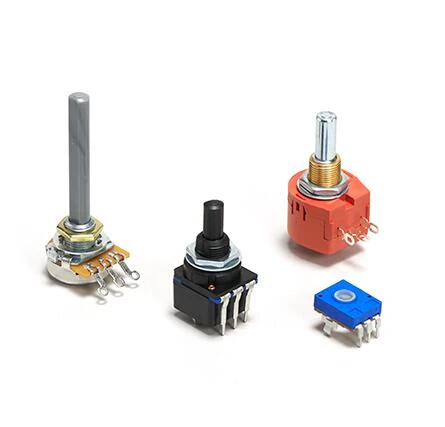
There are still many types of potentiometers. In the choice of potentiometers, it is necessary to select according to certain requirements and needs. When selecting equipment, attention should be paid to the amount of a door-to-door pair. Here are some notes on the selection of potentiometers.
[caption class="snax-figure" align="aligncenter" width="1140"][/caption]
(1) According to Structure
When choosing a potentiometer, we should pay attention to the size of the potentiometer, the length of the shaft shank and the style of the shaft end, and whether the position of the axis needs a locking switch, single or multiple, single or multiple loops, etc. to make specific demands on the structure. For potentiometers that need to be adjusted regularly, a potentiometer milling the axle end into a plane should be selected to install the knob. For potentiometers that do not need constant adjustment, the potentiometer with grooves at the axle end can be selected so that the potentiometer can not rotate after adjustment with a screwdriver, so as to maintain the relative stability of the working state. Potentiometers with locking devices should be selected for potentiometers requiring accuracy and no change after adjustment.
Potentiometer with switch, the switch part is used for on/off control of the circuit power supply, and the potentiometer part is used to adjust the power. The switch forms with switch potentiometers are single-pole single-throw, single-pole double-throw and double-pole double-throw. The selection should be determined according to the needs. The potentiometer with the switch is divided into a push-pull switch potentiometer and rotary switch potentiometer. Push-pull switch potentiometers do not participate in the action when the switch is actuated. The advantage of this is that there is no wear on the resistor body, and the position of the installed potentiometer is not changed. When the switch of the rotary potentiometer is operated once, the movable contact will slide once on the resistor body, so the wear is large, which will affect the service life of the potentiometer.
(2) Resistance Characteristics
The resistance change characteristics of the potentiometer should be selected according to the application. For example, the potentiometer for volume control should be an exponential potentiometer. In the case of an exponential potentiometer, a linear potentiometer can be used instead, but a logarithmic potentiometer cannot be used. Otherwise, the volume vocabulary range will be reduced: The potentiometer for voltage division should use a linear potentiometer; the potentiometer for tone control should use a logarithmic potentiometer.
(3) Requirements of Use
In circuits that are generally less demanding or where the environment is better, a synthetic carbon film potentiometer should be used first. The synthetic carbon film potentiometer has the characteristics of high resolution, wide resistance range, complete variety and low price, but it also has the disadvantages of moisture resistance and stable parts. It can be widely used in indoor household appliances.
For example, a volume potentiometer with a switch for a semiconductor radio, a synthetic carbon film potentiometer can be used; a power-regulating circuit in television can use a straight-slip carbon film potentiometer; a high-load and trimmer potentiometer in other household appliances can also be used. A synthetic carbon film potentiometer is used. In addition, the synthetic carbon film potentiometer has a long mechanical life and can be used in circuits requiring a long wear life.
If the circuit needs to be finely tuned and the power consumed is large, then wire-wound potentiometers should be used. Due to the large distribution parameters, wire-wound potentiometers are only suitable for low-frequency circuits, so wire-wound potentiometers should not be used in high-frequency circuits. In addition, the wire-wound potentiometer has low noise, and such a potentiometer can be selected for circuits requiring low noise.
(4) Parameters of the Potentiometer
The parameters of the potentiometer mainly include nominal resistance, rated power, maximum working voltage, linear accuracy and mechanical life. They are the basis for selecting potentiometers.
Due to the word limit, you can get the full content from How to Select a Correct Potentiometer?

























Sign in to leave a comment.