
If you’ve recently started using liquid shilajit - or you’re considering buying it - you’ve probably come across the “warm water test” at some point. It gets mentioned often in wellness communities and sometimes on product pages, usually as a quick way to check whether what you have is genuine.
The test itself is simple. But understanding what it actually tells you - and what it doesn’t - is a bit more nuanced than most online sources let on.
This guide walks through exactly how to perform the warm water purity test, what you’re looking for, and why your observations should be one part of a broader approach to evaluating liquid shilajit quality rather than the final word on it.
What Is the Warm Water Purity Test?
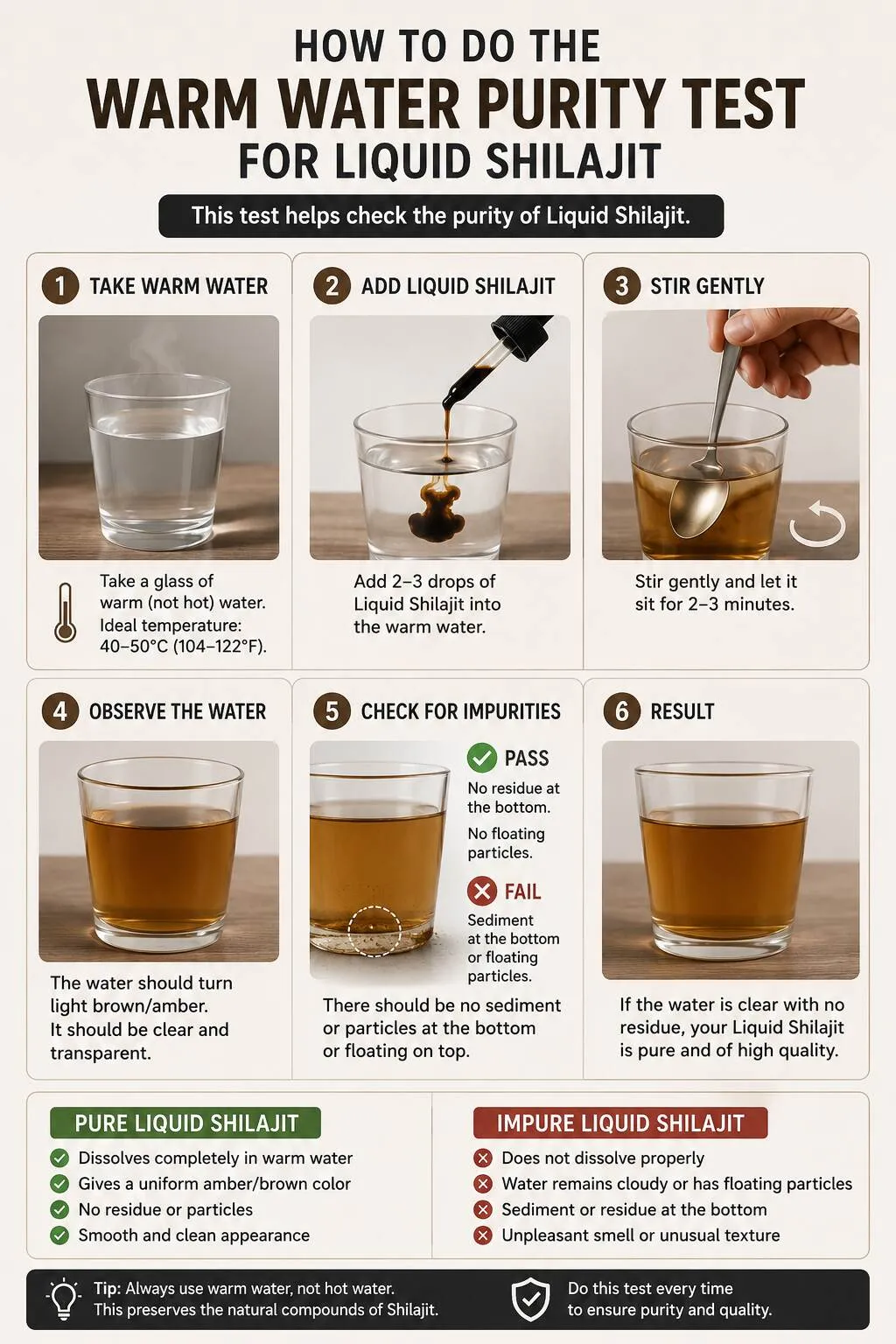
The warm water test is a basic dissolution check used by consumers to observe how liquid shilajit behaves when mixed with warm water. The logic behind it is straightforward: a high-quality, properly processed shilajit should dissolve cleanly and consistently. Visible grit, sandy residue, or unusual separation can point toward lower-grade processing or potential contamination.
It’s worth being clear from the outset - this is a consumer observation technique, not a scientific assay. It can offer useful visual cues, but it cannot confirm the presence or percentage of fulvic acid, detect heavy metals, or authenticate the source of the product. Those require laboratory analysis.
That said, as a starting point for evaluating what you’ve purchased, it’s a practical and accessible method.
Why People Use This Test for Liquid Shilajit
Shilajit has seen a significant rise in popularity across wellness circles globally, and India’s traditional Ayurvedic heritage has contributed to strong demand domestically. With that growth has come an equally significant increase in the number of products on the market - some excellent, others considerably less so.
For consumers who aren’t able to access lab reports directly or who want a simple hands-on check at home, the warm water test fills a gap. It requires no equipment, no expertise, and only a few minutes.
In practice, it’s most useful when used alongside other quality indicators: checking for third-party certificates of analysis, reading ingredient transparency disclosures, and sourcing from brands that document their purification processes.
How to Perform the Warm Water Test Step by Step
The test is easy to replicate consistently if you follow a few simple parameters.
What you’ll need:
- A clean, clear glass
- Warm (not boiling) water - ideally between 40°C and 50°C
- A small measured amount of your liquid shilajit - around 100 to 200 mg is sufficient
- A clean stirring spoon or glass rod
Step 1: Prepare the water
Use warm water, not hot. Water above 70°C can interfere with your observations and isn’t representative of how shilajit would typically be consumed. Room temperature water is too cold - the test relies on gentle warmth to facilitate normal dissolution.
Step 2: Add the shilajit
Measure a small amount of liquid shilajit and place it directly into the glass. If your product is in a dropper bottle, a few drops is usually sufficient. If it comes as a thicker semi-liquid, a pea-sized amount works.
Step 3: Stir gently
Give it a slow, gentle stir for 20 to 30 seconds. Avoid vigorous mixing - you want to observe how the shilajit naturally behaves with mild agitation, not how it disperses under force.
Step 4: Observe
Let the glass sit undisturbed for two to three minutes after stirring. Watch for how the shilajit disperses, whether anything settles to the bottom, and whether the water takes on a consistent appearance throughout.
What Pure Liquid Shilajit Typically Looks Like in Warm Water
A product of reasonable quality will generally show a few consistent characteristics during this test.
Smooth, even dissolution.
The shilajit should begin dispersing into the water relatively quickly with gentle stirring. It won’t fully “disappear” - it will colour the water - but the dispersion should look even rather than patchy or separated.
Uniform colouration.
The water typically turns a golden-brown to deep amber colour, depending on concentration. What you’re looking for is consistency - the colour should be reasonably uniform throughout the glass, not darker in patches or pooled at the bottom.
Minimal visible residue.
Some very fine natural mineral content may settle lightly, but there should be no obvious grit, sand-like particles, or chunky sediment. If you’re seeing visible solids after a few minutes of settling, that warrants closer attention.
No oily film or separation.
High-quality liquid shilajit should not produce an oily layer on the water’s surface, nor should it clump and separate into visible globules.
The appearance won’t be crystal clear - shilajit is a mineral-rich resin, not a refined extract - but it should look clean and consistent.
Signs That May Indicate Lower Quality or Contamination
Not every unfavourable result definitively means a product is fake or unsafe. But certain observations are worth taking seriously.
Sandy or gritty residue at the bottom.
This is one of the more telling signs. A meaningful amount of sandy sediment suggests either inadequate purification or the presence of filler substances.
Visible undissolved particles.
Small clumps or floating particles that don’t break down with gentle stirring are unusual and shouldn’t be present in a properly processed product.
Oily separation.
An oily sheen or visible separation is atypical and suggests the product may contain additives or carrier substances not normally found in authentic shilajit.
Unusual colour.
Very pale or bright yellow water can indicate excessive dilution or the presence of colouring agents. Conversely, a completely black appearance that doesn’t disperse may suggest insufficient processing.
Strong chemical smell.
Shilajit has a characteristic earthy, somewhat pungent natural odour. A sharp chemical or synthetic smell during the test is worth noting.
One thing that’s important to remember: some variation exists between legitimate products. Shilajit from different regional sources - Himalayan, Altai, Caucasus - can look and behave slightly differently. Minor natural variation is normal. Dramatic inconsistency is not.
Common Misconceptions About Shilajit Purity Tests
Social media has amplified a handful of myths about how to verify shilajit quality, some of which deserve clarification.
“Shilajit that doesn’t dissolve completely is fake.”
Not necessarily. Shilajit contains trace mineral compounds that don’t all dissolve uniformly in water. Some very fine natural sediment is normal. The issue is excessive grit or sediment - not any residue at all.
“Authentic shilajit always turns water completely golden.”
Colour varies by concentration and source. Highly concentrated liquid shilajit may produce much darker water. A lighter colour doesn’t automatically indicate lower quality.
“The warm water test is the best way to check purity.”
It’s a useful check, not the best one. Laboratory testing for fulvic acid percentage, heavy metals, and microbial safety remains far more reliable.
“Shilajit that passes the water test is safe to consume.”
Visual dissolution doesn’t screen for contaminants that are invisible to the naked eye - including heavy metals like arsenic or lead, which require analytical testing to detect.
Can the Warm Water Test Prove Authenticity?
Honestly - no. And it’s important to be direct about this.
The warm water test can give you useful observational data. It can flag obvious quality concerns. But it cannot confirm fulvic acid content, verify the geographical source of the shilajit, detect heavy metal contamination, or rule out the presence of fillers that happen to dissolve cleanly.
Authentic product verification requires third-party laboratory testing - specifically, a Certificate of Analysis (COA) that documents fulvic acid percentage, heavy metal screening, and microbial safety testing. Reputable brands make these documents available to consumers.
Brands like Himalayan Shila, which source from verified Himalayan regions and provide transparent lab documentation, offer this level of accountability. When you’re evaluating any liquid shilajit online, checking whether a brand publishes its COA is far more informative than any home test.
The warm water test is a reasonable starting point. It’s not an endpoint.
Additional Ways to Evaluate Liquid Shilajit Quality
Beyond the water test, a few other checks are worth building into your evaluation process:
Check for a published Certificate of Analysis.
A legitimate product should have third-party testing results available. Look specifically for fulvic acid percentage (quality resin typically sits at 60–80%), heavy metal limits, and microbial testing.
Look at sourcing transparency.
Where is the shilajit harvested? At what altitude? Through what extraction and purification method? Brands that can answer these questions clearly are generally more trustworthy.
Read the ingredient list.
Pure liquid shilajit should not contain a long list of additives. Some preservation agents are reasonable; a complex ingredient deck is worth questioning.
Check manufacturing standards.
GMP (Good Manufacturing Practice) certification is a meaningful quality signal. It means the production facility meets defined standards for hygiene, consistency, and quality control.
Trust your nose.
Authentic shilajit has a distinctive earthy, mineral-rich aroma. If a product smells overwhelmingly synthetic or has no characteristic smell at all, that’s worth noting.
Frequently Asked Questions
Does liquid shilajit completely dissolve in warm water?
Not entirely. Liquid shilajit will disperse and colour the water, but trace mineral compounds may leave very fine natural residue. What you shouldn’t see is obvious grit, sandy sediment, or visible clumping.
What temperature of water should I use for the shilajit purity test?
Warm water between 40°C and 50°C is ideal - approximately the temperature of a comfortably warm drink. Avoid boiling water, which can distort your observations.
Is the warm water test reliable for detecting fake shilajit?
It can help identify obvious red flags like excessive sediment or oily separation, but it cannot definitively confirm authenticity. Third-party lab testing is the most reliable verification method.
What colour should liquid shilajit turn water?
Typically a golden-amber to deep brown colour, depending on concentration. The key is that the colouration should be relatively uniform throughout the glass after gentle stirring.
Can a product pass the warm water test but still be contaminated?
Yes. Contaminants like heavy metals dissolve invisibly in water and cannot be detected visually. This is why laboratory testing is important regardless of how a product behaves in the water test.
How much liquid shilajit should I use for the test?
A small amount - approximately 100 to 200 mg, or a few drops from a dropper - is sufficient. Using too much can make observations harder to interpret.
Does shilajit need to be completely clear in water to be pure?
No. Shilajit is a mineral-rich substance and will always colour the water. You’re looking for consistency and the absence of obvious contaminants - not clarity.
What should I do if my shilajit fails the warm water test?
Contact the brand and ask for their Certificate of Analysis. If they can’t provide one, that’s a significant concern. It may also be worth stopping use until you can verify the product’s quality through documentation.
Key Takeaways
- The warm water purity test is a simple consumer check, not a scientific authentication method.
- High-quality liquid shilajit dissolves smoothly in warm water, disperses evenly, and leaves minimal visible residue.
- Red flags include sandy sediment, oily separation, visible clumping, and unusual colour or smell.
- The test cannot detect heavy metals, verify fulvic acid content, or confirm geographical source.
- Third-party laboratory testing and transparent sourcing documentation remain the most reliable quality verification methods.
- Brands like Himalayan Shila that publish their COA and sourcing details give consumers a much clearer picture of what they’re actually purchasing.
Final Thoughts
The warm water test is worth doing - not because it tells you everything, but because it can flag obvious problems quickly and cheaply. Think of it as a basic screening step, not a seal of approval.
What it genuinely can’t replace is the kind of accountability that comes from proper lab documentation and sourcing transparency. As shilajit becomes more widely available online across global markets, that gap between consumer perception and actual product quality is something every buyer needs to navigate thoughtfully.
If a brand you’re considering can’t show you third-party testing results, can’t tell you where or how the shilajit was harvested, and relies solely on the “pass the water test” framing to justify quality - that’s a signal worth paying attention to.
The warm water test is a useful tool in the right hands. Use it alongside better information, not instead of it.
This article is for educational purposes only and does not constitute medical advice. Consult a qualified healthcare professional before starting any new supplement. Individual results may vary.

























Sign in to leave a comment.