

Economics can be challenging for university students because it combines theories, models, statistics and real world situations. Many students understand an economic concept when they read about it in a textbook but struggle to explain the same idea clearly in an assignment.
Knowing the definition of inflation, elasticity or opportunity cost is only the beginning. A strong university assignment requires students to explain what the concept means, how it works, why it matters and how it can be applied to a particular situation.
Clear economic writing is therefore not about using the most complicated vocabulary. It is about showing genuine understanding.
When students explain economic concepts clearly, their assignments become easier to follow and their arguments become more convincing. This is especially important when an assignment asks students to analyse a problem, evaluate a policy or apply economic theory to a real world situation.
What It Means to Explain an Economic Concept Clearly
A clear economic explanation should do more than provide a textbook definition.
When introducing a concept, think about several important questions.
What does the concept mean?
How does it work?
What factors influence it?
What happens when conditions change?
Why does the concept matter?
How can it be observed in the real economy?
For example, saying that inflation means rising prices provides only a basic definition.
A stronger explanation would discuss a sustained increase in the general price level and explain how this can reduce the purchasing power of money. It could then examine possible causes and show how inflation affects households, businesses and government decisions.
This type of explanation demonstrates understanding rather than memorisation.
Start With a Simple Definition
A clear definition gives the reader a foundation.
Students should introduce an economic concept using straightforward language before moving into detailed analysis.
For example, opportunity cost can be explained as the value of the next best alternative that is given up when a choice is made.
This definition becomes easier to understand when connected to a university situation.
Imagine a student has three hours available in the evening. They can either study for an upcoming examination or work a paid shift. If they choose to study, the income they could have earned from working becomes part of the opportunity cost of that decision.
The example makes the economic idea easier to understand because it connects theory with everyday decision making.
Explain the Concept in Your Own Words
Students often rely heavily on textbook definitions.
Academic sources are important, but copying a definition does not necessarily demonstrate understanding.
After reading about an economic concept, close the source and try to explain the idea in your own words.
If you can explain it without relying on the original wording, you are more likely to understand it properly.
For example, instead of copying a technical definition of elasticity, explain that elasticity describes how strongly one variable responds when another variable changes.
You can then introduce the specific type of elasticity being discussed.
Using your own words also makes the assignment sound more natural and allows you to connect the concept to your argument.
Break Complex Concepts Into Smaller Parts
Some economic concepts appear difficult because several ideas are connected together.
Market equilibrium is a good example.
To explain it clearly, students can first discuss demand.
Then they can explain supply.
After that, they can describe how buyers and sellers interact through the market.
Finally, they can explain that equilibrium occurs where the quantity demanded and quantity supplied are equal.
Breaking a complex concept into smaller parts creates a logical progression.
The reader can understand each component before seeing how the components work together.
This technique is particularly useful when explaining theories that involve multiple variables.
Explain Cause and Effect
Economics frequently examines relationships between different variables.
Good economic writing should therefore explain cause and effect whenever appropriate.
For example, an increase in demand can place upward pressure on prices when supply does not increase at the same rate.
Simply saying that higher demand leads to higher prices is not enough.
A stronger explanation discusses why the relationship occurs.
When more consumers want a product while producers have limited capacity, competition among buyers can increase. Sellers may respond to stronger demand by increasing prices. Over time, producers may also respond by increasing output if they have the ability to do so.
This type of explanation demonstrates economic reasoning.
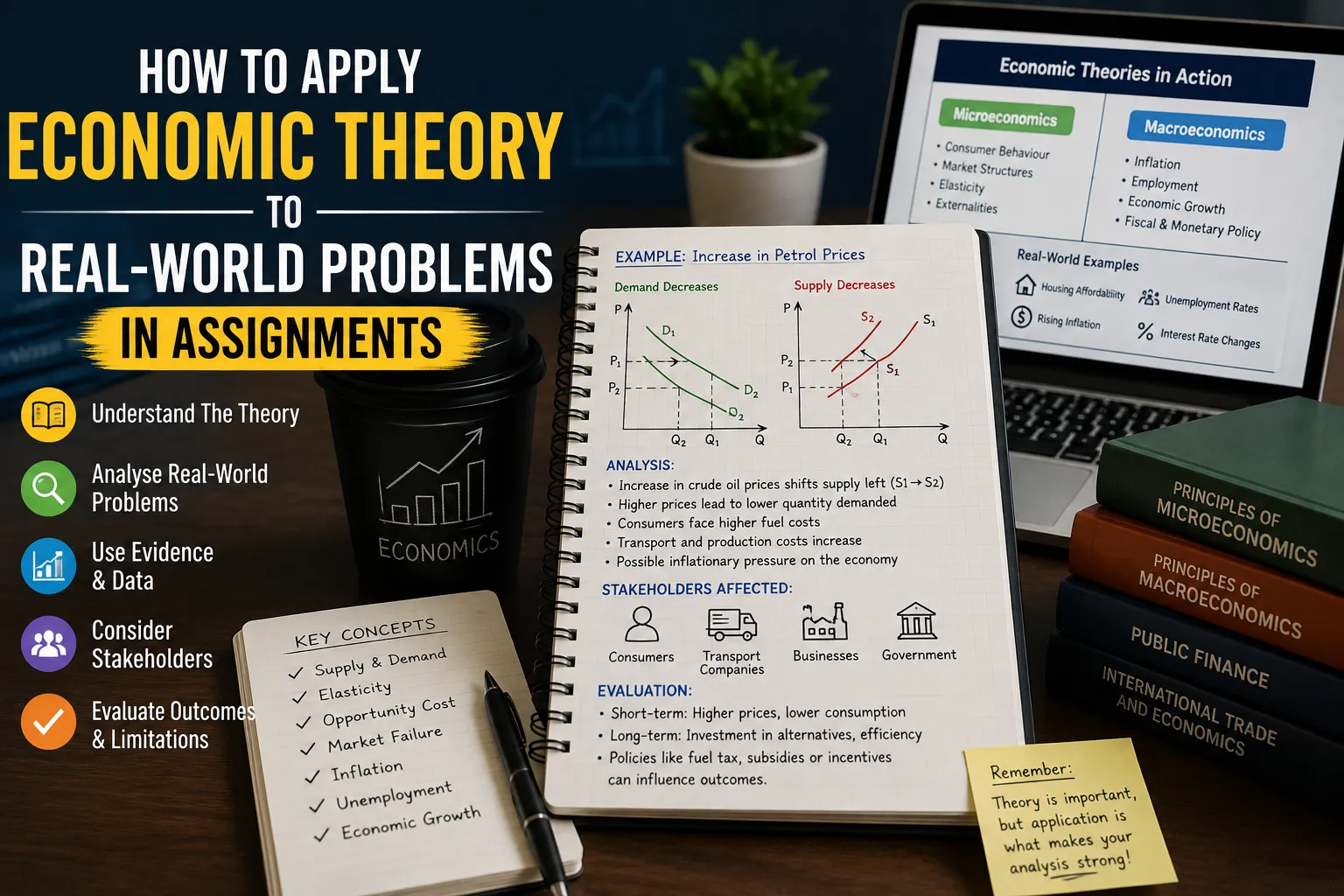
Connect Economic Theory With Real World Examples
Real world examples can make difficult economic concepts much easier to understand.
However, students should avoid adding examples simply to make an assignment longer.
The example should directly support the theory.
Consider the concept of inflation.
A student could discuss rising grocery prices and explain how increasing food costs affect household purchasing power.
The example becomes useful when the student connects it to the economic concept.
If household income does not increase at the same rate as prices, consumers may be able to purchase fewer goods and services with the same amount of money.
The example therefore demonstrates how inflation can affect everyday economic decisions.
Understanding Supply and Demand
Supply and demand are among the most important concepts in economics.
Supply refers to the quantity of a product or service that producers are willing and able to offer at different prices.
Demand refers to the quantity that consumers are willing and able to purchase at different prices.
The interaction between these forces influences market prices and quantities.
A clear explanation should go further than defining both terms.
Suppose demand for a particular type of housing increases while the available supply remains limited. More consumers compete for the available properties. This can place upward pressure on prices.
If new housing construction increases significantly while demand remains relatively stable, the additional supply may reduce pressure on prices.
This example demonstrates why economic concepts become more meaningful when students explain relationships rather than simply provide definitions.
Explain Opportunity Cost With Context
Opportunity cost is another concept that becomes easier when connected to everyday choices.
Every decision involves alternatives.
A student who spends an afternoon studying cannot use the same time to work, exercise or socialise.
The opportunity cost of studying is the value of the most valuable alternative that was given up.
The important point is that opportunity cost is not necessarily the total value of every alternative.
It refers to the next best alternative.
Students should explain this distinction carefully because it demonstrates a deeper understanding of the concept.
Explain Elasticity Properly
Elasticity can seem difficult because it involves mathematical measurement as well as economic interpretation.
Price elasticity of demand describes how responsive the quantity demanded of a product is to a change in its price.
However, students should not stop after presenting the formula.
They should explain what the result means.
Consider two products.
A basic necessity may have relatively low responsiveness to price changes because consumers still need it.
A product with many substitutes may experience a stronger change in demand when its price increases because consumers can switch to alternatives.
A good assignment explanation should connect the numerical result to consumer behaviour.
Explain Inflation Beyond Rising Prices
Inflation is commonly described as a general increase in prices.
That definition is correct but incomplete for many university assignments.
Students should explain that inflation involves a sustained increase in the general price level and consider its effects on purchasing power.
For example, if the prices of food, transport and housing rise while household income remains unchanged, families may find that their income purchases fewer goods and services.
Students can also discuss possible causes.
Demand may increase faster than an economy's ability to produce goods and services.
Production costs may rise.
Supply disruptions may affect the availability of goods.
A strong assignment should explain the economic mechanism rather than simply list possible causes.
Explain Unemployment Clearly
Unemployment is another concept that requires more than a simple definition.
Students should explain who is considered unemployed and distinguish unemployment from situations where people are not participating in the labour force.
They can then discuss different forms of unemployment where relevant.
For example, structural unemployment may occur when the skills available among workers do not match the skills demanded by employers.
Cyclical unemployment can increase when economic activity falls and businesses reduce production or employment.
Connecting unemployment to broader economic conditions creates a stronger explanation.
Explain Fiscal and Monetary Policy
Macroeconomic policy can appear complicated because it involves several economic relationships.
Fiscal policy generally involves government decisions regarding taxation and public spending.
Monetary policy involves decisions that influence financial conditions and interest rates.
Students should explain how these policies can influence economic activity.
For example, lower interest rates can reduce borrowing costs and encourage some households and businesses to increase spending or investment.
Government spending can also influence aggregate demand.
A strong assignment should explain the mechanism rather than simply stating that a policy affects the economy.
Understand the Difference Between Description and Analysis
One of the biggest differences between average and strong economics assignments is the level of analysis.
Description tells the reader what something is.
Analysis explains why it happens, how it works and what its consequences may be.
Consider this statement.
Higher interest rates make borrowing more expensive.
This is a basic description.
A stronger analytical explanation could state that higher interest rates can increase borrowing costs for households and businesses, potentially reducing consumption and investment. Lower spending may then reduce pressure on aggregate demand.
The second explanation demonstrates a chain of economic reasoning.
Use Economic Diagrams Carefully
Economic diagrams can be extremely useful when they are relevant to the assignment.
Supply and demand curves, production possibility frontiers and other economic models can help communicate relationships visually.
However, inserting a diagram without explaining it does not demonstrate strong understanding.
Students should explain what the axes represent.
They should identify the important curves.
They should explain what changed.
They should describe why a curve shifted when relevant.
Finally, they should explain what the change means economically.
For example, if demand increases, the student should explain whether the demand curve shifts and what happens to equilibrium price and quantity.
The written explanation should work together with the diagram.
Explain Graphs in Words
Students sometimes assume that including a graph means they do not need to explain it.
This can weaken an assignment.
A graph should support the written argument.
Start by identifying what the graph represents.
Then describe the important relationship.
Explain any movement or shift.
Finally, connect the result to the economic question being discussed.
This approach demonstrates that the student understands the model rather than simply knowing how to draw it.
Use Economic Terminology Carefully
Technical vocabulary can make academic writing more precise.
Terms such as marginal cost, consumer surplus, producer surplus, externality, comparative advantage and market failure have specific meanings.
Students should use these terms only when they understand them.
Using complicated terminology incorrectly can make an assignment less convincing.
A simple and accurate explanation is better than an impressive sounding sentence that contains incorrect economic reasoning.
Before using a technical term, make sure you understand what it means and how it applies to the situation being discussed.
Avoid Common Economics Writing Problems
Several mistakes appear frequently in economics assignments.
One problem is copying textbook definitions without explaining them.
Another is using real world examples without connecting them to theory.
Some students describe graphs but do not interpret them.
Others make economic claims without evidence.
Another common issue is confusing correlation with causation.
Two variables may change at the same time without one necessarily causing the other to change.
Students should therefore be careful when explaining relationships.
It is also important to avoid making extremely broad claims that cannot be supported by evidence.
Understand Economic Assumptions
Economic models often rely on assumptions.
Students should understand why these assumptions exist.
For example, the phrase ceteris paribus means that other relevant factors are held constant.
This assumption allows economists to examine the relationship between particular variables without constantly changing every factor at the same time.
However, real economies contain many interacting influences.
A strong assignment can acknowledge these limitations when appropriate.
Understanding assumptions helps students avoid treating economic models as perfect descriptions of every real world situation.
Support Economic Claims With Evidence
Economic arguments should be supported by credible evidence.
Useful sources can include government statistics, central bank publications, academic journal articles, university research and reliable international organisations.
Suppose a student claims that inflation has affected household spending.
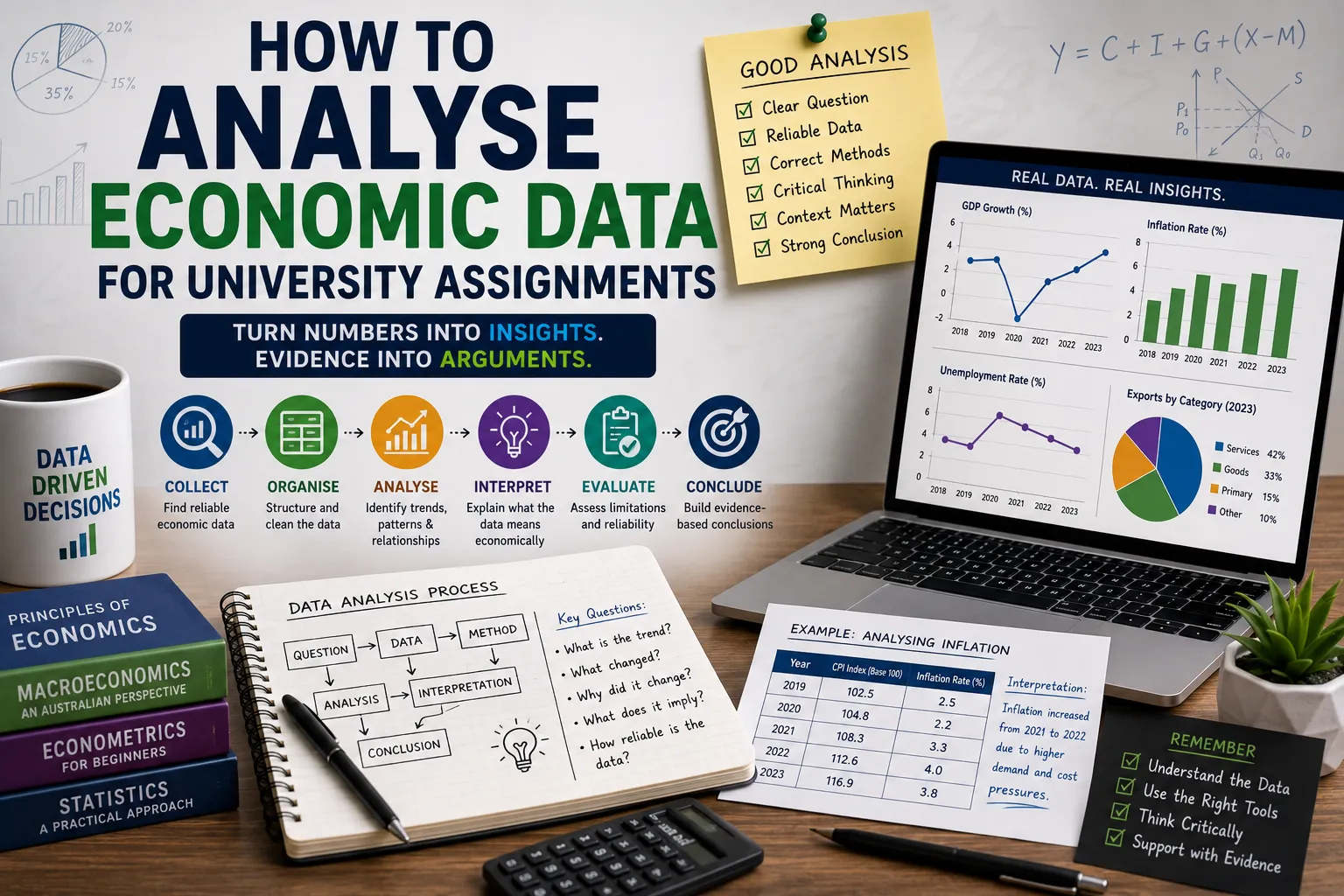
Rather than making the statement without evidence, the student can use relevant economic data and explain what the figures suggest.
Evidence becomes meaningful when it is interpreted.
Do not simply insert a statistic and move on.
Explain what the number shows and why it matters to the argument.
Explain Statistics Rather Than Just Reporting Them
Statistics are common in economics assignments.
However, reporting a number without interpretation does not necessarily demonstrate understanding.
Imagine that an unemployment rate increased from one period to another.
A strong explanation would identify the change and then discuss possible economic reasons for it.
The student could consider changes in economic activity, employment demand, business confidence or other relevant factors.
The exact explanation should depend on the available evidence.
The important principle is to give context to the statistic.
Compare Related Economic Concepts
Comparison can demonstrate a deeper understanding of economics.
Students may be asked to compare concepts such as fiscal policy and monetary policy.
They could explain that both can influence economic activity but operate through different mechanisms.
Similarly, economic growth and economic development are related but not identical.
Economic growth generally focuses on increases in economic output, while economic development involves broader improvements in living standards and social outcomes.
Clear comparisons help students demonstrate that they understand both similarities and differences.
Build a Strong Economics Assignment Paragraph
A useful economics paragraph can follow a logical sequence.
Begin by introducing the economic concept.
Explain what it means.
Describe the relevant economic mechanism.
Provide evidence or a real world example.
Interpret the evidence.
Connect the discussion back to the assignment question.
For example, a paragraph about rising interest rates could begin by explaining the role of interest rates in borrowing decisions. It could then discuss how higher borrowing costs may influence household consumption and business investment. The paragraph could finish by connecting these effects to aggregate demand.
This structure keeps the discussion focused.
Apply Economic Theory to the Assignment Question
Before writing, students should identify exactly what the assignment question requires.
Words such as explain, analyse, compare, evaluate and discuss can require different approaches.
If the question asks why prices have increased, supply and demand may be relevant.
If it asks how a government can stimulate economic activity, fiscal policy may be important.
If it asks why consumers respond differently to price changes, elasticity may provide the appropriate framework.
Understanding the question prevents students from filling their assignment with economic information that does not directly answer the task.
A Simple Method for Explaining Any Economic Concept
Students can use a straightforward process when they are unsure how to structure an explanation.
First, define the concept.
Second, explain it using your own words.
Third, identify the important variables or factors.
Fourth, explain the relationship between those factors.
Fifth, provide a relevant real world example.
Sixth, analyse the consequences.
Finally, connect the explanation to the assignment question.
This method can be adapted to many areas of economics.
Improve a Basic Economics Paragraph
Imagine a student writes the following idea.
Inflation means prices increase. Inflation affects consumers because things become more expensive.
The explanation is understandable but quite basic.
It can be improved by adding economic reasoning.
Inflation refers to a sustained increase in the general price level. When prices rise faster than household income, consumers may experience a decline in purchasing power because the same income can purchase fewer goods and services. This can influence household spending decisions, particularly when essential expenses such as food, housing and transport account for a significant proportion of income.
The improved version defines the concept, explains the mechanism and discusses its consequences.
Use assignmentdude as a Learning Resource
Students sometimes need additional guidance when they are unsure how to approach an economics assignment.
assignmentdude can be useful as an academic resource for students who want support with understanding assignment requirements, organising economic arguments and improving academic writing.
The most valuable approach is to use academic support as a way to understand the process.
Students should still develop their own understanding, evaluate evidence and build their own economic reasoning.
A Practical Checklist for Clear Economic Writing
Before submitting an economics assignment, ask yourself whether you have clearly defined the main concepts.
Check whether you have explained important economic relationships.
Make sure technical terminology is used correctly.
Look at your examples and confirm that they actually support the theory.
Check whether statistics have been interpreted rather than simply reported.
If you have used diagrams, explain what they show.
Make sure important claims are supported by credible evidence.
Review whether your paragraphs analyse the issue rather than simply describing it.
Finally, check that every major discussion connects to the assignment question.
Frequently Asked Questions
How do I explain an economic concept in an assignment?
Begin with a clear definition and then explain the concept using your own words. Discuss how it works, identify important relationships, provide a relevant example and connect the explanation to the assignment question.
How can I make economics writing easier to understand?
Use straightforward language and introduce technical terminology only when necessary. Break complicated ideas into smaller parts and explain the relationship between different economic factors.
Should I use real world examples in economics assignments?
Yes, when they are relevant. A good example demonstrates how an economic theory applies outside the textbook. Always explain why the example supports the concept.
How much economic terminology should I use?
Use enough terminology to communicate economic ideas accurately. Avoid using complicated terms simply to sound academic. Every technical term should be used correctly and explained when necessary.
How do I explain an economics graph?
Identify the axes and curves first. Then describe the relevant movement or shift and explain why it occurred. Finally, discuss how the change affects the economic outcome.
What is the difference between description and analysis in economics?
Description explains what something is or what happened. Analysis explores why it happened, how economic factors are connected and what consequences may follow.
How can I support economic claims?
Use credible academic and institutional sources. Government data, central bank publications, academic research and reliable economic databases can provide useful evidence.
How do I avoid common economics assignment mistakes?
Understand the concept before writing, use accurate terminology, connect examples to theory, interpret statistics and graphs and make sure your discussion directly answers the assignment question.
How can I connect economic theory to a real world situation?
Identify a real situation where the economic mechanism can be observed. Then explain the situation using the relevant theory and discuss what the example demonstrates.
Can assignmentdude help me understand economics assignments?
assignmentdude can provide academic guidance that may help students understand economics assignment requirements, organise their writing and improve their approach to economic concepts. Students should use such resources to develop their own understanding and academic skills.
Final Tips for University Economics Assignments
Understanding comes before writing.
Do not begin by trying to memorise complicated definitions.
Learn what the concept means.
Then explain it in your own words.
Think about the economic relationships involved.
Ask what causes a change and what consequences may follow.
Use examples that actually support your argument.
Interpret evidence instead of simply presenting it.
Explain graphs rather than leaving them to speak for themselves.
Use technical terminology accurately.
Most importantly, keep returning to the assignment question.
A strong economics assignment is not simply a collection of definitions, diagrams and statistics. It is a connected explanation that demonstrates how economic theory helps us understand real situations.
Conclusion
Explaining economic concepts clearly is an important skill for university students.
Economics can involve complicated theories and models, but effective academic writing does not require unnecessarily complicated language. The strongest explanations usually begin with a clear definition and then build understanding through explanation, evidence, examples and analysis.
Students should learn to move beyond memorised definitions.
If you are explaining inflation, discuss how changes in the general price level can influence purchasing power.
If you are explaining supply and demand, discuss how changes in market conditions can influence equilibrium.
If you are explaining elasticity, show how consumers or producers respond to changes.
If you are discussing unemployment, connect labour market conditions with broader economic activity.
The same principle applies across economics.
Define the concept.
Explain how it works.
Show why it matters.
Use relevant evidence.
Connect it to the real world.
Then relate everything back to the assignment question.
With regular practice, difficult economic concepts become easier to communicate. Students who focus on genuine understanding rather than memorisation can develop clearer arguments and more convincing academic writing.
Resources such as assignmentdude can provide additional academic guidance when students need help understanding economics assignments, but the ultimate goal should always be developing independent knowledge and analytical skills.
Clear economic writing is not about making an assignment sound complicated.
It is about making complex economic ideas understandable, accurate and meaningful.
When your reader can easily understand the concept, follow your reasoning and see how the theory applies to the real world, your economics assignment becomes much stronger.




























Sign in to leave a comment.