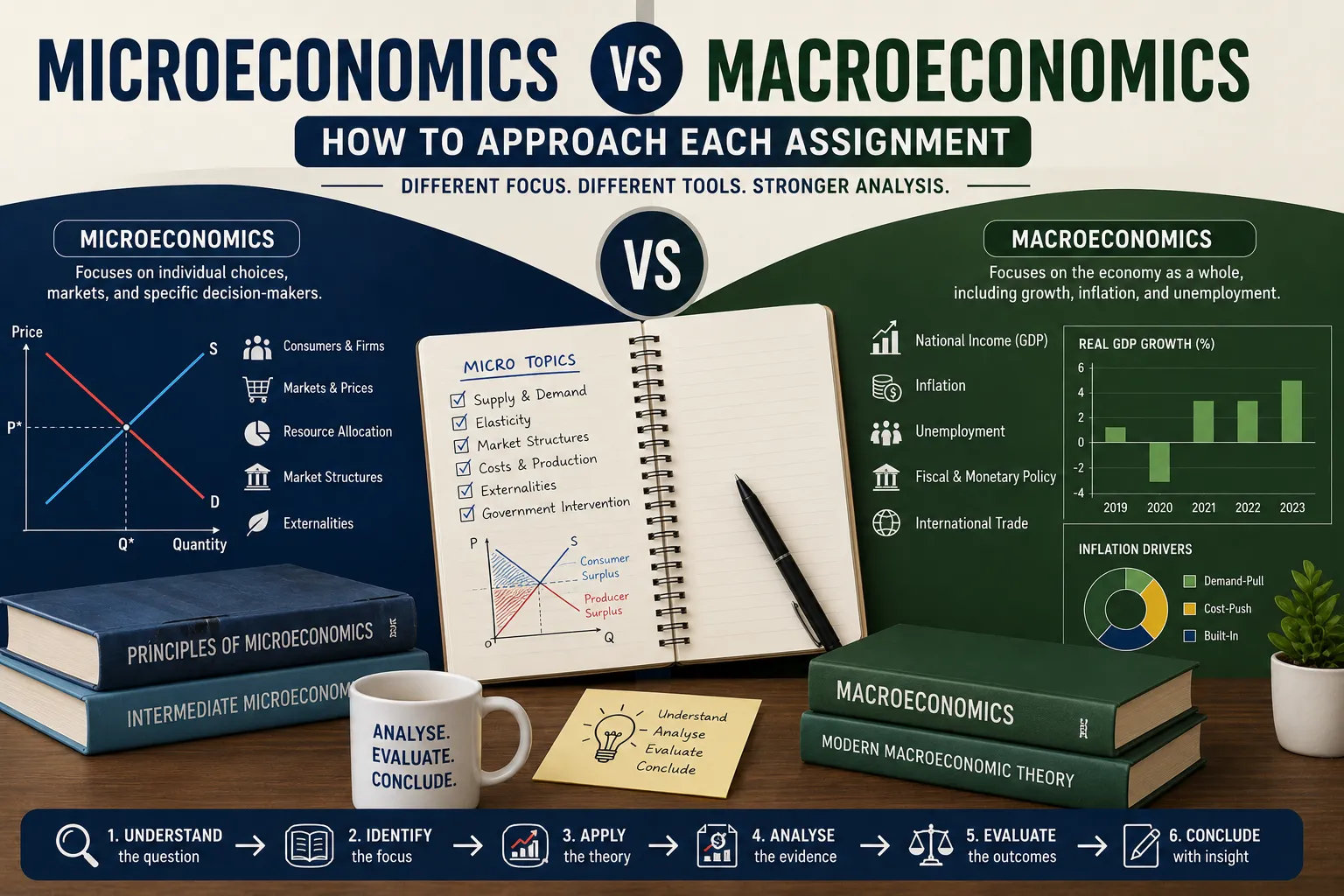


You've got an economics assignment sitting in front of you and you know the basic concepts reasonably well. The trouble is you're not entirely sure whether this particular question wants you to think like a microeconomist looking at a single market or a macroeconomist looking at the entire economy at once.
Here's the fundamental distinction worth keeping in mind. Microeconomics focuses on individual consumers, firms, markets and specific economic decisions, while macroeconomics examines the economy as a whole, covering things like inflation, unemployment, economic growth, interest rates and national output. Recognizing which lens your assignment actually calls for makes a genuinely big difference in how you plan your response, which theories you select and how you build your argument. This guide walks through how to approach both types of assignments, select appropriate theories, interpret evidence, use graphs properly and build an economic argument that actually holds together.
1. Understanding the Difference Between Microeconomics and Macroeconomics
Microeconomics
Microeconomics generally covers topics such as
- Supply and demand
- Consumer behaviour
- Producer behaviour
- Price elasticity
- Market structures
- Production and costs
- Externalities
- Government intervention
- Consumer and producer surplus
Macroeconomics
Macroeconomics generally covers topics such as
- Gross domestic product
- Inflation
- Unemployment
- Economic growth
- Fiscal policy
- Monetary policy
- Interest rates
- Exchange rates
- Aggregate demand and aggregate supply
- Business cycles
| Aspect | Microeconomics | Macroeconomics |
|---|---|---|
| Focus | Individual markets and decisions | The economy as a whole |
| Scale | Households, firms, industries | National and international level |
| Common tools | Supply and demand graphs, elasticity | GDP, inflation rates, policy models |
| Typical questions | How does a tax affect a single market | How does inflation affect the whole economy |
2. How to Identify Whether an Assignment Is Microeconomic or Macroeconomic
The wording of the question usually gives you a strong clue about which branch of economics you're actually dealing with.
Common Microeconomic Signals
- Consumer
- Firm
- Industry
- Market
- Price
- Demand
- Supply
- Competition
- Production
- Costs
Common Macroeconomic Signals
- National economy
- GDP
- Inflation
- Unemployment
- Economic growth
- Interest rates
- Government spending
- Central bank
- Exchange rates
Consider these hypothetical assignment questions. A question asking you to explain how a new tax on sugary drinks might affect consumer demand is clearly microeconomic, since it focuses on a specific product market. A question asking you to discuss the causes of rising national inflation is clearly macroeconomic, since it deals with the economy as a whole. A question asking you to analyze competition between two coffee chains is microeconomic, focusing on firm behaviour within a specific industry. A question asking you to evaluate a central bank's decision to raise interest rates is macroeconomic, since it deals with monetary policy at a national level.
3. How to Approach a Microeconomics Assignment
A useful process for microeconomic assignments looks like this.
Understand the market, identify the economic problem, select the theory, analyze the factors, use graphs, evaluate, conclude.
Start by pinning down exactly which market, consumers, firms or decision makers are actually involved in the scenario you're analyzing. From there identify the specific economic problem, whether that's a price change, a new regulation or a shift in consumer preferences, before selecting the theory that genuinely fits the situation.
4.Key Microeconomic Concepts Students Should Know
Supply and Demand
Understanding equilibrium price and quantity, along with how shifts in either supply or demand affect the market, forms the foundation of most microeconomic analysis.
Elasticity
Elasticity comes in several forms worth knowing, including price elasticity of demand, price elasticity of supply, income elasticity and cross price elasticity. Elasticity helps explain how sensitive consumers and producers are to changes in price or income, which is genuinely useful when analyzing how a market responds to a shock.
Market Structures
Different market structures behave differently, including perfect competition, monopoly, monopolistic competition and oligopoly. Each structure has different implications for pricing, competition and consumer outcomes.
Externalities
Positive and negative externalities occur when a transaction affects third parties who weren't directly involved, which can lead markets to produce inefficient outcomes without some form of intervention.
Government Intervention
Governments can intervene in markets through taxes, subsidies, price ceilings, price floors and various forms of regulation. Understanding why and how each tool works helps explain the intended and unintended effects of policy decisions.
Focus on applying these concepts to your specific assignment rather than getting lost in overly complicated mathematical derivations that aren't actually required.
5 How to Use Graphs in a Microeconomics Assignment
Diagrams genuinely matter in microeconomics assignments since they help visually demonstrate concepts that are harder to explain in words alone.
Common graphs you'll likely use include those for supply and demand, taxes, subsidies, price ceilings, price floors, externalities, market structures and consumer and producer surplus.
When building your graphs make sure to
- Label both axes clearly
- Identify each curve properly
- Mark the equilibrium point
- Show any shifts clearly with labelled arrows or dashed lines
- Explain the difference between a movement along a curve and a shift of the curve entirely
A movement along a curve happens when price itself changes, while a shift of the entire curve happens when something other than price changes, such as consumer income or production costs. Always explain the economic meaning behind your graph rather than simply dropping it into your assignment without commentary, since the graph alone doesn't demonstrate analysis on its own.
6. How to Approach a Macroeconomics Assignment
A useful process for macroeconomic assignments looks like this.
Identify the economic indicator, determine the problem, select the macroeconomic model, analyze causes, examine policy responses, evaluate consequences, conclude.
Imagine a hypothetical assignment asking you to analyze rising inflation in a country. You'd start by identifying inflation as the relevant indicator, determine what's actually driving it, whether that's rising demand or supply side pressures, select an appropriate macroeconomic model such as aggregate demand and supply, analyze the underlying causes, examine possible policy responses such as raising interest rates and finally evaluate the likely consequences of those responses before reaching your conclusion.
7. Key Macroeconomic Concepts Students Should Know
Gross Domestic Product
GDP measures the total value of goods and services produced within an economy over a given period, and it's commonly used as a broad indicator of overall economic activity.
Inflation
Inflation refers to a general rise in prices over time, and it can be driven by various factors including rising demand, increasing production costs or expansive monetary policy.
Unemployment
Different forms of unemployment, including cyclical, structural and frictional unemployment, carry different economic implications and often call for different policy responses.
Economic Growth
Long term economic growth is typically influenced by factors such as investment, productivity, labour force growth and technological progress.
Fiscal Policy
Fiscal policy involves government decisions around spending and taxation, which can be used to influence overall economic activity.
Monetary Policy
Central banks use tools such as interest rates to influence borrowing, spending and overall economic activity, particularly in response to inflation or unemployment concerns.
Exchange Rates
Currency movements can significantly affect trade, imports, exports and even domestic inflation, since a weaker currency makes exports cheaper abroad but imports more expensive at home.
8. How to Use Economic Data in a Macroeconomics Assignment
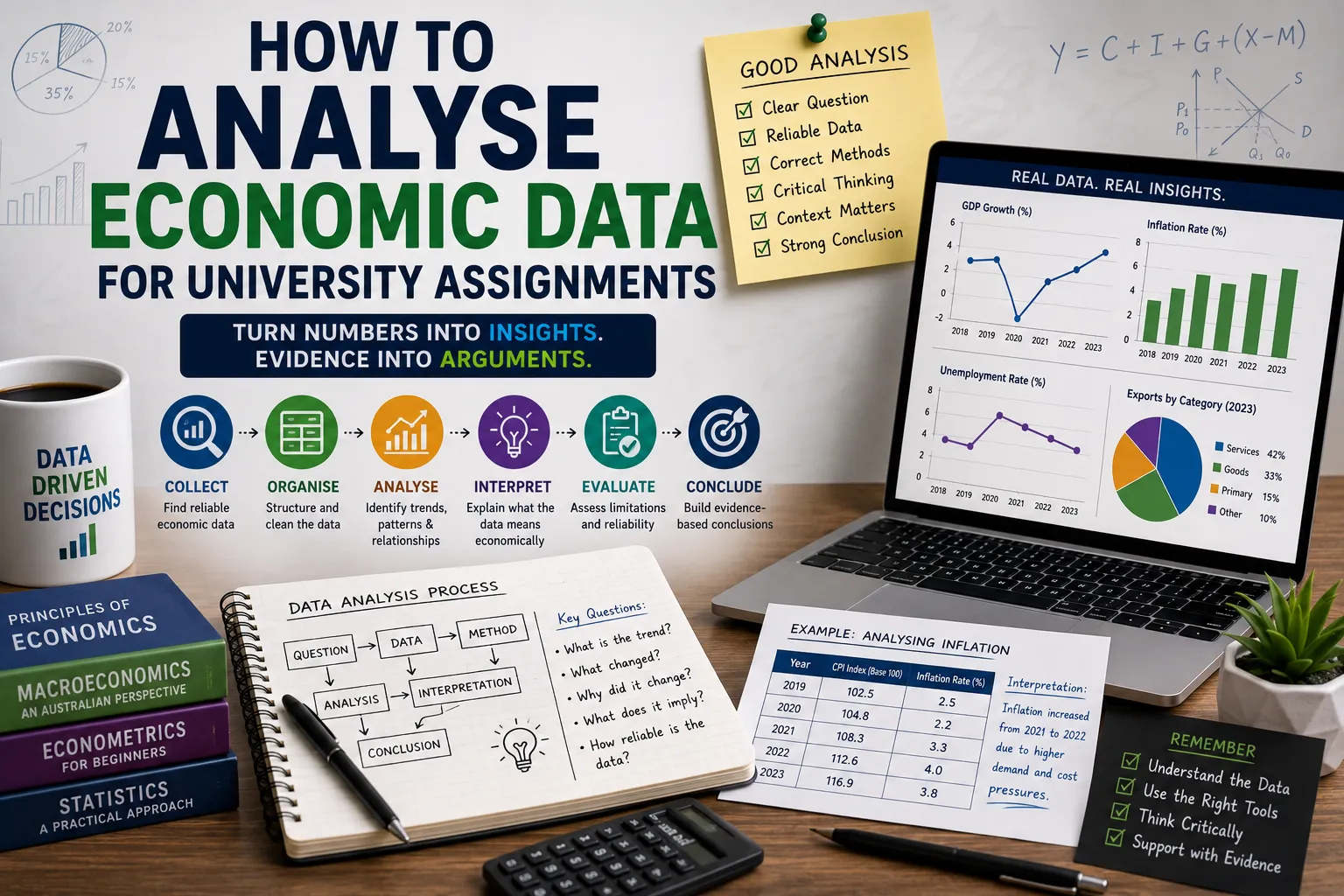
Working effectively with data means going beyond simply listing numbers. You'll typically work with GDP data, inflation rates, unemployment figures, interest rates, exchange rates, government spending figures and trade data.
When examining this kind of data, look for
- Trends over time
- Meaningful changes between periods
- Comparisons across countries or regions
- Relationships between different indicators
- Possible underlying causes
- Limitations within the data itself
The key here is explaining what the numbers actually mean economically rather than simply stating that a figure went up or down. A rising unemployment rate alongside falling GDP, for example, suggests something meaningfully different than rising unemployment alongside steady GDP growth, and your analysis should reflect that distinction.
9. Microeconomics vs Macroeconomics Choosing the Right Theory
| Assignment Focus | Likely Area | Useful Concepts |
|---|---|---|
| Consumer response to price | Microeconomics | Demand, elasticity |
| Effect of a tax on a product | Microeconomics | Supply, demand, tax incidence |
| Competition between firms | Microeconomics | Market structures |
| Rising national inflation | Macroeconomics | Inflation, monetary policy |
| Increasing unemployment | Macroeconomics | Labour market, fiscal policy |
| Falling GDP | Macroeconomics | Economic growth, aggregate demand |
| Currency depreciation | Macroeconomics | Exchange rates, trade |
Some topics genuinely overlap both branches, such as how rising interest rates affect both individual borrowers at the micro level and overall economic activity at the macro level. When this happens, follow the specific focus and wording of your actual assignment question rather than trying to cover both angles equally.
10. How to Build a Strong Economics Assignment Argument
A reliable structure for building your argument is claim, economic theory, evidence, analysis, evaluation, conclusion.
Say your claim is that a minimum wage increase could reduce employment in a specific industry. You'd introduce the relevant theory around labour markets and wage floors, bring in evidence such as employment trends in similar cases, analyze what that evidence actually suggests, evaluate the strength and limitations of that evidence and conclude with a supported judgement rather than a vague, uncommitted statement. If you ever want to sense check whether your argument structure actually holds together before submitting, running it past a study group, teaching assistant or even a resource like assignmentdude for feedback can be a useful step, though the underlying economic reasoning needs to be genuinely your own.
11 .How to Evaluate Economic Policies
Evaluation becomes particularly important in higher level economics assignments, where simply describing a policy isn't enough.
Consider factors such as
- Short term effects
- Long term effects
- Winners and losers
- Efficiency
- Equity
- Government costs
- Unintended consequences
- Effectiveness
- Feasibility
- Prevailing economic conditions
Imagine a hypothetical comparison between two responses to high inflation, one involving raising interest rates and another involving wage and price controls. Raising interest rates might reduce inflation over time but could slow economic growth and increase borrowing costs in the short term. Wage and price controls might offer quicker relief but often create shortages or distortions elsewhere in the economy. Weighing these trade offs against each other is exactly what genuine policy evaluation looks like.
12. Common Mistakes in Microeconomics Assignments
- Using the wrong economic concept, avoided by carefully matching the theory to the specific market situation
- Misreading graphs, prevented by double checking axes, curves and equilibrium points
- Confusing movement along a curve with a shift of the curve, avoided by clearly identifying what actually changed
- Ignoring elasticity, solved by considering how sensitive consumers or producers are to the change being analyzed
- Describing instead of analyzing, fixed by consistently explaining why something matters rather than just what happened
- Failing to explain assumptions, avoided by stating clearly what conditions your analysis depends on
- Using graphs without explanation, solved by always accompanying a diagram with written analysis
- Making unsupported claims, prevented by tying every claim back to theory or evidence
13. Common Mistakes in Macroeconomics Assignments
- Confusing GDP with overall economic well being, avoided by remembering GDP measures output, not quality of life
- Listing statistics without analysis, fixed by always explaining what the numbers actually mean
- Ignoring the relevant time period, avoided by clearly stating the timeframe your analysis covers
- Treating inflation and price levels as the same thing, clarified by remembering inflation is the rate of change in prices, not the price level itself
- Oversimplifying policy effects, avoided by considering multiple angles and trade offs
- Ignoring trade offs entirely, solved by weighing benefits against costs for every policy discussed
- Failing to consider short term versus long term effects, fixed by explicitly separating the two in your analysis
- Making claims without economic evidence, prevented by grounding every argument in data or established theory
14. How to Structure a Microeconomics Assignment
Introduction introduces the economic problem, defines important concepts and states your argument clearly.
Economic Analysis explains the relevant theory, applies it to the specific market and brings in graphs and evidence to support your reasoning.
Evaluation considers alternative outcomes, discusses assumptions and limitations and assesses the effects of any policy or market change involved.
Conclusion directly answers the question and summarizes your key economic reasoning.
15. How to Structure a Macroeconomics Assignment
Introduction establishes the macroeconomic issue, defines important indicators and states the focus of your analysis.
Macroeconomic Analysis applies relevant models, analyzes data and explains relationships between different indicators.
Policy Evaluation examines possible responses, discusses benefits, costs and trade offs and considers both short term and long term effects.
Conclusion summarizes the analysis and provides a supported final judgement.
16. How to Use Real World Examples Effectively
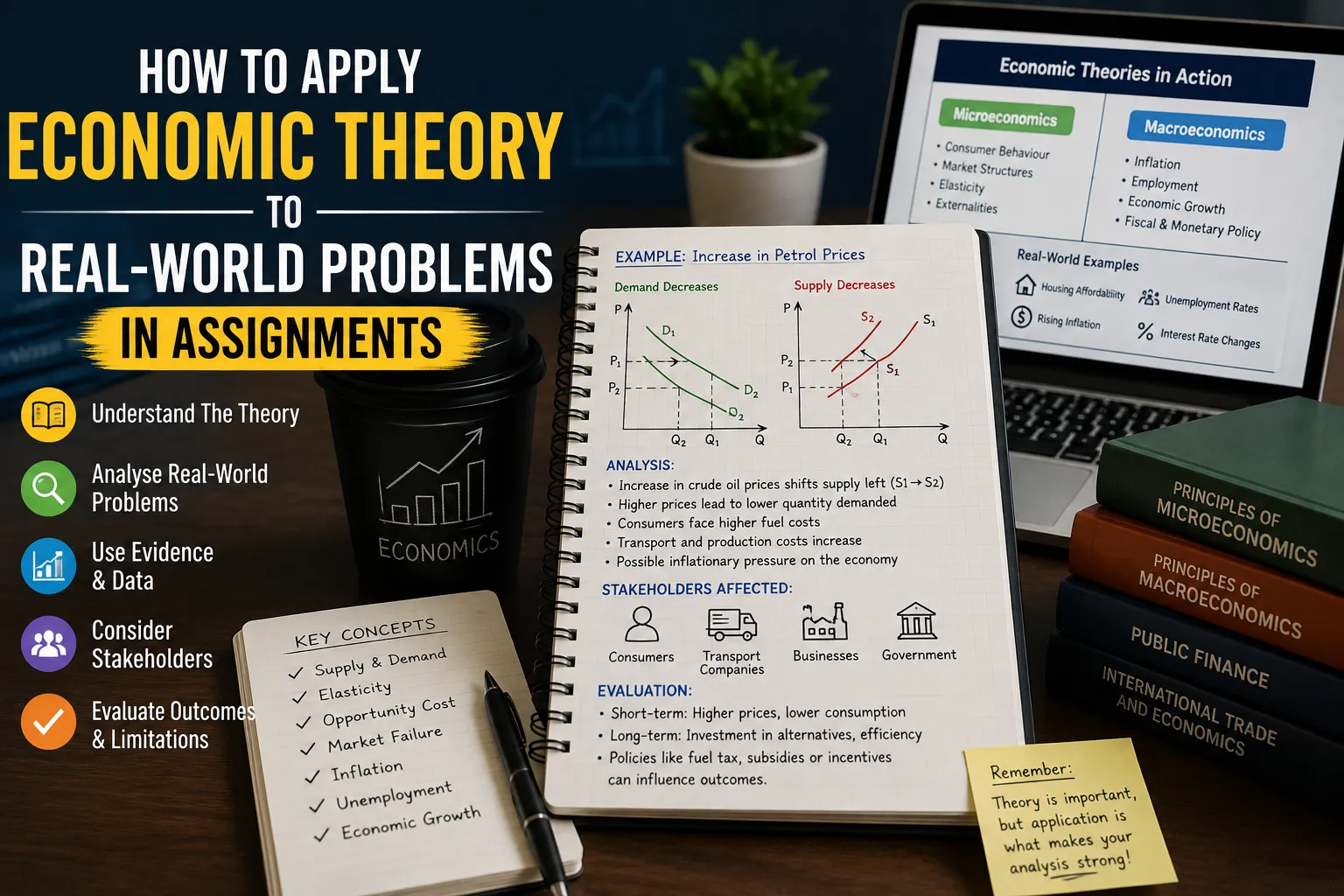
Real world examples can genuinely strengthen an economics assignment when they're used thoughtfully. Useful areas to draw examples from include inflation, housing markets, minimum wages, taxation, interest rates, unemployment, international trade and government spending.
The key is making sure your examples actually support your economic argument rather than simply filling space to hit a word count. Avoid inventing specific statistics or presenting hypothetical scenarios as though they were real documented events, since that undermines the credibility of your analysis.
17. Microeconomics vs Macroeconomics Assignment Checklist
Microeconomics Checklist
- Have I identified the relevant market?
- Have I identified the main economic problem?
- Have I selected the correct theory?
- Have I used relevant graphs?
- Are my graphs correctly labelled?
- Have I explained changes in supply and demand?
- Have I considered elasticity where relevant?
- Have I analyzed rather than simply described?
- Have I evaluated possible outcomes?
- Does my conclusion answer the question?
Macroeconomics Checklist
- Have I identified the key macroeconomic indicator?
- Have I explained the relevant economic problem?
- Have I used appropriate macroeconomic theory?
- Have I analyzed relevant data?
- Have I considered policy options?
- Have I discussed trade offs?
- Have I considered short term and long term effects?
- Have I used evidence appropriately?
- Have I evaluated limitations?
- Does my conclusion provide a clear judgement?
Frequently Asked Questions
What is the main difference between microeconomics and macroeconomics?
Microeconomics studies individual economic agents and specific markets, such as consumers and firms, while macroeconomics studies the economy as a whole, including national output, inflation and unemployment.
How do I know whether my assignment is microeconomic or macroeconomic?
Look at the keywords in the question, the scale of the issue being discussed and any specific economic indicators mentioned. Questions about a single market or firm tend to be microeconomic, while questions about the national economy tend to be macroeconomic.
What topics are usually covered in microeconomics assignments?
Common topics include supply and demand, elasticity, market structures, consumer behaviour, production costs, externalities and government intervention within specific markets.
What topics are usually covered in macroeconomics assignments?
Common topics include GDP, inflation, unemployment, economic growth, fiscal policy, monetary policy, interest rates and exchange rates.
Should I use graphs in an economics assignment?
Yes, when they genuinely support your argument. Just make sure every graph is properly labelled and accompanied by a clear explanation of what it actually demonstrates economically.
How can I improve my economics assignment analysis?
Connect economic theory directly to evidence, explain cause and effect relationships clearly, evaluate the assumptions behind your argument, consider alternative outcomes and reach a conclusion that's genuinely supported by your analysis.
Can an economics assignment include both microeconomics and macroeconomics?
Some topics do overlap both branches, such as interest rate changes affecting individual borrowers and the broader economy simultaneously. Follow the specific scope of your assignment question rather than assuming both branches always need equal coverage.
How important is real world evidence in economics assignments?
Genuinely important, provided the evidence is accurate, properly sourced and clearly connected back to the economic theory you're applying. Avoid presenting hypothetical scenarios as though they were real documented data.
What is the biggest mistake students make in economics assignments?
Describing economic concepts without actually applying them to the specific question or evidence at hand is one of the most common issues, often leaving an assignment feeling more like a definition list than a genuine analysis.
How should I conclude an economics assignment?
Directly answer the original question, summarize your strongest economic reasoning and provide a supported final judgement where the assignment calls for one, rather than ending on a vague or noncommittal note.
Conclusion
Successful economics assignments were never really about memorizing definitions. What matters is identifying the actual scale of the economic problem, selecting the theory that genuinely fits, applying it to evidence, using graphs or data where relevant and evaluating the consequences of different outcomes. Microeconomics deals with individuals, firms, markets, prices and specific economic decisions, while macroeconomics deals with national economies, GDP, inflation, unemployment, growth and broader economic policy. Identify the question, choose the right economic perspective, apply the appropriate theory, support it with evidence, analyze carefully, evaluate thoughtfully and conclude with a judgement that genuinely follows from your reasoning.





























Sign in to leave a comment.