
Introduction
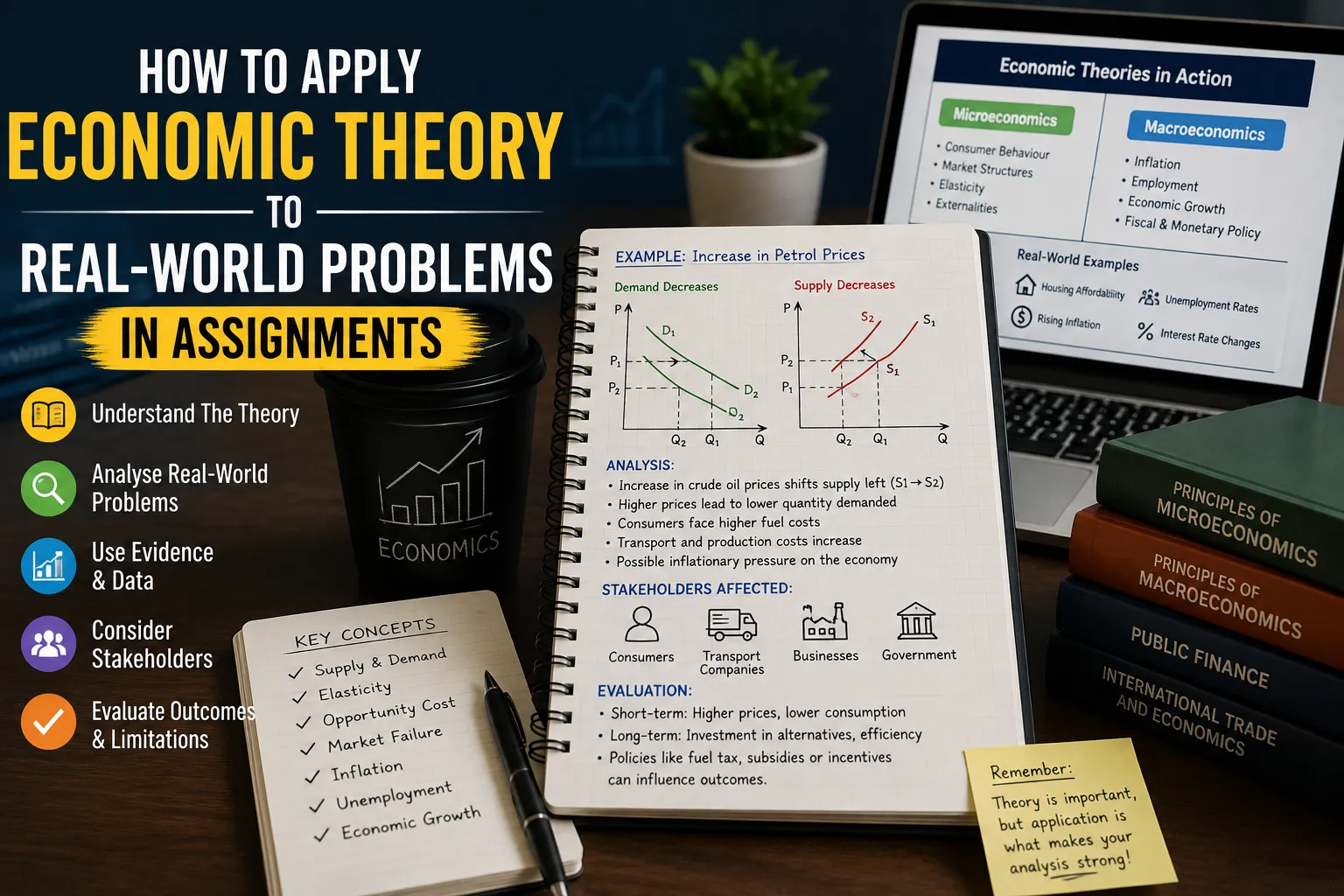
You understand supply and demand. You can explain opportunity cost in your sleep. You know what market equilibrium means. Then your assignment asks you to apply that theory to an actual real world issue such as rising rents or interest rate hikes and suddenly you're staring at a blank page wondering where to even start.
This is one of the most common struggles economics students face. There's a real difference between knowing an economic theory and actually using that theory to analyse a genuine problem. Strong economics assignments don't just define textbook concepts. They connect theory, evidence, context and evaluation into something that actually explains what's happening in the real world. This guide walks you through exactly how to make that connection.
Understand What the Assignment Question Is Really Asking
Before you even think about which theory to use, take a moment to understand what the question is actually asking of you. Command words matter far more than students often realise.
- Analyse asks you to break something down and examine how its parts relate to each other
- Evaluate asks you to weigh up strengths and weaknesses before forming a judgement
- Discuss asks for a broader exploration of different angles
- Compare asks you to identify similarities and differences
- Explain asks you to clarify how or why something happens
- Assess is similar to evaluate but often focuses more on significance or effectiveness
- Examine asks for a close, detailed look at an issue
The same economic topic can produce completely different answers depending on which command word is used. A question asking you to explain the effect of a minimum wage increase requires a different response than one asking you to evaluate whether a minimum wage increase is good policy. Missing this distinction is one of the easiest ways to lose marks even when your economic knowledge is solid.
Identify the Real World Economic Problem
Once you understand the question, clearly define the actual issue you're being asked to address. This sounds obvious but plenty of students skip straight to theory without pinning down the problem first.
Common real world issues economics assignments tend to focus on include
- Rising inflation
- Housing affordability
- Unemployment
- Minimum wage policies
- Increased interest rates
- Market competition
- Rising energy prices
- Government taxation
- International trade
A clearly defined problem gives your entire assignment a natural structure to build around. If you're vague about what you're actually analysing your argument will feel scattered no matter how much theory you throw at it.
Choose the Economic Theory That Fits the Problem
Don't force a theory into your assignment just because it's the one you happen to remember best. The theory needs to genuinely fit the problem you're analysing.
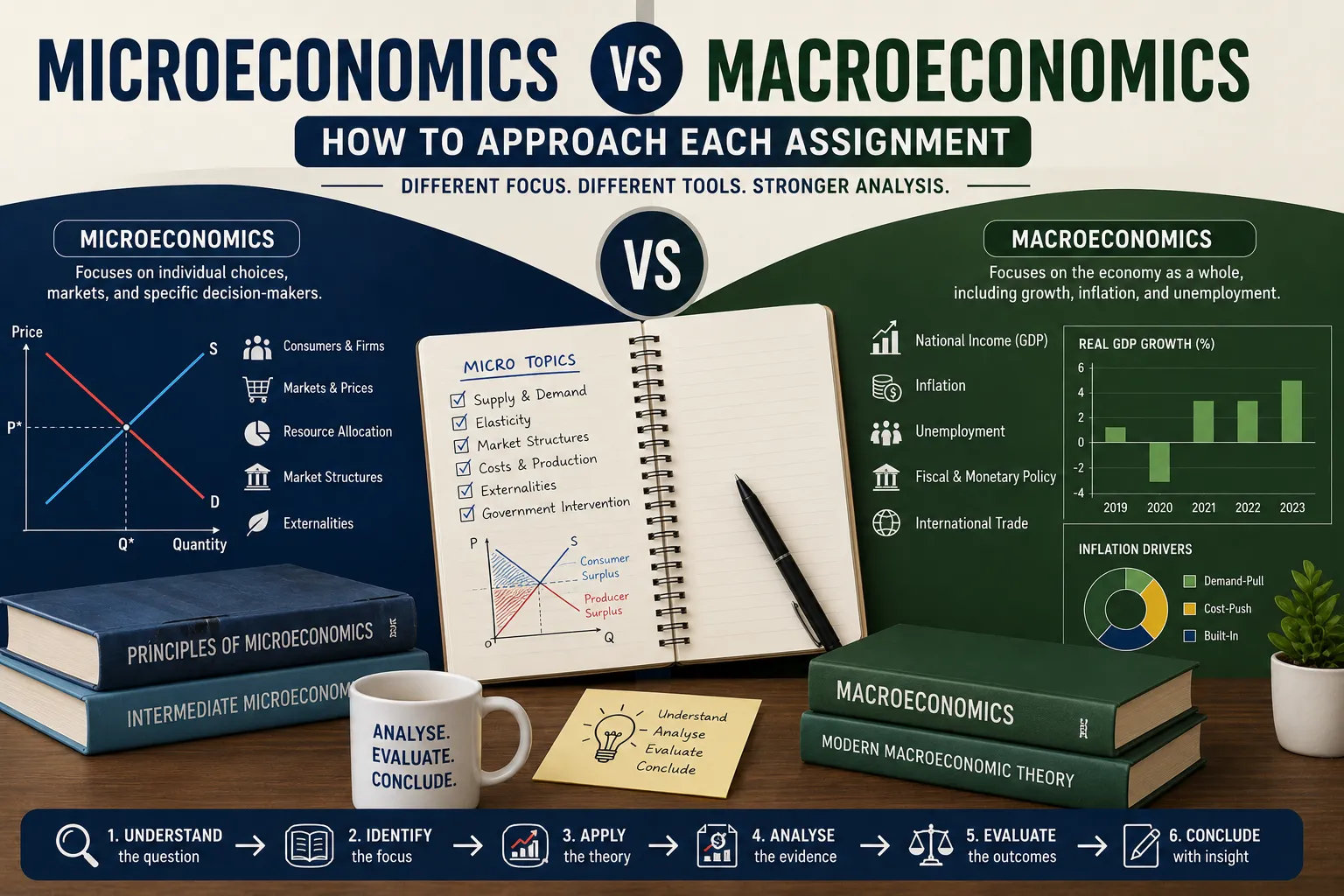
Microeconomics
Useful microeconomic concepts include
- Supply and demand
- Elasticity
- Consumer behaviour
- Market structures
- Externalities
- Opportunity cost
Macroeconomics
Useful macroeconomic concepts include
- Inflation
- Unemployment
- Economic growth
- Fiscal policy
- Monetary policy
- Aggregate demand and supply
Ask yourself whether your problem relates to an individual market or business, which points toward microeconomics, or whether it relates to the economy as a whole, which points toward macroeconomics. This one distinction alone often narrows your options significantly.
Move Beyond Definitions
Simply defining a theory isn't the same as analysing a problem, yet this is where a lot of assignments fall flat. Writing a sentence like "supply and demand determine market prices" tells your marker you understand the definition but nothing about the actual situation you're supposed to be examining.
Instead, aim for this progression.
Definition leads to mechanism, mechanism leads to real world application, application leads to outcome.
For example rather than stopping at the definition, explain how a sudden drop in housing supply in a growing city pushes rental prices upward as more people compete for fewer available properties, and then discuss what this actually means for renters, landlords and government housing policy. That's the difference between describing a theory and applying it.
Use Real World Evidence to Support Economic Theory
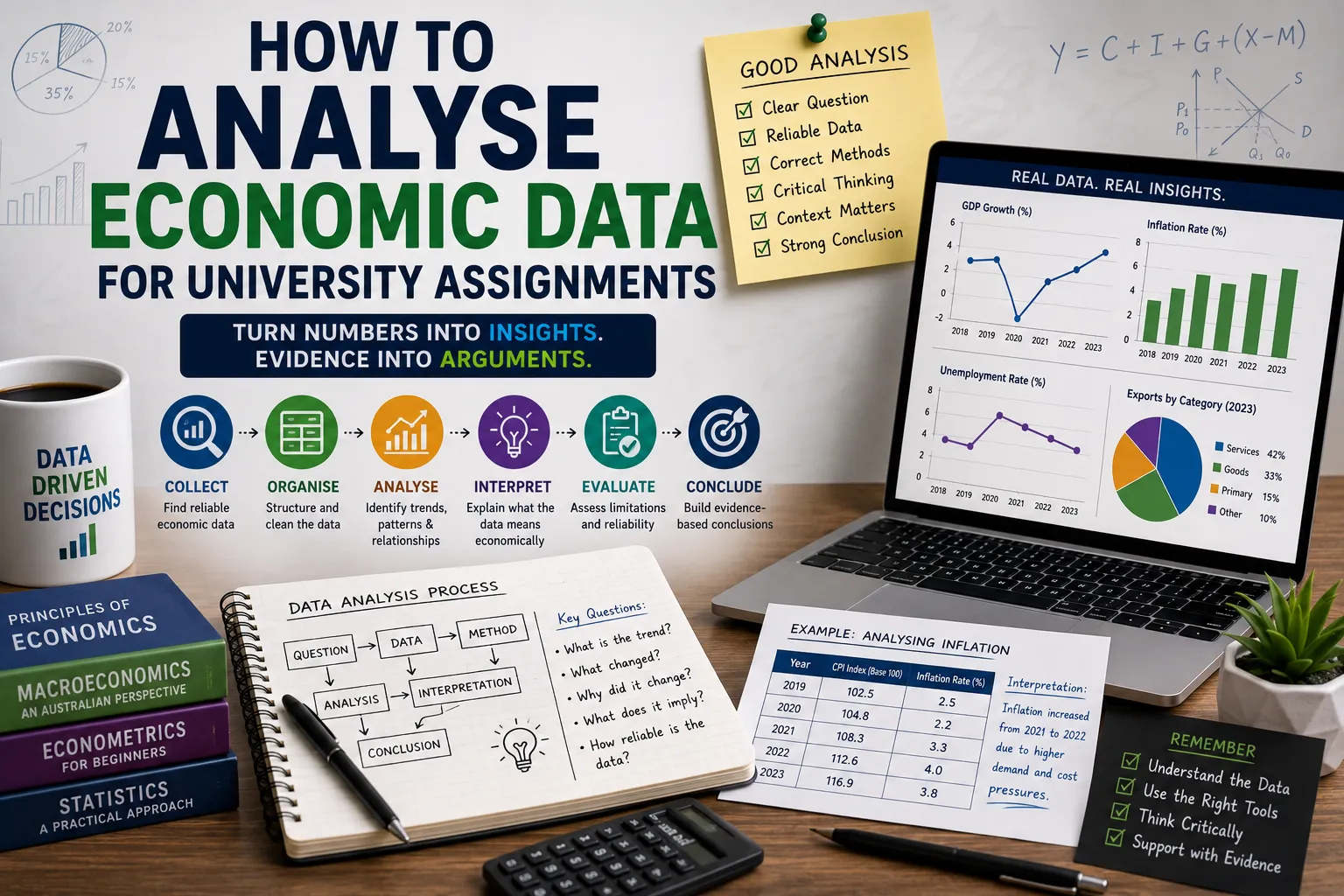
Evidence is what turns a theoretical discussion into a genuine piece of economic analysis. Useful sources of evidence include
- Government statistics
- Central bank reports
- Industry reports
- Academic research
- Credible economic data
- Company reports
- International organisations
The key is connecting your evidence directly to your argument rather than just dropping in a statistic and moving on. If you mention that interest rates have risen, explain what that actually means for the specific issue you're analysing rather than leaving the reader to make that connection themselves.
Use Supply and Demand to Analyse Everyday Markets
Supply and demand is one of the most practical tools available for analysing everyday economic issues. Take rising rental prices as an example.
- What caused demand to change? Perhaps population growth or increased migration into a city
- What caused supply to change? Perhaps a shortage of new housing developments
- How did equilibrium change? Higher demand against limited supply pushes the equilibrium price upward
- What happened to price and quantity? Rental prices rise while the quantity of available properties stays limited
- Which groups were affected? Renters face higher costs while landlords benefit from increased returns
This same basic model can be applied to petrol prices, food prices or almost any market where you can identify a genuine shift in supply or demand.
Apply Elasticity to Consumer and Business Decisions
Price elasticity of demand measures how sensitive consumers are to a change in price. Some goods are far more elastic than others.
- Petrol tends to be relatively inelastic because people still need to drive even when prices rise
- Public transport can be more elastic depending on how many alternatives are available
- Restaurant meals tend to be elastic since people can easily cook at home instead
- Essential groceries are usually inelastic because people need them regardless of price
- Luxury products tend to be highly elastic since they're easy to cut back on
Businesses and governments care deeply about elasticity because it directly affects pricing and taxation decisions. If demand for a product is inelastic, a business can raise prices with relatively little drop in sales. This is also why governments often tax inelastic goods such as tobacco and fuel, since consumption doesn't fall dramatically even as prices increase.
Apply Macroeconomic Theory to Current Economic Issues
Macroeconomic theory helps explain issues that affect the entire economy rather than a single market. Consider how these concepts connect to real events.
- Inflation reduces purchasing power, meaning the same amount of money buys less over time
- Rising interest rates increase the cost of borrowing, which can slow down spending and investment
- Unemployment reflects conditions in the labour market and can be influenced by both economic growth and structural change
- Economic growth affects overall living standards and business confidence
- Government spending and taxation directly shape aggregate demand
- Monetary policy, set by the central bank, influences borrowing costs and overall economic activity
The goal is moving from simply describing what happened, such as noting that interest rates rose, to explaining the actual mechanism behind why that change affects borrowing, spending and broader economic activity.
Consider Different Stakeholders
Economic decisions almost always create winners and losers, and strong assignments acknowledge this rather than presenting an issue as entirely good or entirely bad.
Take an increase in interest rates as an example. This can affect
- Borrowers, who face higher repayment costs
- Savers, who often benefit from improved returns
- Homeowners, particularly those with variable rate mortgages
- Businesses, which may face higher costs of financing
- Consumers, who might reduce discretionary spending
- Governments, which may see changes in tax revenue and borrowing costs
Looking at an issue from multiple perspectives shows your marker you're capable of genuine analysis rather than a one sided summary.
Discuss Assumptions and Limitations
Economic models simplify reality, and it's important to acknowledge that in your assignments. Consider factors such as
- The assumptions built into the model you're using
- Behavioural differences between real consumers and the rational actors assumed by many models
- Market imperfections such as monopolies or information gaps
- External factors like global events or natural disasters
- Data limitations, including outdated or incomplete statistics
- The difference between short term and long term effects
Acknowledging these limitations doesn't weaken your argument. It actually strengthens it by showing you understand that economic theory is a tool for understanding reality rather than a perfect representation of it.
Compare Theory With What Happens in Reality
Real markets rarely behave exactly the way simplified models predict, and pointing this out demonstrates genuine critical thinking. Consider reasons why theory and reality might diverge.
- Government intervention such as price controls or subsidies
- Information gaps between buyers and sellers
- Consumer behaviour that doesn't always align with rational decision making
- External shocks such as pandemics or supply chain disruptions
- Market power held by large firms
- Global events affecting trade and prices
- Cultural or institutional factors specific to a particular country or industry
Comparing what a model predicts against what's actually happening in a real market is one of the clearest ways to show analytical depth in your assignment.
Build an Economic Argument Step by Step
A clear paragraph structure makes it far easier to build a strong economic argument. Try this sequence.
Point, economic theory, evidence, application, analysis, evaluation.
For example you might start with the point that rising interest rates have slowed housing demand. You'd then introduce the relevant theory, such as the relationship between borrowing costs and consumer spending. Next you'd bring in evidence such as changes in lending activity. You'd then apply that theory specifically to the housing market, analyse what it means for buyers and sellers and finally evaluate whether the effect has been significant or limited. This structure keeps your paragraphs focused and analytical rather than descriptive.
Common Mistakes Students Make
A number of recurring mistakes tend to weaken otherwise solid economics assignments.
- Listing theories without actually applying them to the problem
- Using a theory that isn't genuinely relevant to the question
- Relying on outdated examples that no longer reflect current conditions
- Adding statistics without explaining what they actually mean
- Ignoring the impact on different stakeholders
- Making claims without supporting evidence
- Describing an issue without analysing why it's happening
- Forgetting to mention assumptions or limitations
- Cramming in too many theories without exploring any of them properly
Avoiding even a handful of these mistakes can noticeably lift the quality of your analysis.
A Practical Workflow for Economics Assignments
Here's a repeatable process you can apply to almost any economics assignment.
Read, identify the problem, select theory, find evidence, apply theory, analyse, evaluate, conclude.
Say your assignment focuses on inflation. You'd start by reading the question carefully, identify that rising prices and reduced purchasing power are the core issue, select relevant theory around aggregate demand and monetary policy, gather evidence such as recent interest rate decisions, apply that theory specifically to the situation, analyse the effects on households and businesses, evaluate how significant those effects have been and conclude by directly answering what the assignment originally asked.
If you ever want a second opinion while working through a tricky economics assignment, platforms like AssignmentDude are sometimes used by students looking for general guidance and feedback, though your own analysis and understanding should always remain the foundation of your work.
Economic Theory Application Checklist
Before submitting your assignment run through this checklist.
- Have I clearly identified the economic problem?
- Have I selected the most relevant theory?
- Have I explained the theory accurately?
- Have I applied it to the specific situation?
- Have I used credible evidence?
- Have I explained cause and effect?
- Have I considered different stakeholders?
- Have I discussed assumptions or limitations?
- Have I evaluated the outcome?
- Does my conclusion directly answer the assignment question?
Conclusion
Strong economics assignments don't just prove you know your theory. They prove you can use that theory as a genuine tool for understanding real world problems. The process comes down to understanding the problem, selecting the right theory, applying it to evidence, analysing the outcome and evaluating its limitations. Keep practising this approach and applying economic theory to real situations will start to feel far more natural with every assignment you tackle.



























Sign in to leave a comment.