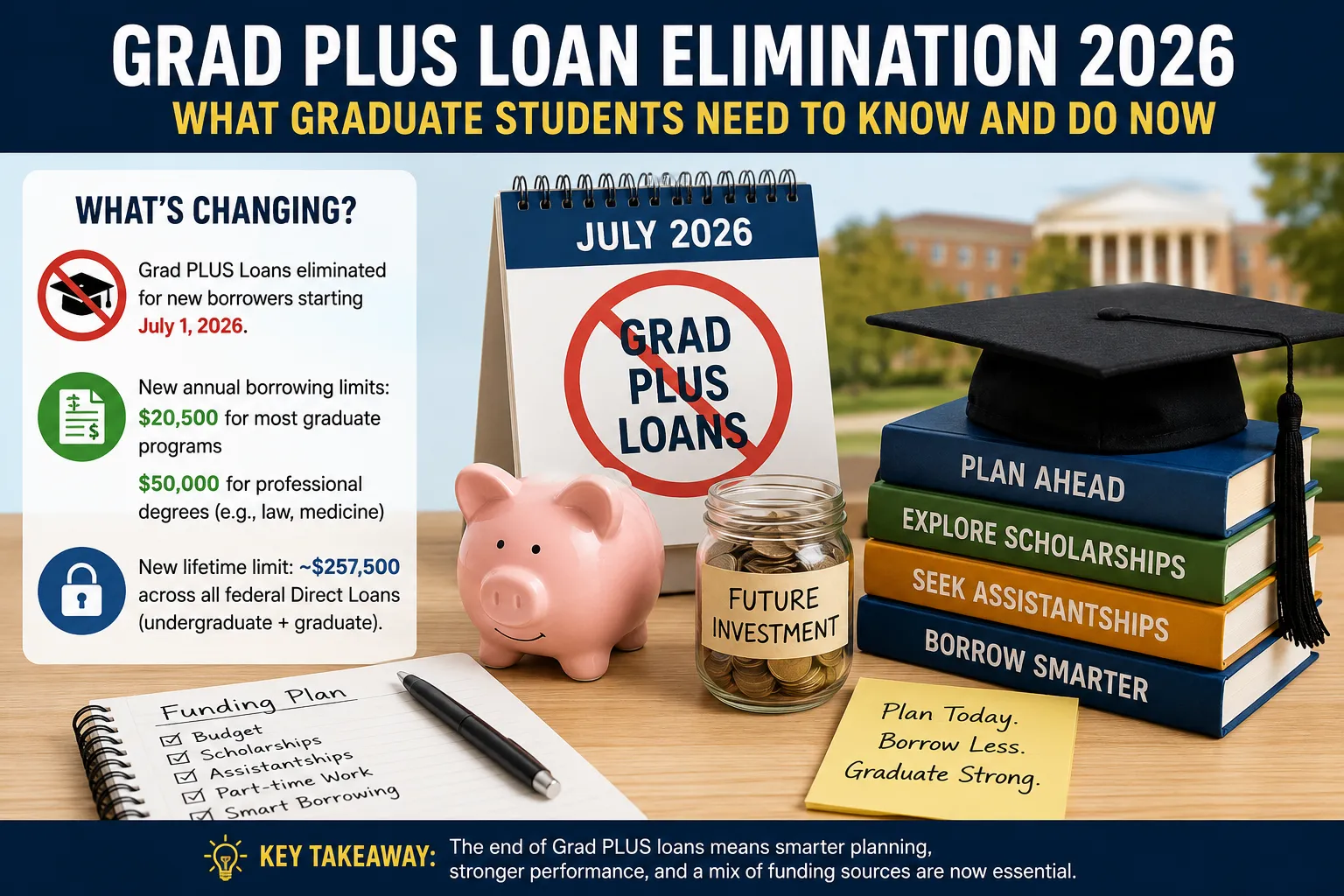

For years, graduate students had a simple solution when tuition exceeded federal loan limits: Grad PLUS loans.
That solution disappears for new borrowers on July 1, 2026.
The Department of Education's new lending framework replaces the old "borrow up to cost of attendance" model with fixed annual and lifetime borrowing caps. Most graduate students will be limited to about $20,500 annually through Direct Unsubsidized Loans, while designated professional programs receive higher limits. At the same time, all borrowers face an overall federal lifetime cap of roughly $257,500. For many students, the question is no longer whether they can get admitted. It is how they will pay the bill.
The good news is that students are already building new funding strategies. The challenge is understanding where the gaps appear and how to fill them.
The New Graduate School Funding Gap
The easiest way to understand the impact is through real numbers.
Imagine a student entering a two-year MBA program with a total annual cost of attendance of $90,000. That figure includes tuition, fees, housing, books, insurance, and living expenses.
Under the previous system, the student could combine Direct Unsubsidized Loans with Grad PLUS loans to cover nearly the entire amount.
Beginning in 2026, that same student may only have access to approximately $20,500 in annual federal borrowing.
The math becomes uncomfortable quickly.
Annual cost: $90,000
Federal loan availability: $20,500
Annual funding gap: $69,500
Over two years, the shortfall exceeds $139,000.
The situation can be even more dramatic in professional programs. Medical students, law students, and dental students often face total educational costs well above six figures. While some professional programs qualify for higher federal borrowing limits, many students will still encounter substantial financing gaps.
Step One: Maximize Money You Never Have to Repay
The first layer of every funding plan should be non-repayable aid.
Graduate scholarships, fellowships, grants, and institutional awards effectively reduce educational costs without creating future debt. Universities are expected to place greater emphasis on these programs as federal borrowing options become more restricted.
Many students make the mistake of focusing only on nationally known scholarships. In reality, departmental awards, industry associations, nonprofit foundations, and employer-sponsored scholarships often have smaller applicant pools and higher success rates.
A $5,000 scholarship may seem modest compared with graduate tuition costs. Yet multiple awards can significantly reduce borrowing needs over the life of a degree.
Step Two: Treat Assistantships as Income, Not Perks
Graduate assistantships are becoming one of the most valuable assets in higher education financing.
Teaching assistantships (TA), research assistantships (RA), and graduate assistant (GA) positions frequently provide a combination of tuition support and monthly stipends. Some programs cover a significant portion of tuition in exchange for academic or research work.
Consider a master's student whose assistantship provides:
- $18,000 annual stipend
- 50% tuition remission
That arrangement could reduce total educational costs by tens of thousands of dollars over two years.
In the post-Grad PLUS environment, assistantships should be viewed as part of a financial strategy rather than an academic bonus.
Step Three: Use Employer Tuition Assistance Strategically
Employer-sponsored education programs remain one of the most underused graduate funding resources.
Large corporations, healthcare organizations, technology firms, and government agencies increasingly reimburse employees for approved graduate coursework. Some programs provide several thousand dollars annually, while others cover entire degrees tied to workforce development goals.
For working professionals, a part-time MBA funded by employer assistance may generate a better financial outcome than leaving the workforce and borrowing heavily for a full-time program.
The key is researching policies before enrollment. Many organizations require advance approval or continued employment commitments.
Step Four: Consider Lower-Cost Learning Formats
The end of Grad PLUS borrowing is also changing how students compare programs.
Online learning and hybrid education models often reduce living expenses, transportation costs, and housing requirements. A student who continues working while studying online may avoid tens of thousands of dollars in additional borrowing.
This does not mean online education is always the right choice. Some fields benefit greatly from campus networking, clinical experiences, or laboratory access.
However, when federal borrowing is capped, total program cost becomes a much larger part of the decision-making process.
A degree that costs $40,000 less can be financially equivalent to receiving a substantial scholarship.
Step Five: Evaluate Private Student Loans Carefully
Eventually, many students will reach the final layer of graduate financing: private loans.
This is where the keyword private student loans graduate school 2026 becomes increasingly relevant.
Private lenders, banks, fintech companies, and state-based nonprofit loan programs are expected to play a larger role as federal borrowing options shrink. Several state-supported lending organizations already position themselves as alternatives for graduate and professional students facing funding gaps.
Before signing any private loan agreement, students should compare:
- Interest rates and APRs
- Fixed versus variable rates
- Co-signer requirements
- Grace periods
- Hardship protections
- Repayment flexibility
- Co-signer release policies
Unlike federal loans, private loans generally offer fewer borrower protections. They should be viewed as a gap-filling tool rather than a first-choice funding source.
The Academic Planning Factor Most Students Miss
One overlooked way to reduce borrowing is simply graduating on time.
Every additional semester creates new tuition expenses, housing costs, and lost earning potential. Under the new federal caps, academic delays become significantly more expensive.
Many students now use university writing centers, online tutoring programs, mentoring services, and academic support platforms such as Expertsmind.com to strengthen performance in difficult courses and stay on schedule. Avoiding one repeated class or an extra semester can save thousands of dollars and reduce reliance on private borrowing.
Financial planning and academic planning are becoming inseparable.
A Sample Funding Gap Calculator
Imagine a graduate student facing a $70,000 annual cost of attendance.
Federal Direct Loan: $20,500
Department Scholarship: $8,000
Graduate Assistantship Stipend: $12,000
Employer Tuition Support: $5,000
Remaining Gap: $24,500
Instead of borrowing the full $70,000, the student only needs financing for about one-third of the original cost.
That example illustrates the new reality. The solution is no longer one large Grad PLUS loan. It is a combination of multiple funding sources working together.
The New Rule: Build a Funding Portfolio
The era of unlimited graduate borrowing is ending. The students who adapt fastest will treat education financing the same way investors treat a portfolio.
No single source will carry the entire burden.
Scholarships reduce costs. Assistantships generate income. Employers contribute funding. Online learning can lower expenses. Private loans fill carefully measured gaps.
The students who combine these tools effectively will be the ones who continue pursuing graduate education without letting the end of Grad PLUS derail their goals.





























Sign in to leave a comment.