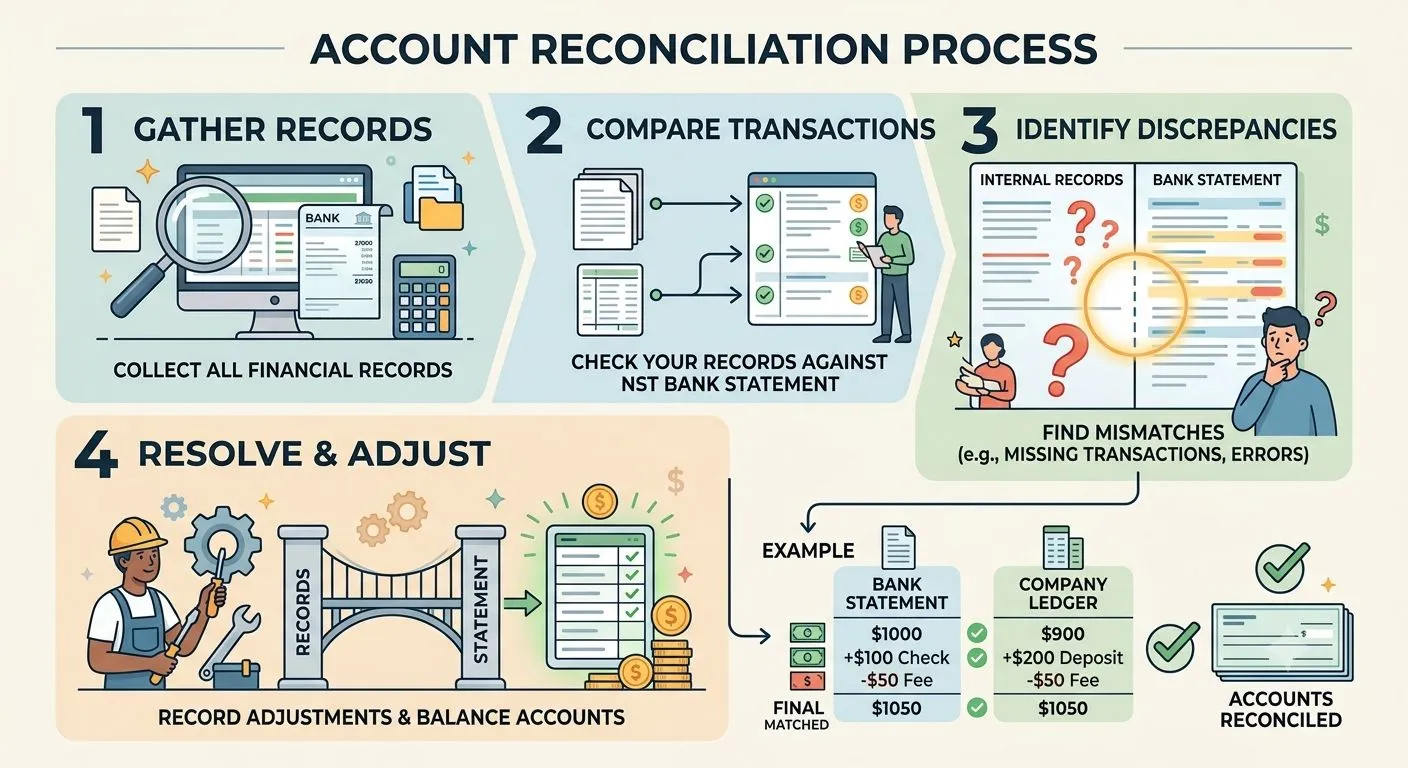

Finance teams process thousands of transactions across bank accounts, customer invoices, supplier payments, payroll records, and journal entries every month. As transaction volumes grow, even small errors can create reporting issues, unsupported balances, and audit concerns. A missing entry, duplicate posting, or timing difference can leave account balances out of sync with supporting records.
The challenge becomes more visible during month-end close, when finance teams need confidence that reported balances are accurate. This is where account reconciliation becomes a critical finance process. In this guide, we explain what account reconciliation means, the types of accounts commonly reconciled, the information required before starting, and a practical step-by-step account reconciliation example that shows how the process works in practice.
Why Account Reconciliation Matters in Finance Operations
Account reconciliation helps finance teams verify that reported balances are accurate and supported by evidence.
Growth in transactions across banking, payable, receivable, payroll, and accounting systems
Modern finance operations rely on multiple systems that process payments, invoices, payroll transactions, tax entries, and journal postings. More systems create more opportunities for discrepancies.
Why unreconciled balances create reporting and compliance risks
When balances remain unreconciled, financial statements may contain inaccurate figures. This can affect reporting, compliance reviews, and management decisions.
Impact of reconciliation accuracy on financial statements and audits
Accurate reconciliation reduces reporting errors, improves confidence in financial statements, and creates stronger audit support.
What Account Reconciliation Means
Before reviewing the process, it helps to understand the purpose of reconciliation.
Definition of account reconciliation in accounting and finance
Account Reconciliation is the process of comparing account balances against supporting records to confirm accuracy and completeness.
Purpose of comparing balances against supporting records
The objective is to identify differences, investigate their cause, and ensure balances are supported by valid transactions and documentation.
Why reconciliation confirms the accuracy of financial data
A reconciled account provides evidence that reported balances reflect actual financial activity.
Types of Accounts Commonly Reconciled
Different accounts require reconciliation throughout the reporting cycle.
Cash and bank accounts
Cash balances are compared against bank statements and treasury records.
Accounts receivable balances
Customer balances are validated against invoices, payments, and credit notes.
Accounts payable balances
Supplier balances are reviewed against invoices, payments, and outstanding obligations.
Payroll and employee-related accounts
Payroll liabilities, taxes, and employee-related balances require regular validation.
Inventory, accrual, and prepaid expense accounts
These accounts often contain adjustments that require supporting schedules and documentation.
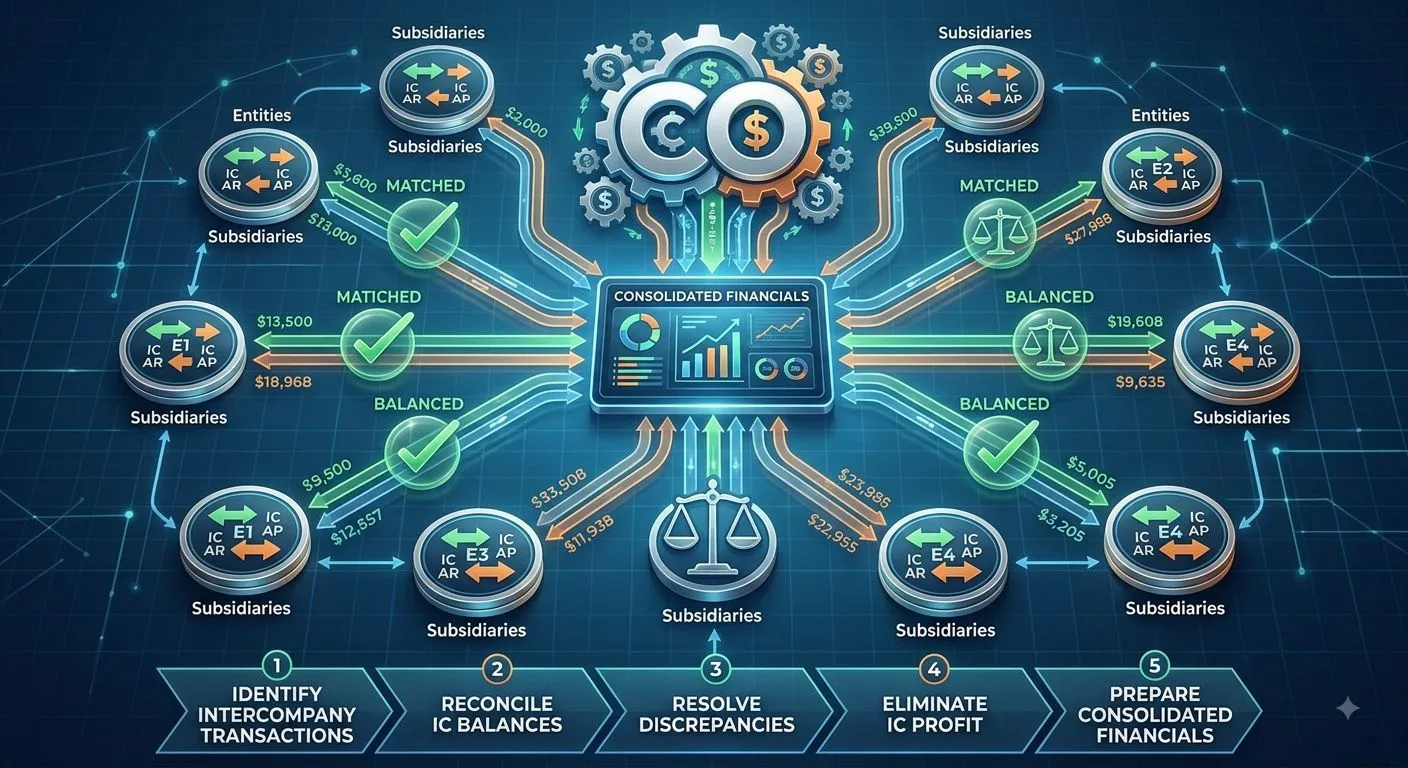
Intercompany accounts and clearing accounts
Organizations with multiple entities reconcile balances between related companies and temporary clearing accounts.
When Finance Teams Should Reconcile Accounts
The timing of reconciliation depends on transaction volume and account risk.
Daily reconciliation for high-volume transactions
Cash-intensive accounts may require daily monitoring.
Weekly reconciliation for operational accounts
Operational accounts often benefit from weekly review cycles.
Month-end reconciliation before financial close
Most account reconciliations are completed before month-end reporting.
Quarter-end and year-end reconciliation requirements
Additional review is typically performed during major reporting periods.
Information Needed Before Starting Account Reconciliation
Preparation is one of the most important parts of the process.
General ledger balances
The general ledger provides the official account balance being reviewed.
Supporting schedules and account reports
Schedules provide detailed activity supporting the balance.
Source documents and transaction records
Invoices, receipts, statements, contracts, and reports help validate transactions.
Prior-period reconciliation records
Previous reconciliations provide context for recurring items.
Approval and adjustment documentation
Any prior corrections should be properly approved and documented.
Step 1: Identify the Account and Reporting Period
Every reconciliation begins with defining the scope.
Confirm account ownership and responsibility
Assign responsibility for reviewing and approving the account.
Define the reconciliation period
Determine whether the reconciliation covers a month, quarter, or year.
Verify opening and closing balances
Confirm that balances agree with the reporting period being reviewed.
Once the account is defined, supporting records can be collected.
Step 2: Gather Supporting Records
Collect all documents needed to support the account balance.
Collect statements, schedules, and transaction reports
Gather relevant reports from finance systems and external sources.
Review source documents supporting account activity
Validate invoices, receipts, contracts, and statements.
Confirm data completeness before analysis
Missing records can lead to incorrect conclusions during reconciliation.
With supporting data available, balances can now be compared.
Step 3: Compare Account Balances Against Supporting Records
This stage identifies whether differences exist.
Match balances to schedules and reports
Compare ledger balances with supporting schedules and source records.
Identify differences between records
Any mismatch should be documented for review.
Separate explained and unexplained variances
Known timing differences should be separated from unexplained discrepancies.
After differences are identified, investigation begins.
Step 4: Investigate Reconciliation Differences
Understanding why a discrepancy exists is the core of reconciliation.
Review missing transactions
Determine whether transactions were omitted from records.
Check duplicate entries and duplicate postings
Duplicate activity can overstate balances.
Validate account classifications and coding
Incorrect coding can place transactions in the wrong account.
Review timing-related differences
Settlement delays and reporting cut-offs often create temporary differences.
After investigation, findings must be documented.
Step 5: Document and Resolve Exceptions
Every discrepancy should have a documented explanation.
Record findings for each discrepancy
Maintain records explaining each identified difference.
Obtain supporting evidence for corrections
Supporting documents should validate any proposed correction.
Escalate unresolved items when necessary
Material differences may require management review.
Once exceptions are approved, adjustments can be posted.
Step 6: Post Approved Adjustments
Corrections should follow established approval procedures.
Create correcting journal entries
Adjust balances where errors have been confirmed.
Validate approval requirements
Ensure corrections meet internal approval policies.
Update supporting schedules after adjustments
Schedules should reflect the revised balance.
The final step confirms that reconciliation objectives have been achieved.
Step 7: Verify Final Reconciled Balance
The account should now agree with supporting records.
Confirm account balance matches supporting records
The reconciled balance should align with validated documentation.
Review outstanding items remaining open
Any unresolved items should be documented and tracked.
Validate reconciliation completeness
Confirm that all reconciliation procedures have been completed.
Step-by-Step Account Reconciliation Example
The following example demonstrates the process in practice.
Example scenario and account balance
Assume a cash account shows a general ledger balance of $100,000 at month-end. Supporting bank records show a balance of $97,500.
Identification of reconciliation differences
The review identifies:
- Deposit in transit: $3,000
- Outstanding payment: $500
Investigation and adjustment process
The deposit was recorded internally but had not yet appeared in the bank statement. The payment had been issued but not yet cleared.
Both items were supported by documentation, so no correcting entry was required.
Final reconciled balance calculation
Bank balance: $97,500
Plus deposit in transit: $3,000
Less outstanding payment: $500
Adjusted balance: $100,000
The adjusted balance matches the ledger balance, meaning the account is reconciled.
A useful way to validate that all reconciliation steps have been completed is to follow an Account Reconciliation Review Checklist before final approval.
Common Reconciliation Differences Explained
Reconciliation differences usually fall into a few common categories.
Missing transactions
A transaction may appear in one record but not another because it was not posted, imported, or recorded on time.
Duplicate transactions
Duplicate entries can overstate balances and create false account activity.
Timing differences
Timing differences occur when a transaction is recorded in one period or system before it appears in another.
Incorrect account postings
Transactions may be posted to the wrong account, cost center, or entity.
Unsupported adjustments
Adjustments without approval or evidence should be reviewed before the account is signed off.
How to Handle Outstanding Reconciliation Items
Outstanding items should be tracked until they are resolved.
Items awaiting supporting documentation
Assign ownership and due dates for missing invoices, statements, approvals, or receipts.
Transactions pending settlement
Keep settlement-related items open until bank, vendor, customer, or payroll records confirm completion.
Open exceptions carried into the next period
Carry-forward items should include explanations, owners, and expected resolution dates.
Escalation procedures for aging discrepancies
Older or high-value items should be escalated for management review.
Reconciliation Controls That Improve Accuracy
Controls help finance teams make reconciliation consistent.
Segregation of duties
The person preparing the reconciliation should not be the only reviewer or approver.
Review and approval checkpoints
Reconciliations should pass through documented review before close.
Standardized reconciliation templates
Standard templates help teams apply consistent checks across accounts.
Documentation requirements for audit readiness
Each reconciliation should include source records, explanations, approvals, and open-item notes.
Common Mistakes to Avoid During Account Reconciliation
Avoiding common errors improves reconciliation quality.
Relying on balances without supporting evidence
A matching balance is not enough if there is no support behind it.
Ignoring small recurring differences
Small recurring differences can indicate larger process issues.
Posting adjustments without approval
Every adjustment should have a clear reason and approval.
Leaving open items unresolved across periods
Unresolved items should not remain open without owner tracking.
How Account Reconciliation Supports Month-End Close
Account reconciliation improves close quality by confirming account accuracy before reports are finalized.
Validation of account balances before reporting
Finance teams can confirm balances before financial statements are prepared.
Reduction of close-related corrections
Fewer unresolved differences mean fewer late corrections.
Faster review and approval processes
Clear documentation helps reviewers approve reconciliations faster.
Improved confidence in reported numbers
Reconciled accounts give finance leaders more confidence in period-end results.
How Account Reconciliation Supports Audit Readiness
Audit readiness depends on clear records and traceable balances.
Creation of a clear audit trail
Reconciliation creates a link between reported balances and source records.
Evidence supporting reported balances
Invoices, schedules, statements, and approvals support account accuracy.
Documentation of adjustments and corrections
Corrections should show what changed, why it changed, and who approved it.
Reduced audit queries and follow-up requests
Well-supported reconciliations reduce audit back-and-forth.
Why Spreadsheet-Based Reconciliation Creates Challenges
Spreadsheets become harder to manage as account volume grows.
Version-control issues
Different team members may work from different file versions.
Formula and manual-entry errors
Manual formulas and copied data can create errors.
Limited visibility into reconciliation status
It becomes difficult to see which accounts are complete, open, or overdue.
Difficulty maintaining supporting evidence
Evidence may be spread across folders, emails, and attachments.
Metrics That Measure Reconciliation Effectiveness
Metrics help finance leaders understand reconciliation quality.
Number of unresolved discrepancies
A high number of open items shows process risk.
Aging of open reconciliation items
Older items need faster review and escalation.
Percentage of accounts reconciled on time
This shows whether teams are meeting close deadlines.
Frequency of manual adjustments
Frequent adjustments may indicate weak upstream records.
Close delays linked to reconciliation issues
Close delays show where reconciliation problems affect reporting timelines.
How Automation Improves Account Reconciliation
Automation helps finance teams reduce manual work and improve exception visibility.
Automated matching of balances and transactions
Automation compares balances, transactions, schedules, and source records faster than manual review.
Continuous validation of account activity
Accounts can be checked throughout the period instead of only at month-end.
Real-time visibility into exceptions
Finance teams can see unresolved items, owners, and aging in one place.
Centralized management of supporting documentation
An account reconciliation software helps centralize matching, documentation, approvals, audit trails, and exception tracking.
What High-Performing Finance Teams Do Differently
High-performing teams treat reconciliation as an ongoing finance process.
Reconcile accounts throughout the reporting period
They review high-risk accounts before close pressure begins.
Assign clear ownership for each account
Each account has a preparer, reviewer, and escalation owner.
Monitor exceptions before close deadlines
Open items are reviewed before reporting deadlines.
Review recurring discrepancies for root-cause resolution
Recurring issues are corrected at the process level.
Future Direction of Account Reconciliation
Account reconciliation is moving toward continuous validation and better exception visibility.
AI-assisted identification of unusual transactions
AI can help identify unusual postings, duplicates, and high-risk balances.
Predictive detection of reconciliation risks
Predictive checks can flag accounts likely to delay close.
Continuous reconciliation across finance systems
Continuous reconciliation reduces period-end pressure.
Real-time account validation supported by intelligent matching logic
The future of reconciliation depends on connected records, faster matching, and real-time visibility into account accuracy.























Sign in to leave a comment.