

Learning music can seem intimidating when you're starting from scratch. You may wonder which instrument to choose, whether you need to read music, how often you should practice, or whether you're simply too old to begin.
The good news is that there is no single correct way to start learning music.
Children, teenagers, college students, working professionals, and older adults can all develop musical skills with the right approach. The key is to choose an instrument that interests you, find instruction that matches your goals, and create a realistic practice routine.
Whether you want to play your favorite songs, perform for others, develop a new hobby, or simply understand music better, this guide explains how to begin.
1. Decide Why You Want to Learn Music
Before choosing an instrument or signing up for lessons, think about what you actually want to achieve.
Your reason for learning can influence almost every other decision.
For example, you might want to:
- Play songs you enjoy
- Learn a new hobby
- Perform for friends or family
- Join a band
- Develop better musical skills
- Prepare for examinations
- Improve singing or vocal technique
- Explore songwriting or composition
- Build confidence
- Return to an instrument you played years ago
There is no wrong reason.
Someone learning piano for relaxation may need a very different lesson structure from a teenager preparing for a performance. Similarly, an adult learning guitar after work may prefer a flexible schedule rather than an intensive program.
Knowing your goal helps you choose the right learning path.
2. Choose an Instrument That Interests You
One of the biggest beginner mistakes is choosing an instrument simply because someone else recommends it.
Interest matters.
If you are genuinely excited about an instrument, you're more likely to practice consistently and continue learning when the early stages become challenging.
Piano
Piano is a popular starting point because the layout makes it relatively easy to visualize musical notes, scales, chords, and harmony.
Beginners can gradually learn:
- Notes and basic music theory
- Scales
- Chords
- Rhythm
- Sight-reading
- Hand coordination
- Songs and repertoire
Piano can also provide a useful foundation for students who later become interested in composition, arranging, or other instruments.
Guitar
Guitar is particularly appealing to people who want to accompany songs.
Beginners commonly start with:
- Basic chords
- Strumming patterns
- Chord transitions
- Simple melodies
- Rhythm
- Scales
- Favorite songs
As skills develop, guitar players can explore acoustic, classical, blues, rock, jazz, pop, and other styles.
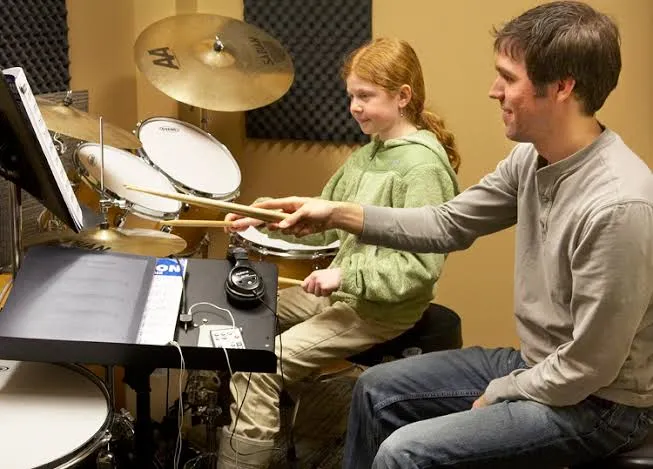
Drums
If rhythm and energetic performance appeal to you, drums may be a natural choice.
Drumming develops timing, coordination, listening skills, and rhythmic awareness. Beginners can start with basic beats before gradually learning fills, independence, dynamics, and more complex patterns.
Singing
Your voice is an instrument you already have, which makes singing an accessible starting point.
Voice lessons can help students develop:
- Pitch
- Breathing
- Vocal control
- Tone
- Range
- Musical expression
- Performance confidence
Singing can also complement another instrument.
Violin
Violin offers a different learning experience because beginners need to develop intonation, bow control, posture, and coordination.
It can be especially rewarding for students who enjoy classical music, orchestral playing, folk music, or other styles that use string instruments.
3. Don't Worry About Being "Too Old" to Learn
A common misconception is that music lessons are mainly for children.
Adults can learn instruments too.
An adult beginner may actually bring useful advantages to the learning process, including stronger self-awareness, clearer goals, and the ability to understand why particular exercises matter.
The learning process may be different for every age group, but the basic principle remains the same:
Consistent practice is more important than starting at a particular age.
You don't need to become a professional musician for learning an instrument to be worthwhile.
Even a few months of structured learning can help you understand rhythm, melody, technique, and musical expression in ways that make listening to and creating music more enjoyable.
4. Decide Between Self-Learning and Professional Lessons
Today, beginners have access to thousands of videos, tutorials, apps, online courses, and music websites.
These resources can be useful.
However, self-learning can also create challenges.
A beginner may unknowingly develop poor posture, incorrect finger placement, inefficient technique, or timing problems. Without feedback, it can be difficult to know whether you're practicing correctly.
Professional instruction provides another layer of support.
A teacher can:
- Demonstrate techniques
- Identify mistakes
- Adjust exercises
- Answer questions
- Adapt lessons to your ability
- Introduce appropriate songs
- Track progress
- Help establish realistic goals
This doesn't mean every learner needs formal lessons forever. Some students eventually become comfortable combining teacher guidance with independent practice.
The important thing is having reliable feedback during the stages where you're building fundamental skills.
5. Find a Teacher Who Matches Your Learning Style
A teacher's musical ability is important, but teaching ability matters too.
Different students respond to different approaches.
Some prefer detailed explanations. Others learn best through demonstrations. Some students want structured exercises, while others become more motivated when lessons involve songs they already know.
Before choosing a teacher, consider:
Experience
Does the teacher regularly work with beginners?
Age group
If the student is a child, does the teacher have experience teaching children?
Musical style
Does the teacher understand the genres the student wants to explore?
Teaching approach
Are lessons adapted to individual students?
Scheduling
Can lessons fit comfortably into the student's weekly routine?
Learning goals
Can the teacher help with the student's specific objectives?
The right teacher doesn't have to teach every style or suit every learner. What matters is finding an appropriate match.
6. Set Realistic Expectations
Learning an instrument takes time.
One of the easiest ways to become frustrated is to expect professional-level results after a few weeks.
Beginners usually need time to develop coordination, muscle memory, listening skills, rhythm, technique, and confidence.
Instead of asking:
"How quickly can I become good?"
ask:
"What can I improve this week?"
That shift can make the learning process much more manageable.
Your first goals might be as simple as:
- Learning five chords
- Playing one short song
- Reading a few notes
- Maintaining a basic rhythm
- Singing a melody accurately
- Playing a simple scale
- Practicing for ten minutes consistently
Small improvements accumulate.
7. Create a Practice Routine You Can Actually Maintain
You don't necessarily need hours of practice every day.
Consistency is often more useful than occasional marathon sessions.
A beginner might start with a short routine such as:
5 minutes: Warm-up
10 minutes: Technique
10 minutes: Review previous material
10 minutes: Work on a song
5 minutes: Play something enjoyable
The exact structure can change depending on the instrument and level.
The important thing is to create a routine that fits your lifestyle.
If practicing for an hour feels impossible after work or school, start with 15–20 minutes.
A manageable routine is easier to maintain than an ambitious schedule that quickly becomes stressful.
8. Practice the Difficult Parts Separately
Many beginners simply play a song from beginning to end repeatedly.
That can be enjoyable, but it isn't always the most efficient way to improve.
Instead, identify the section that causes problems.
For example, a guitarist might struggle with a chord transition. A pianist may have difficulty coordinating both hands. A drummer may lose timing during a particular fill.
Isolate that section.
Practice it slowly.
Repeat it several times.
Then gradually increase the speed.
This approach helps turn a vague problem into a specific skill that can be improved.
9. Use Songs to Stay Motivated
Technical exercises are important, but beginners also need opportunities to make music.
Learning songs can provide a sense of progress.
Choose music that is:
- Interesting to you
- Appropriate for your current level
- Slightly challenging
- Enjoyable to practice
Don't worry if the song isn't technically impressive.
Playing a simple song successfully can be much more motivating than struggling through advanced material simply because it looks impressive.
As your skills improve, you can gradually increase the difficulty.
10. Learn the Basics of Music Theory
You don't need to become a music theory expert before playing an instrument.
However, basic theory can make learning easier.
Depending on the instrument, useful concepts may include:
- Musical notes
- Rhythm
- Time signatures
- Scales
- Chords
- Keys
- Intervals
- Tempo
- Dynamics
Understanding these concepts can help you communicate with teachers and musicians and make sense of what you're playing.
Theory becomes much easier when you connect it to actual music.
For example, learning a chord on guitar is more meaningful when you understand how that chord functions within a song.
11. Consider Online and In-Person Lessons
Technology has changed how people learn music.
Online lessons can be convenient for students who prefer learning from home or have scheduling limitations.
In-person lessons provide face-to-face interaction and direct physical demonstration, which some learners prefer.
Neither format automatically works for every student.
Consider:
- Your schedule
- Your learning preferences
- Your available equipment
- Your internet connection
- Your age and experience
- The type of instrument
- The teacher's approach
For students in Toronto, schools such as Greater Toronto Music School offer multiple learning formats and instruction across instruments, giving beginners different ways to structure their musical education.
12. Make Learning Music Enjoyable
Progress matters, but enjoyment matters too.
If every practice session feels like an examination, motivation can disappear.
Give yourself permission to explore.
Try different songs.
Listen to unfamiliar artists.
Experiment with rhythms.
Improvise.
Play with another musician.
Record yourself occasionally.
Perform for a family member if you're comfortable doing so.
Music is not only about technical accuracy. It is also about creativity, communication, emotion, and personal expression.
13. Common Beginner Mistakes to Avoid
Trying to learn everything at once
Focus on a few foundational skills instead of jumping between too many techniques.
Practicing only when you feel motivated
A simple routine is usually more reliable than waiting for inspiration.
Comparing yourself with advanced musicians
Someone who has practiced for ten years should not be your benchmark when you've been learning for ten weeks.
Ignoring technique
Correct technique can help prevent inefficient habits from becoming difficult to change later.
Choosing music that is too difficult
Challenge is useful, but material far beyond your current ability can become discouraging.
Never reviewing old material
Repetition helps reinforce skills and reveals whether something has actually become comfortable.
14. When Should You Start Music Lessons?
There is no perfect age or perfect month to begin.
If you have been thinking about learning an instrument for a while, starting with a beginner-friendly lesson can help you understand what the process actually involves.
For parents, an introductory lesson can also help reveal whether a child enjoys the instrument before committing to a long-term schedule.
Adults can take the same approach.
You don't need to know how to read music before your first lesson. You don't need expensive equipment. And you don't need to arrive with years of musical knowledge.
You simply need an interest in learning.
15. Choosing a Music School or Teacher in Toronto
Toronto has a wide range of options for music education, from private instructors and specialized studios to larger music schools.
When comparing options, look beyond advertising claims.
Consider:
- Teacher qualifications and experience
- Instruments offered
- Beginner programs
- Lesson formats
- Scheduling flexibility
- Age groups served
- Teaching environment
- Student goals
- Trial or introductory lesson options
- Reviews and independent feedback
Greater Toronto Music School is one option for students looking for music instruction across instruments such as piano, guitar, drums, singing, and violin.
The most important consideration is whether the program fits the learner's goals, schedule, interests, and preferred learning style.
Frequently Asked Questions
Can I learn an instrument if I have no musical experience?
Yes. Beginners can start with no previous experience. A structured learning approach can introduce the basics gradually.
How long does it take to learn an instrument?
It depends on the instrument, your goals, practice frequency, previous experience, and the complexity of the music you want to play. Basic skills can develop relatively quickly, while advanced ability requires longer-term practice.
How often should beginners practice?
A short, consistent routine is often easier to maintain than occasional long sessions. Your teacher can help create a practice schedule appropriate for your level.
Is it better to learn music online or in person?
Both formats have advantages. The right choice depends on your schedule, learning preferences, instrument, technology, and access to a suitable teacher.
Can adults take beginner music lessons?
Absolutely. Adults can begin learning piano, guitar, drums, singing, violin, and other instruments at any stage of life.
Do I need to learn music theory first?
No. Theory can be introduced alongside practical playing. Many beginners understand theory more easily when they can immediately connect it to an instrument or song.
Final Thoughts
Starting music lessons doesn't require you to be naturally gifted or already understand musical notation.
Start with curiosity.
Choose an instrument that genuinely interests you, find instruction that matches your learning style, establish a realistic practice routine, and give yourself enough time to develop.
Most importantly, don't measure your musical journey against someone else's.
Your first goal doesn't have to be becoming an exceptional musician. It can simply be learning your first song, playing your first chord, keeping your first steady rhythm, or singing a melody with confidence.
Every experienced musician was once a beginner.
The most important step is deciding to begin.






















Sign in to leave a comment.