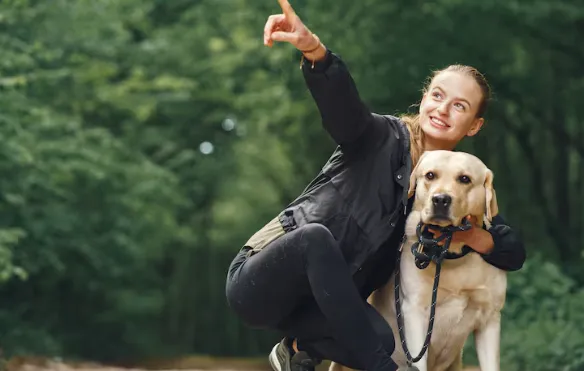
A high-energy dog can look like pure enthusiasm at first. The tail never stops. The paws bounce. The dog seems ready for action the second a door opens, a leash moves, or a guest arrives. That is where many owners misread the problem. The dog is not always “naughty” or “stubborn.”
Often, the dog is under-guided, over-stimulated, and missing the calm routines that make good behavior easier to repeat. Humane, reward-based training works best when it teaches the dog what to do, keeps the dog feeling safe, and builds calm as a real skill rather than hoping it appears by accident.
Key Takeaways
- Calm is trained, not hoped for.
- Exercise helps, but over-arousal can backfire.
- A reward-based structure builds obedience faster than pressure.
- The best results come from a simple system: outlet, skill, and consistency.
What Calm Really Means
A calm, obedient dog is not a sleepy dog. It is a dog that can settle, recover from excitement, and still make good choices when life gets noisy. That usually starts with two things: controlled physical outlet and clear behavior teaching. VCA notes that calm behaviors, like settling in the house, are learned through practice, not magic.
The quote that fits this mindset is short and honest: “Fear is the enemy of learning,” as Karen Pryor put it. That idea matters here because dogs learn best when the training environment feels safe, not chaotic.
Why More Chaos Is Not More Exercise
Many owners try to burn off energy with more and more stimulation. But some play styles make a dog harder to settle, not easier. VCA warns that play should avoid excessive arousal because some dogs struggle to wind down once excitement spikes. It also recommends using walks, sniffing, and structured games that build control instead of just intensity.
The number that matters most is simple: the AVMA says dogs should have at least 30 minutes of physical activity per day. That is a baseline, not a finish line, and it works best when the movement is calm, purposeful, and matched to the dog’s age and condition.
The 3-Part Calm Method
The strongest training plans usually follow the same pattern.
Give The Dog The Right Outlet
Walking, sniffing, search games, and safe play all help release energy without pushing the dog into a frenzy. VCA specifically recommends walks, search-and-find games, and controlled games that avoid roughness and constant chasing.
Teach A Calm Behavior On Cue
“Go to place,” “settle,” and quiet mat work give the dog a job that is incompatible with spinning, barking, or pacing. VCA describes go-to-mat work as a useful skill for helping dogs settle when guests arrive or when a pause is needed.
Reward The Right Emotional State
AVSAB recommends reward-based methods and says management strategies matter in every behavior plan. In plain language: the dog should be set up to win, then rewarded for choosing the behavior that will be repeated later.
A Simple Four-Step Reset
- Lower household excitement before training.
- Start with a calm walk or sniff break.
- Ask for one small behavior, like eye contact or a sit.
- Reward calm instantly and end while the dog is still successful.
What To Teach First
If a dog cannot settle, obedience becomes fragile. That is why the first wins should be small and repeatable: eye contact, loose-leash walking, a short stay, and a mat cue. VCA emphasizes that dogs should be trained with positive reinforcement and that the goal is to help the dog learn while keeping the process engaging.
A good rule of thumb is to teach the dog how to succeed before asking for longer or harder behavior. In practice, that means a dog is not dragged into a stressful environment and expected to “figure it out.” The environment is adjusted first, then the behavior is built.
| Practice | When It Helps Most | A Simple Cue | Common Mistake |
| Sniff walk | When the dog arrives home, wound up | “Let’s go sniff.” | Turning every walk into a march |
| Go to mat | When guests, food, or noise raise arousal | “Place” | Waiting until the dog is already frantic |
| Calm handling | When touch makes the dog squirm or escalate | Slow touch, treat, release | Holding on too long too soon |
| Desensitization | When specific triggers set the dog off | Low-level exposure | Moving too fast and triggering stress |
What Most Owners Get Wrong
The biggest mistake is confusing exhaustion with training. A dog can be physically tired and still be mentally unmanaged. Another common mistake is using harsh corrections and hoping pressure will produce calm. AVSAB’s position is clear: reward-based training is recommended for dog training and behavior modification, and fear-heavy approaches work against learning.
A better approach is to watch the dog’s body language. If the dog is panting hard, spinning, snapping into motion, or struggling to disengage, the session is too much. VCA recommends backing off, lowering intensity, and building calm more gradually.
A Realistic Family Scenario
Picture a large, bright dog that greets every visitor like a parade has just entered the house. The owners keep adding more fetch, more excitement, and more correction. The dog gets fitter, but not calmer.
Then the routine changes. Walks become sniff-heavy and structured. A mat gets introduced near the front door. The family starts rewarding eye contact and quiet pauses instead of only rewarding bursts of excitement. Within that structure, the dog is still energetic, but the energy has somewhere to go. That is the difference between a dog that merely burns energy and a dog that learns self-control.
The Last Thing That Matters
The goal is not to erase a dog’s personality. It is to shape it. High-energy dogs often become wonderful companions when they are given exercise, clarity, and a calm routine they can actually understand.
For owners who want a premium path to behavior correction, board-and-train guidance, or a fully trained dog, brands like Canine Behavior Institute offer the kind of specialized help worth considering.
FAQ
- What makes a good training plan for a high-energy dog?
A good plan mixes exercise, calm practice, and reward-based teaching.
- What are the best practices for calm behavior?
Use sniff walks, place training, and short sessions that reward quiet choices.
- When should a professional be hired?
When the dog cannot settle, escalates fast, or the behavior feels unsafe or unmanageable.
- What does CBI focus on for calm, obedient dogs?
CBI’s kind of premium training fits owners who want structured behavior change and stronger everyday control.
- How does CBI support fully trained dogs?
It aligns with the kind of guided, reward-based work that produces steadier real-world behavior.


























Sign in to leave a comment.