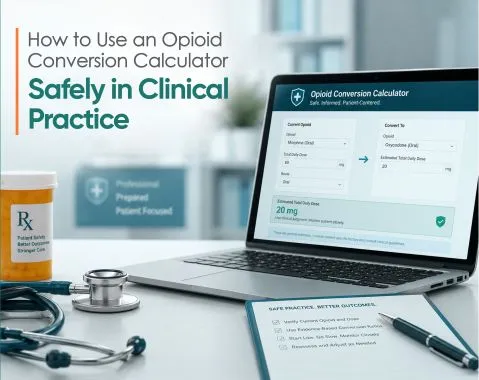

Managing severe or chronic pain requires meticulous clinical accuracy, especially when transitioning a patient from one analgesic medication to another. Because different opioids vary significantly in potency, route of administration, and duration of action, switching drugs without precise mathematical calibration can lead to under-treating pain or triggering dangerous overdose events.
This is where an opioid conversion calculator becomes an indispensable tool in modern medical care.
In this comprehensive 2026 guide, you will learn what an opioid conversion tool is, how to calculate Morphine Milligram Equivalents (MME), step-by-step instructions for performing safe equianalgesic conversions, and critical precautions every clinician must take.
What is an Opioid Conversion Calculator?
An opioid conversion calculator (or equianalgesic calculator) is a specialized clinical decision-support tool used by physicians, pharmacists, and pain specialists to convert the dosage of one opioid medication to an equivalent dose of a different opioid or a different route of administration (e.g., oral to intravenous).
You can Use Opioid Conversion Calculator at MedTree Platform
These tools rely on standardized equianalgesic conversion factors to determine a baseline equivalent dose most commonly expressed as Morphine Milligram Equivalents (MME) per day. MME serves as a universal currency for measuring opioid potency, helping clinicians assess overall overdose risk and navigate medication rotations safely.
Why Is Opioid Dose Conversion Necessary in Pain Management?
There are several clinical scenarios where rotating a patient’s pain medication is necessary:
- Inadequate Pain Control: The patient has developed a tolerance to their current medication, resulting in diminished pain relief despite dose escalation.
- Intolerable Side Effects: Severe nausea, sedation, constipation, or neurotoxicity (e.g., myoclonus) occurs with a specific drug.
- Route Changes: The patient can no longer swallow oral tablets (e.g., due to dysphagia) and requires a transdermal patch, sublingual liquid, or intravenous (IV) formulation.
- Formulary or Cost Constraints: Hospital, hospice, or insurance formulary changes require switching to a more accessible or cost-effective alternative.
Key Terms to Understand Before Calculating
Before inputting numbers into an opioid calculator, it is essential to understand the core pharmacodynamic concepts:
- Morphine Milligram Equivalent (MME): The standard value used to compare different opioids against oral morphine. For example, oral oxycodone is generally considered 1.5 times as potent as oral morphine (1 mg oxycodone = 1.5 MME).
- Equianalgesic Dose: The dose of two different opioids that produces approximately the same level of pain relief.
- Cross-Tolerance: The phenomenon where tolerance to one opioid confers partial tolerance to others.
- Incomplete Cross-Tolerance: A critical safety principle recognizing that because patients do not have full cross-tolerance across different opioids, the calculated target dose must usually be reduced by 25% to 50% to prevent accidental overdose.
Step-by-Step Guide: How to Use an Opioid Conversion Calculator?
Using a digital opioid calculator streamlines complex mathematical equations, but clinicians must still verify inputs and clinical context manually. Here is the standard protocol:
Step 1: Determine the Total Daily Dose of the Current Opioid
Calculate the complete 24-hour baseline intake of the current drug, including both scheduled doses and any breakthrough/PRN (as-needed) doses taken regularly over the past 24 to 48 hours.
- Example: A patient takes Oxycodone Extended-Release 20 mg twice daily plus Oxycodone Immediate-Release 5 mg three times daily.
- Total Daily Oxycodone Intake: $(20 \times 2) + (5 \times 3) = 55\text{ mg/day}$.
Step 2: Convert to Baseline MME
Multiply the total daily dose by the specific drug's MME conversion factor.
- Oxycodone MME Factor: $1.5$
- Calculation: $55\text{ mg Oxycodone} \times 1.5 = 82.5\text{ MME/day}$.
Step 3: Convert MME to the New Target Opioid
Select the target drug and divide the daily MME by the target drug's conversion factor (or multiply by its equianalgesic ratio).
Step 4: Apply Safety Reductions for Incomplete Cross-Tolerance
Because the body reacts differently to distinct opioid molecules, always reduce the calculated dose by 25% to 50% when switching to a new agent in a stable patient to prevent unintended respiratory depression.
Step 5: Establish the New Dosing Schedule
Divide the final adjusted daily target dose into appropriate intervals based on the new drug's half-life (e.g., every 4 hours or every 12 hours), and formulate a separate breakthrough pain plan (typically 10% to 15% of the total daily dose as needed).
Common MME Conversion Rates (Quick Reference)
| Opioid (Oral) | Conversion Factor (Multiplier to MME) | Example: 30 mg Oral Dose in MME |
| Morphine | 1.0 | 30 MME |
| Codeine | 0.15 | 4.5 MME |
| Hydrocodone | 1.0 | 30 MME |
| Oxycodone | 1.5 | 45 MME |
| Hydromorphone | 4.0 | 120 MME |
| Tapentadol | 0.4 | 12 MME |
| Fentanyl Transdermal | Variable (Mcg/hr to MME calculation) | Requires specialized clinical tables |
Critical Safety Note: Methadone and transdermal Fentanyl do not follow simple linear conversion factors. Methadone's conversion ratio varies non-linearly depending on the starting dose due to its long half-life and accumulation. Methadone and Fentanyl conversions should only be calculated using specialized protocols or under the supervision of a certified pain management expert.
Frequently Asked Questions
What is a safe MME threshold for chronic pain?
Clinical practice guidelines, including those from the CDC, advise exercising heightened caution when escalating doses above 50 MME/day, and generally avoiding or carefully justifying doses exceeding 90 MME/day due to exponential increases in overdose and respiratory depression risks.
Why do digital calculators reduce doses automatically?
Many modern digital opioid calculators offer built-in cross-tolerance reduction toggles (e.g., 25% or 50%). They include this feature because failing to account for incomplete cross-tolerance is one of the leading causes of accidental opioid toxicity during medication rotation.
Can I use an opioid calculator for methadone or buprenorphine?
Standard online calculators should be used with extreme caution for methadone and buprenorphine. Methadone has complex, non-linear pharmacokinetics, while buprenorphine is a partial mu-opioid agonist with a high binding affinity that can precipitate withdrawal if introduced incorrectly. Always use dedicated, specialized clinical guidance for these substances.
What should I do if a patient has renal or liver impairment?
Opioid metabolites are primarily excreted by the kidneys and metabolized by the liver. In patients with renal failure (e.g., reduced eGFR) or hepatic dysfunction, standard conversion doses must be further reduced, dosing intervals prolonged, or specific safer agents chosen (such as Fentanyl or Buprenorphine over Morphine/Codeine).
Conclusion
An opioid conversion calculator provides vital mathematical precision when managing complex pain regimens. By translating different formulations into Morphine Milligram Equivalents (MME) and applying crucial safety adjustments for incomplete cross-tolerance, healthcare professionals can navigate drug rotations with diagnostic confidence.
























Sign in to leave a comment.