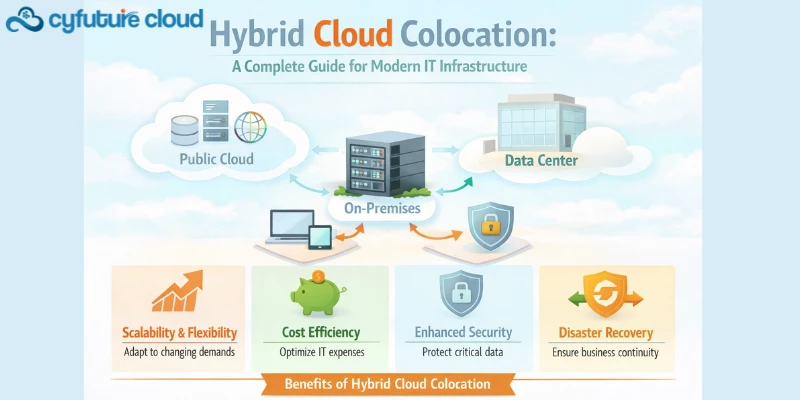

As businesses continue to modernize their IT environments, flexibility, security, and scalability have become top priorities. Traditional on-premises infrastructure alone often struggles to meet these demands, while fully public cloud models may raise concerns around compliance, control, and predictable costs. This is where hybrid cloud colocation has emerged as a reliable and balanced approach for organizations seeking performance and agility without compromising governance.
Understanding Hybrid Cloud Colocation
Hybrid cloud colocation combines private infrastructure hosted in a colocation data center with public and private cloud resources. In this model, businesses place their physical servers and networking equipment in a third-party colocation facility, while also integrating cloud platforms for scalable workloads. This setup allows organizations to manage sensitive or mission-critical applications on dedicated hardware, while using cloud services for flexibility and burst capacity.
Unlike traditional data centers, colocation facilities provide enterprise-grade power, cooling, physical security, and connectivity, enabling businesses to focus on applications and growth rather than infrastructure management.
Why Businesses Are Adopting Hybrid Cloud Colocation
The adoption of hybrid cloud colocation is driven by several practical business needs:
1. Flexibility and Scalability
Hybrid environments allow workloads to move between private infrastructure and cloud platforms based on performance, cost, or compliance requirements. Businesses can scale resources without over-investing in hardware.
2. Cost Optimization
Colocation reduces capital expenditure by eliminating the need to build and maintain private data centers. At the same time, hybrid cloud strategies help control cloud costs by keeping predictable workloads on dedicated infrastructure.
3. Improved Security and Compliance
Sensitive data can remain on private servers hosted in a secure colocation facility, helping organizations meet regulatory and data residency requirements while still benefiting from cloud innovation.
4. High Performance and Low Latency
By placing infrastructure closer to users and cloud on-ramps, hybrid cloud colocation improves application performance and ensures reliable connectivity.
Key Components of a Hybrid Cloud Colocation Strategy
To successfully implement hybrid cloud colocation, organizations must align several components:
- Colocation Infrastructure: Secure racks, redundant power, advanced cooling, and physical access controls form the foundation.
- Cloud Connectivity: Direct connections to public cloud providers enable seamless workload integration and data transfer.
- Network Architecture: Software-defined networking and private interconnects ensure smooth communication between environments.
- Management and Monitoring Tools: Unified visibility across on-premises and cloud resources simplifies operations and improves control.
Together, these components create a cohesive environment that supports both stability and innovation.
Use Cases Across Industries
Hybrid cloud colocation is not limited to a single sector. Its versatility makes it suitable for a wide range of industries:
- Enterprises use it to modernize legacy systems while gradually adopting cloud technologies.
- BFSI organizations rely on it to maintain strict compliance and security while leveraging cloud analytics and automation.
- E-commerce and SaaS providers benefit from scalable infrastructure that handles seasonal traffic spikes efficiently.
- Healthcare and education institutions use hybrid models to protect sensitive data while enabling digital services.
These use cases highlight how hybrid cloud colocation supports both operational continuity and digital transformation.
Business Benefits Beyond Infrastructure
Beyond technical advantages, hybrid cloud colocation also delivers strategic business benefits. It allows organizations to respond faster to market changes, improve disaster recovery capabilities, and reduce downtime risks. By distributing workloads across environments, businesses gain resilience and avoid single points of failure.
Additionally, this model supports future-ready IT strategies. As technologies like AI, IoT, and edge computing evolve, hybrid environments provide the adaptability needed to integrate new solutions without major disruptions.
Choosing the Right Colocation Partner
Selecting the right provider is critical for a successful hybrid cloud colocation deployment. Businesses should consider factors such as facility reliability, uptime guarantees, connectivity options, security standards, scalability, and local support. A trusted colocation partner acts as an extension of the IT team, enabling long-term growth and stability.
Location also plays an important role. Proximity to users, regional compliance needs, and network availability can significantly impact performance and operational efficiency.
The Role of Colocation Jaipur in Hybrid Strategies
Toward the end of a hybrid infrastructure journey, regional facilities are gaining importance. Colocation Jaipur is becoming a strategic choice for organizations looking to extend hybrid cloud colocation closer to emerging business hubs. With improved connectivity, growing demand for localized data hosting, and cost advantages, Colocation Jaipur supports businesses seeking reliable infrastructure outside traditional metro markets while maintaining integration with cloud platforms.























Sign in to leave a comment.