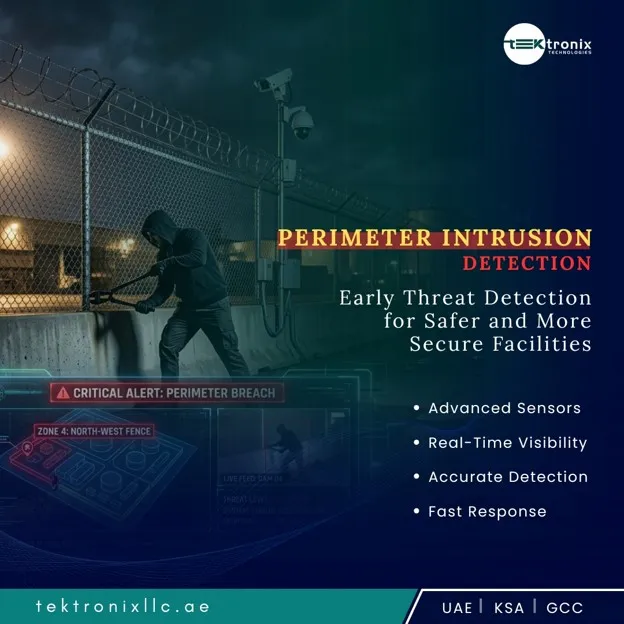

A robust Perimeter Intrusion Detection System is no longer an optional security upgrade for the UAE's residential enclaves — it is the foundational layer upon which every credible estate-security strategy must be built. As gated communities across Dubai, Abu Dhabi, and Sharjah scale rapidly in size and resident population, the threat landscape evolves in equal measure. Trespass, theft, vandalism, and unauthorised access incidents are rising in correlation with urban density, making a professionally engineered detection perimeter indispensable.
This article examines how to design, deploy, and operate a perimeter intrusion detection system in the UAE that genuinely protects residents, assets, and the community's reputation — while satisfying the regulatory expectations of local authorities.
Why Perimeter Security Is the First Line of Defence in UAE Residential Communities
Traditional security models that rely solely on guard patrols and CCTV monitoring are demonstrably reactive: by the time an officer or operator identifies a threat on camera, the intruder may already be inside the compound. A properly implemented perimeter-first philosophy detects, verifies, and triggers response before a breach is completed.
For UAE communities specifically, this matters for three reasons. First, the sheer physical scale of master-planned estates — some exceeding several square kilometres — makes human-patrol coverage mathematically inadequate without technology augmentation. Second, the UAE's premium residential market expects a security posture commensurate with the property's value. Third, authorities including Dubai Police and Abu Dhabi Police increasingly recommend electronic perimeter detection as a best-practice baseline for new residential developments.
The Sensor Ecosystem: Building a Layered Detection Architecture
A best-in-class perimeter detection deployment does not rely on a single sensor technology. Instead, it layers complementary detection mechanisms, each tuned to a specific threat vector and environmental condition. In the UAE's unique operating environment — characterised by extreme summer heat, windblown sand, salt-laden coastal air, and occasional flooding — sensor selection and weatherproofing are engineering-critical decisions.
1. Motion Sensors — Wide-Area Threat Detection
Motion sensors form the outer ring of the detection architecture. Passive Infrared (PIR) and microwave-based variants detect human movement across large open zones — boundary walls, landscaped buffer areas, and car parks. For UAE deployments, dual-technology motion sensors (PIR + microwave) are strongly recommended because they dramatically reduce false alarms triggered by the region's frequent sand-laden wind gusts and small animals. Long-range PIR curtain detectors mounted on boundary walls provide a cost-effective first-alert layer across extended perimeters, signalling the Video Management System (VMS) to direct PTZ camera attention to the precise zone activated.
2. Motion Detectors — Volumetric Zone Coverage
While motion sensors sweep extended linear boundaries, motion detectors provide volumetric three-dimensional coverage of enclosed or semi-enclosed zones — guard shelters, utility rooms, pump houses, substation enclosures, and community infrastructure buildings. Ceiling-mounted 360-degree PIR motion detectors with pet immunity features (essential where community cats and birds are prevalent) ensure that protected utility areas remain breach-proof without generating nuisance alerts that erode operator trust over time. Advanced models with anti-mask detection prevent tampering, a critical feature for high-value infrastructure protection.
3. Door and Window Sensors — Point-of-Entry Monitoring
Door and window sensors — magnetic contact switches — provide granular, deterministic detection at every discrete entry point. Every boundary gate (pedestrian and vehicular), utility room, plant room, pool enclosure, and clubhouse door become a monitored access point. In UAE community environments, surface-mount contacts rated to IP67 are specified as standard, given the humidity and dust ingress challenges. When integrated with the central intrusion alarm panel, any unauthorised opening during off-hours immediately triggers a zoned alert, enabling security staff to respond to the precise door rather than conducting a broad-area search.
4. Glass Break Sensors — Silent Entry Point Protection
Glass break sensors protect the silent but highly exploitable entry vectors in community amenity buildings: glazed facades on clubhouses, reception lobbies, retail kiosks, and large window panels on guard booths. Acoustic glass break detectors, tuned to the specific frequency signature of shattering safety and plate glass, trigger an alarm within milliseconds of impact — before a perpetrator can gain access. In UAE community architectures, where glass-intensive modern design is prevalent, a deployment without glass break sensors leaves a significant and widely exploited vulnerability gap. Shock sensor variants applied directly to glass panels provide an additional layer for ultra-high-value locations such as community management offices and cash-handling facilities.
5. The Central Intrusion Alarm Panel — Intelligence and Integration Hub
All sensor inputs converge at the central intrusion alarm panel — the intelligence hub that classifies, prioritises, and communicates every security event. Enterprise-grade panels deployed in UAE communities support hundreds of individually addressable zones, dual-path IP and GPRS communication (for network failover resilience), encrypted signalling to the Central Monitoring Station (CMS), and direct integration with access control, CCTV, and building management systems. Graded to EN 50131 Grade 3 (high-risk) as a minimum for UAE residential applications, these panels ensure that a compromised zone automatically notifies the guard post, the community manager's mobile, and the contracted monitoring centre simultaneously — eliminating the single-point human failure that undermines guard-only operations.
Perimeter Intrusion Detection System Dubai: Engineering for Scale and Smart City Integration
Deploying a Perimeter Intrusion Detection System in Dubai requires alignment with the Emirate's overarching smart infrastructure vision. Dubai Police's smart security initiative and the Dubai Municipality's construction and safety guidelines collectively shape specification requirements for new and retrofit installations. Leading communities in Mohammed Bin Rashid City, Palm Jumeirah, The Villa, and Damac Hills already operate fully integrated detection perimeters that feed event data directly into the community's Video Management System and, where applicable, to Dubai Police's Command and Control Centre via approved API protocols.
Tektronix LLC's perimeter intrusion detection deployments in Dubai are engineered to withstand the Emirate's extreme climatic conditions: IP66/IP67-rated field devices, UV-stabilised cable management, thermally managed control panels in ventilated enclosures, and fibre-optic backbone cabling where perimeter spans exceed 500 metres. Every deployment is designed with N+1 power redundancy, combining mains supply with UPS battery backup and optional solar supplementation for remote boundary pillars.
Perimeter Intrusion Detection System Abu Dhabi: Island Communities and Compound Complexity
Abu Dhabi's island communities — Saadiyat, Yas, Al Reem, and Al Maryah — present perimeter detection challenges unique to coastal geographies: salt-laden air accelerates sensor corrosion, tidal variation affects buried cable routes, and high ambient temperatures push device operating limits. A Perimeter Intrusion Detection System in Abu Dhabi must therefore be specified to NEMA 4X or IP68 enclosure standards in exposed waterfront zones, with marine-grade stainless steel fixings throughout.
For the large compound-style communities in Khalifa City, Al Mushrif, and Mohammed Bin Zayed City — where villa plots border semi-public roads — virtual fence technology using thermal and long-wave infrared cameras combined with AI-based video analytics delivers a detection layer that conventional sensor wiring cannot economically span. Tektronix LLC's Abu Dhabi engineering team has successfully deployed hybrid sensor-video analytics perimeters for Aldar Properties, IMKAN, and government housing authority communities across the capital.
Perimeter Intrusion Detection System UAE: National Best Practices and Standards
Across the UAE's seven Emirates, the adoption of electronic perimeter detection is being accelerated by a convergence of regulatory guidance and insurance-market incentives. A Perimeter Intrusion Detection System across the UAE should be designed and installed in accordance with the following standards framework:
- EN 50131 Series — European Standard for Alarm Systems, widely adopted by UAE authorities for intrusion detection grading
- IEC 62599 — International standard for alarm systems used in security applications
- Dubai Civil Defence (DCD) requirements for fire and security system integration
- Abu Dhabi Department of Municipalities and Transport (DMT) building safety code alignment
- UAE National Media Council and Telecommunications and Digital Government Regulatory Authority (TDRA) data-handling requirements for connected security devices
Property insurers operating in the UAE — including RSA, AXA/GIG, and Oman Insurance — now offer meaningful premium reductions (typically 8–15%) for residential communities that can demonstrate a certified, monitored intrusion detection perimeter, providing a compelling financial case alongside the security benefits.
Implementation Methodology: From Site Survey to Operational Handover
Tektronix LLC implements perimeter intrusion detection projects through a structured five-phase methodology proven across UAE community deployments, delivered by our certified intrusion detection and alarm engineering team:
- Security Risk Assessment — Threat modelling, perimeter vulnerability mapping, and existing system audit conducted by our certified security consultants.
- System Design — Zone architecture design, sensor technology selection, cable routing planning, panel placement, and integration blueprint with CCTV and access control systems.
- Installation and Commissioning — Certified technician installation, weatherproofing, cable termination, panel programming, and zone-by-zone commissioning with walk-test documentation.
- Integration and Testing — Full integration with CCTV VMS, access control, and BMS; end-to-end alarm scenario testing with documented results against specification.
- Training and Annual Maintenance Contract (AMC) — Guard-force operational training, community manager dashboard orientation, and an AMC covering preventive maintenance, firmware updates, and priority emergency response.
Emerging Technologies Enhancing Perimeter Detection in UAE Communities
The perimeter intrusion detection landscape is evolving rapidly. Three technologies are increasingly being integrated into UAE community deployments to enhance detection accuracy and reduce response times:
- AI-Powered Video Analytics — Deep learning algorithms that classify detected movement as human, vehicle, or animal in real time, filtering false positives generated by motion sensors reacting to environmental stimuli.
- Fibre-Optic Fence Sensing — Distributed acoustic sensing (DAS) cables woven into perimeter fencing that detect and locate vibration patterns consistent with climbing or cutting, providing metre-level location accuracy across kilometres of boundary.
- Thermal Imaging — Long-wave infrared cameras that detect human heat signatures in complete darkness, heavy rain, and through foliage, eliminating the visibility constraints of conventional CCTV-based detection.
Tektronix LLC: Proven Expertise in UAE Perimeter Security Integration
Tektronix LLC is a UAE-based electronic security integrator with over 12 years of experience designing and implementing intrusion detection systems for residential, commercial, and critical infrastructure clients across the Emirates. Our engineering team holds certifications from Bosch Security, Honeywell, Hikvision, and Risco Group — the leading intrusion panel and sensor manufacturers deployed in the Gulf region.
We have delivered perimeter intrusion detection projects for gated residential communities in Jumeirah, Business Bay, Dubai Investment Park, Yas Island, Al Reem Island, and Khalifa City, as well as for Sharjah's Al Zahia and Al Mamsha master developments. Our projects consistently achieve false-alarm rates below industry benchmarks, a performance metric that reduces guard fatigue, preserves system credibility, and ensures genuine threat events receive the rapid response they demand.
Conclusion
Securing the perimeter of a UAE gated community demands a multi-layered, technology-driven approach that begins long before a guard is posted or a camera is positioned. A professionally engineered Perimeter Intrusion Detection System — integrating wide-area Motion Sensors, volumetric Motion Detectors, point-of-entry door And Window Sensors, acoustic Glass Break Sensors, and a certified Intrusion Alarm panel — delivers the detection reliability, response speed, and audit capability that modern UAE communities require.
Whether your community requires a tailored Perimeter Intrusion Detection System in Dubai, a coastal-hardened solution for a Perimeter Intrusion Detection System in Abu Dhabi, or a comprehensive national rollout of a Perimeter Intrusion Detection System across the UAE, Tektronix LLC has the engineering depth, product certifications, and regional delivery capability to execute with confidence. Contact our security consulting team today to arrange a site survey and system design proposal.





























Sign in to leave a comment.