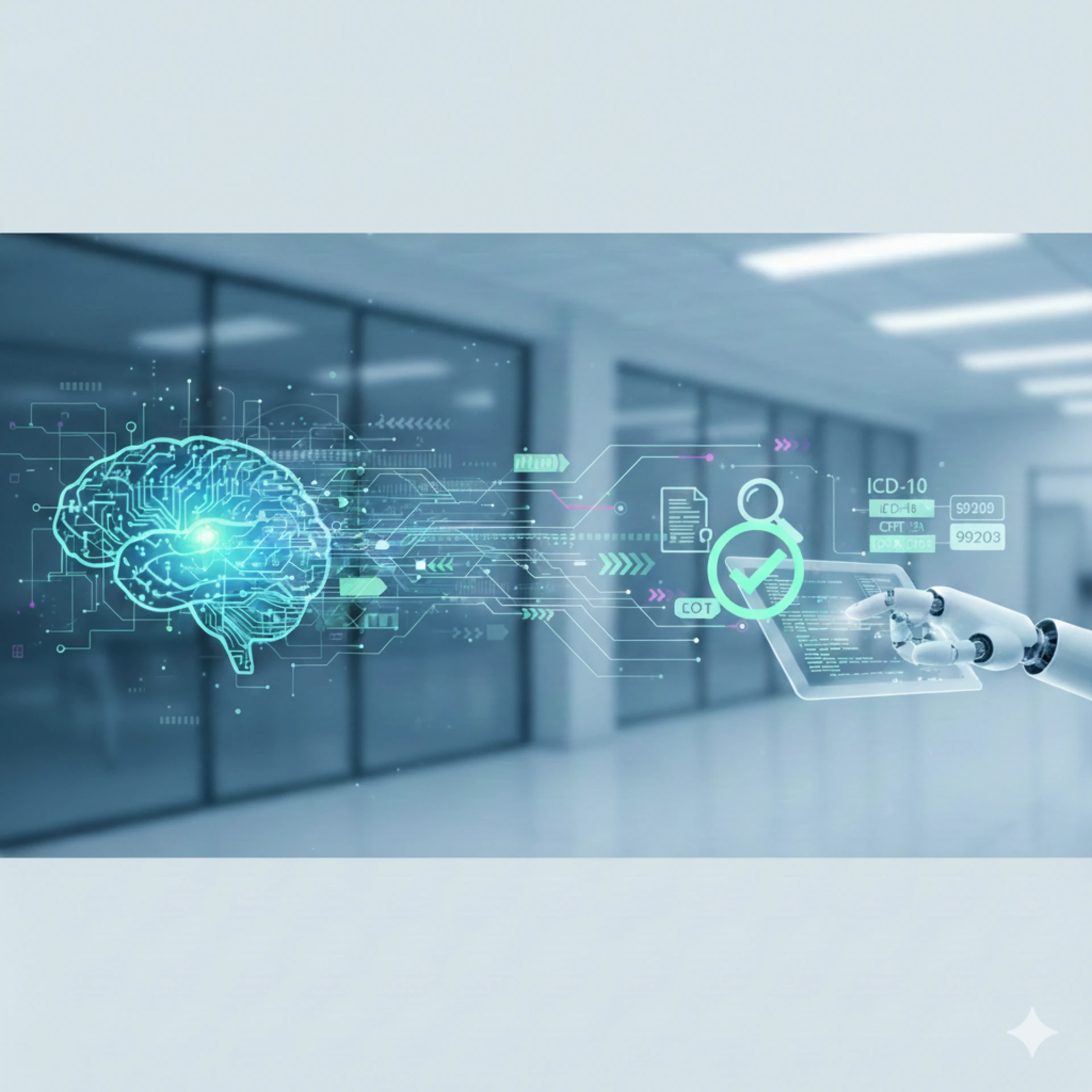

Medical coding accuracy plays a critical role in ensuring timely reimbursements, reducing claim denials, and maintaining compliance. However, growing documentation complexity, frequent coding updates, and payer-specific rules make accuracy harder to achieve with manual or rule-based systems alone. This is where Agentic AI is reshaping medical coding workflows.
By introducing intelligent, autonomous decision-making, Agentic AI helps healthcare organizations significantly improve coding precision while reducing operational burden.
Why Accuracy Is a Major Challenge in Medical Coding
Even experienced coding teams face challenges that impact accuracy, including:
- Incomplete or inconsistent clinical documentation
- Complex ICD, CPT, and HCPCS guidelines
- Frequent regulatory and payer updates
- High workload and time pressure
- Manual interpretation errors
Traditional coding tools rely heavily on static rules or keyword matching, which often miss clinical context. As a result, errors slip through, leading to denials, audits, and revenue loss.
What Is Agentic AI in Medical Coding?
Agentic AI refers to autonomous AI systems capable of understanding context, reasoning through complex scenarios, and taking action across workflows.
Agentic AI for medical coding goes beyond basic automation by:
- Interpreting unstructured clinical notes
- Understanding encounter context and care intent
- Recommending accurate codes based on evidence
- Flagging documentation gaps before submission
- Learning from historical coding outcomes and payer feedback
These capabilities are enabled through advanced AI Agent Development Services
designed specifically for healthcare use cases.
How Agentic AI Improves Coding Accuracy
Context-Aware Code Assignment
Unlike rule-based systems, Agentic AI evaluates the full clinical narrative not just keywords leading to more precise and defensible code selection.
Real-Time Documentation Validation
AI agents identify missing or conflicting documentation early, allowing corrections before claims are submitted.
Reduced Human Error
By handling first-pass coding and validation, Agentic AI minimizes fatigue-related errors and inconsistencies across large coding volumes.
Continuous Learning
Agentic AI systems adapt as coding guidelines, payer rules, and audit requirements evolve without constant manual rule updates.
Human Coders and Agentic AI: A Quality-First Model
Agentic AI is not designed to replace certified medical coders. Instead, it enhances their effectiveness.
In this collaborative model:
- AI agents perform initial coding and accuracy checks
- Human coders focus on complex cases and audits
- Quality assurance becomes more proactive
- Overall coding confidence and consistency improve
This approach allows coding teams to maintain high accuracy while scaling operations efficiently.
Business Impact of Improved Coding Accuracy
Improving accuracy with Agentic AI leads to measurable benefits:
- Fewer claim denials related to coding errors
- Faster claim acceptance and reimbursements
- Reduced audit risk and compliance issues
- Lower rework and operational costs
- Better visibility into coding performance
To implement these capabilities securely and at scale, many healthcare organizations partner with an experienced AI Agent Development Company in the USA.
The Future of Accurate Medical Coding
As healthcare data grows more complex, accuracy will depend less on manual effort and more on intelligent systems. Agentic AI enables a shift from reactive error correction to proactive accuracy assurance.
Organizations that adopt agentic ai for medical coding early will be better positioned to improve revenue cycle performance, maintain compliance, and scale without compromising quality.
Final Thoughts
Improving medical coding accuracy is no longer just about training and audits it’s about intelligent workflow design. Agentic AI brings context, adaptability, and continuous learning to coding operations, helping healthcare organizations achieve higher accuracy with greater efficiency.
The path to accurate, scalable medical coding is increasingly agent-driven.























Sign in to leave a comment.