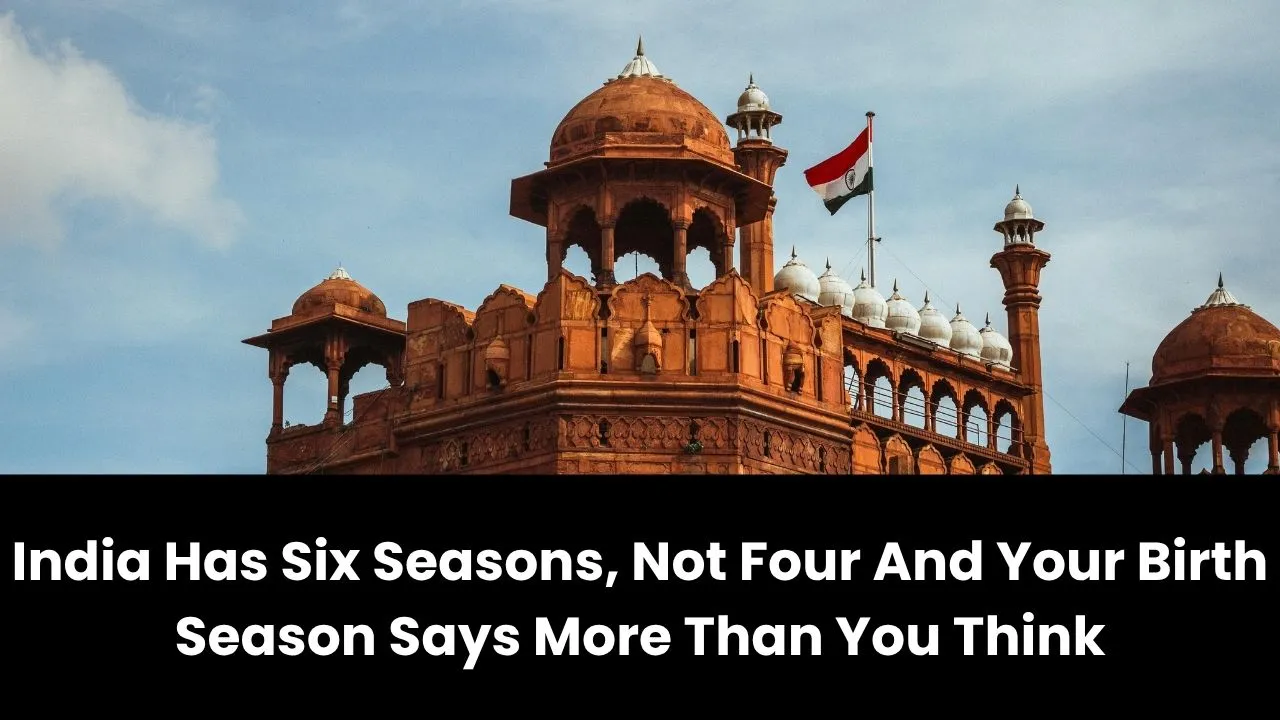

Rajan's grandmother never forgot her birthday. Not because she kept a diary. Not because her phone sent her reminders. She remembered because she tied every birth in the family to a season not summer or winter, but something older. "Tum Varsha mein aaye the," she would tell Rajan. "Baarish ki pehli raat." You came in the monsoon season. The first night of rain.
Rajan grew up thinking this was just the poetic way old people spoke. It wasn't until he sat with a Pandit before his daughter's naming ceremony that he understood his grandmother wasn't being poetic. She was being precise.
There is a version of India that most modern Indians have quietly forgotten. Not because it disappeared but because it was slowly pushed to the edges of daily life, surviving only in temples, in grandmothers' kitchens, and in the careful hands of astrologers who still read almanacs printed in Sanskrit margins.
That version of India counts time differently.
It does not divide the year into four seasons. It divides it into six.
And the season you were born into your birth Ritu carries meaning that goes far beyond weather.
The World Has Four Seasons. India Always Had Six.
When British administrators arrived in India, they brought their four-season framework with them spring, summer, autumn, winter. The framework made sense for England. For a land as climatically diverse and astronomically sophisticated as India, it was a dramatic oversimplification.
The ancient Hindu calendar, refined over thousands of years by astronomers, mathematicians, and sages, recognized six distinct seasons. They called them Ritu, a Sanskrit word that carries within it the ideas of order, rhythm, and cosmic regularity.
Each Ritu lasts approximately two months and follows the movement of the sun through the zodiac with mathematical precision. Together they form a complete picture of the Indian year — agricultural, spiritual, and astronomical all at once.
The six Ritus are:
Vasanta — the season of spring, running from mid-March to mid-May. This is the season of new beginnings, of flowers blooming after winter's silence, of Holi's colors and the fragrance of mango blossoms in the air. Children born in Vasanta were considered by many traditions to carry a natural lightness of spirit.
Grishma — the fierce summer season, from mid-May to mid-July. The sun is at its most powerful. The earth waits. Ancient Ayurvedic texts prescribed specific diets and daily routines for this season because its heat was understood to affect the body differently than any other time of year.
Varsha — the monsoon, from mid-July to mid-September. For an agricultural civilization, this was not merely a season. It was the heartbeat of survival. The arrival of rains was celebrated, anticipated, prayed for. Births during Varsha were considered deeply auspicious in many regional traditions; the child arrived with the rains, with abundance, with life.
Sharad — the post-monsoon autumn, from mid-September to mid-November. The sky clears. The air turns crisp. This is the season of Navratri, of Dussehra, of Diwali India's most spiritually concentrated period of the year falls entirely within Sharad. A child born in this season arrived into a world already celebrating.
Hemanta — the gentle pre-winter, from mid-November to mid-January. Unlike the sharp cold of northern winters, Hemanta in most of India is a season of warmth and harvest of weddings, of sesame sweets, of early mornings wrapped in shawls. It is a season of preparation and gratitude.
Shishira — the deep winter, from mid-January to mid-March. The season of stillness. Of fog over fields. Makar Sankranti and Basant Panchami marking winter's slow retreat. In yogic tradition, Shishira is considered a powerful season for introspection and spiritual practice.
Why Your Birth Season Was Never Just About Weather
In ancient India, the season of your birth was not a footnote. It was a starting point.
The Pandit who performed a child's naming ceremony the Namkaran sanskar would look at the birth Ritu alongside the birth Nakshatra, the Rashi, and the position of planets to understand the cosmic environment the child had entered. This was not superstition. It was the application of a sophisticated observational system built over centuries.
Ayurveda, India's classical system of medicine, understood that a child born in Varsha entered a world of high humidity, abundant water, and specific microbial conditions. A child born in Grishma arrived in dry heat and intense solar energy. These environmental factors at birth were considered relevant to the child's constitutional type, their Prakriti which would guide their health recommendations for life.
Even in folklore and regional literature, birth seasons carry distinct identities. In Bengali tradition, children born during the monsoon are said to carry the emotional depth of rain feeling things intensely. In Rajasthani tradition, children born in Hemanta, the harvest season, are said to be naturally generous born into abundance, they share naturally.
Modern science, interestingly, has begun to explore similar territory. Researchers have found correlations between birth month and certain health outcomes, personality tendencies, and even academic performance not because stars govern human fate, but because seasonal variation in sunlight, temperature, maternal nutrition, and early childhood environment creates measurable differences in development.
Your ancestors knew this. They simply had a different language for it.
The Calendar Behind the Seasons — Vikram Samvat
The six-season framework does not exist in isolation. It is part of a complete calendar system, the Vikram Samvat, that has been tracking Indian time for over two thousand years.
Named after the legendary Emperor Vikramaditya, this lunisolar calendar runs approximately 57 years ahead of the Gregorian calendar. That means if you were born in 1995 by the Gregorian count, your Vikram Samvat birth year is approximately 2052. This is not merely a numerical curiosity; it represents a completely different way of organizing time, one that aligns human life with lunar cycles, solar movements, and seasonal rhythms simultaneously.
The Vikram Samvat calendar gives India its festival dates. Diwali, Holi, Navratri, Eid-ul-Fitr, Guru Nanak Jayanti all fall on different Gregorian dates every year because they follow the lunisolar rhythm of the Vikram Samvat, not the fixed solar count of January to December.
This is why your Indian birth date, your true birth date in the traditional sense carries information your Gregorian birthday simply cannot hold.
If you want to discover your own Vikram Samvat birth year, your Hindu Rashi, your birth Nakshatra, and most importantly your birth Ritu the Indian season that marked your arrival into this world the Indian Age Calculator does this instantly, pulling together all these traditional elements from a single date of birth.
What Rajan's Daughter's Naming Ceremony Revealed
Back to Rajan. When the Pandit sat with the family before his daughter's Namkaran, he asked for the exact date and time of birth. He cross-referenced the Nakshatra. He noted the Rashi. And then he said something Rajan didn't expect.
"She came to Sharad," the Pandit said. "The season of light festivals. The season when the sky is clearest after the rains."
He wasn't giving a weather report. He was placing the child within a cosmic and cultural framework that her great-great-grandparents would have immediately understood. He was connecting her, through the language of seasons, to thousands of years of accumulated wisdom about time, nature, and human life.
Rajan's grandmother, had she been alive, would have nodded and said — "Bilkul sahi. Sharad ki bacchi hai."
A Living System in a Modern World
It would be easy to dismiss all of this as beautiful but irrelevant. We have Gregorian calendars on our phones. We celebrate birthdays on fixed dates. We book wedding venues based on availability, not Muhurta.
But something interesting is happening in modern India. Younger generations particularly those living abroad, separated from the daily cultural immersion that keeps these traditions alive are actively seeking to reconnect. They are asking questions their parents' generation took for granted. What is my Nakshatra? What does my Rashi mean? What was the traditional Indian season I was born into?
The six Ritus are not a relic. They are a living system, one that still governs the timing of festivals, the planting of crops in rural India, the scheduling of ceremonies, and the recommendations of Ayurvedic practitioners across the country.
Knowing your birth Ritu is not about going back. It is about understanding the full picture of where you came from culturally, cosmically, and seasonally.
The Season Your Grandmother Remembered
India's six seasons were never just about temperature and rainfall. They were a language — a way of understanding when a person arrived, what the world looked like when they took their first breath, and what cosmic rhythms surrounded that beginning.
Rajan's grandmother never needed a calendar on her wall. She had an older and more precise way of reading time that placed every birth inside a season, every season inside a year, and every year inside a river of time that had been flowing long before any of us arrived and will continue long after.
The next time someone asks when you were born, you have two answers.
The Gregorian one precise, administrative, universally recognized.
And the Indian one richer, older, and carrying within it six seasons of meaning that a simple date in January can never fully hold.
Which Ritu did you arrive in? The answer might tell you more about yourself than you expect.




















Sign in to leave a comment.