
What if the smartest MBA decision isn’t the most expensive one?
That’s the uncomfortable truth many aspirants ignore. While everyone chases ₹20–25 lakh B-schools, institutes like Delhi Institute of Advanced Studies quietly deliver outcomes that punch far above their fee bracket—especially under the umbrella of Guru Gobind Singh Indraprastha University.
Let’s unpack what’s really going on here.
The Real Math Most Students Miss
Before brand names, before brochures—MBA is a financial decision.
Here’s the simplest way to look at it (and almost nobody does this properly):
ROI = (Post-MBA Salary – Pre-MBA Salary) ÷ Total Investment
Now plug DIAS into this.
- Total Fee: ~₹3.4 lakhs
- Average Placement (approx): ₹6–7 LPA range (varies year to year)
- Opportunity Cost: Lower, since investment is small
This flips the equation completely.
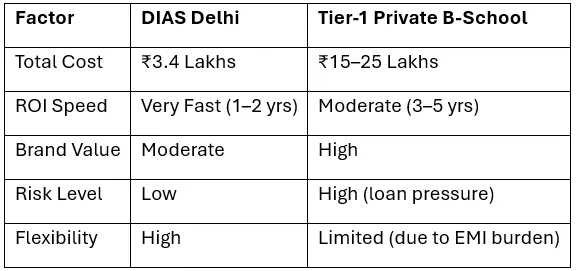
While a ₹20 lakh MBA needs years to recover, DIAS students often recover their cost in less than a year.
That’s where the “176% ROI” narrative starts making sense—not as marketing, but as math.
“Affordable” Doesn’t Mean “Low Value”
There’s a common myth:
“Low fee colleges = low career outcomes.”
Reality is more nuanced.
Colleges under GGSIPU operate in a structured academic ecosystem with:
- Standardized curriculum
- Centralized admission process (via CET/CAT/CMAT)
- Comparable evaluation systems
So the baseline quality is already controlled.
The difference comes down to execution + student effort, not just brand.
Where DIAS Actually Stands Out
Let’s not oversell it—DIAS is not an IIM. But that’s not the game it’s playing.
It wins in a different way.
1. Location Leverage (Delhi Advantage)
Being in Delhi means access to:
- Corporate hubs (Gurgaon, Noida)
- Internship pipelines
- Guest lectures & industry exposure
That proximity matters more than rankings in many cases.
2. Low Risk, High Flexibility
A ₹3.4 lakh MBA gives you something expensive colleges don’t:
Freedom to experiment.
You can:
- Switch domains early
- Take risks in startups
- Avoid heavy loan pressure
That changes career decisions dramatically.
3. Peer Competition (The Hidden Filter)
GGSIPU colleges attract a mix of:
- Serious CAT/CET aspirants
- Delhi NCR talent pool
- Cost-conscious but ambitious students
This creates a competitive but grounded environment.
Quick Comparison: DIAS vs High-Fee B-Schools
How This Plays Out in Reality
Imagine two students:
Rahul (DIAS):
- Invests ₹3.4L
- Gets ₹6 LPA job
- Breaks even within 8–10 months
Aman (Private B-School):
- Invests ₹20L
- Gets ₹10 LPA job
- Takes 3–4 years to recover
Who’s actually ahead early in career?
Rahul has liquidity, flexibility, and less stress.
Aman has brand—but also EMIs.
Different games. Different trade-offs.
Where Most Aspirants Go Wrong
They chase:
- Brand over outcome
- Fees over ROI
- Hype over fit
And ignore this:
“An MBA doesn’t create success. It amplifies the direction you already have.”
The GGSIPU Edge (Why It Matters)
Being affiliated with Guru Gobind Singh Indraprastha University gives DIAS:
- Curriculum credibility
- Degree recognition
- Structured academic rigor
It’s not just a random private institute—it operates within a known university system.
That matters for long-term credibility.
What the Data Actually Suggests
If your goal is:
- Fast ROI
- Entry into corporate roles
- Skill + exposure without heavy debt
DIAS becomes a strategic choice, not a backup.
And that’s the shift happening quietly among smarter applicants.
Insight You Shouldn’t Ignore
“The best MBA is not the one with the highest package. It’s the one that maximizes your personal upside with minimum downside.”
So, Should You Choose DIAS Delhi?
It depends on your intent.
Choose DIAS if:
- You want strong ROI without financial burden
- You’re self-driven and can build your own profile
- You value location + exposure over pure brand
Avoid it if:
- You’re only chasing brand names
- You expect placements to do all the work for you
FAQ
1. Is DIAS Delhi good for MBA placements?
Yes, for its fee range. It offers decent placement opportunities, especially in marketing, finance, and operations roles within NCR.
2. What exams are accepted for DIAS MBA?
Primarily CAT, CMAT, and IPU CET as per GGSIPU admission process.
3. Is DIAS better than expensive private colleges?
Not in brand value—but often better in ROI and risk management.
4. Does GGSIPU affiliation matter?
Yes, it ensures degree credibility, structured curriculum, and standardized evaluation.
5. Who should consider DIAS seriously?
Students focused on ROI, practical exposure, and low financial risk.
The MBA decision isn’t about prestige anymore. It’s about leverage.
And colleges like Delhi Institute of Advanced Studies prove that sometimes, the smartest move is the one nobody is talking about loudly.
(For a deeper understanding of MBA ROI frameworks and decision-making logic, refer to this detailed breakdown: )






























Sign in to leave a comment.