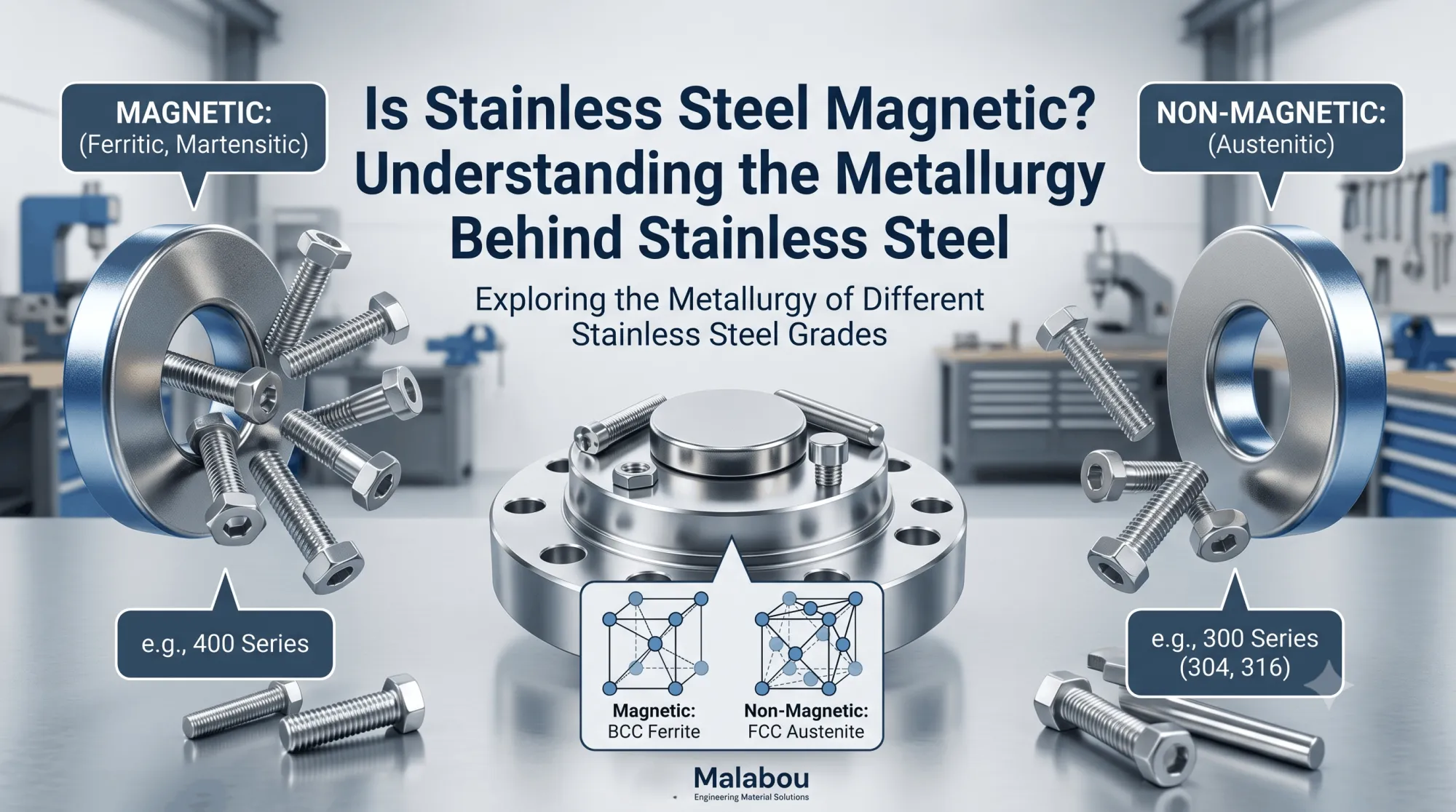
Stainless steel is one of the most widely used engineering materials in the world due to its exceptional corrosion resistance, durability, and versatility. However, one question frequently asked by engineers, manufacturers, and consumers alike is: Is stainless steel magnetic?
The answer is not as straightforward as a simple yes or no. Some stainless steel grades are magnetic, while others are not. Understanding why requires a closer look at metallurgy and the crystal structures that determine magnetic properties.
What Makes a Metal Magnetic?
Magnetism in metals depends largely on their atomic arrangement, known as the crystal structure. Iron, the primary element in steel, can exist in different crystal structures that influence whether the material exhibits magnetic behavior.
At room temperature, ordinary carbon steel typically has a ferritic structure, which is magnetic. When heated above approximately 730°C, steel transforms into an austenitic structure, which is generally non-magnetic. Certain alloying elements can stabilize this austenitic structure even at room temperature.
The Role of Nickel in Stainless Steel
Nickel is one of the key alloying elements responsible for making some stainless steels non-magnetic. It stabilizes the austenitic phase, allowing the material to retain its non-magnetic properties at ambient temperatures.
This is why the widely used 300-series stainless steels, including 304 and 316, are generally considered non-magnetic. These grades contain sufficient nickel to maintain an austenitic microstructure.
However, even these grades may exhibit slight magnetism after processes such as cold working, bending, or welding because part of the austenite can transform into martensite.
Which Stainless Steels Are Magnetic?
Not all stainless steels belong to the 300 series. Different families of stainless steel have varying magnetic properties:
Austenitic Stainless Steel (300 Series)
- Grades: 304, 316, 316L
- Magnetic? Generally No
- Characteristics: Excellent corrosion resistance and high nickel content.
Ferritic Stainless Steel (400 Series)
- Grades: 409, 430, 439
- Magnetic? Yes
- Characteristics: High chromium content and little or no nickel. Ferritic structures are inherently magnetic.
Martensitic Stainless Steel
- Grades: 410, 420, 440
- Magnetic? Yes
- Characteristics: High strength, heat-treatable, and commonly used in tools and cutlery.
Duplex Stainless Steel
- Magnetic? Partially Magnetic
- Characteristics: Combines ferritic and austenitic phases, providing both strength and corrosion resistance.
Why Is 316 Stainless Steel Sometimes Magnetic?
A common misconception is that 316 stainless steel is always non-magnetic. In reality, cast versions of 316 often exhibit some magnetic response.
This occurs because cast stainless steels use different specifications than wrought grades. For example, cast equivalents such as CF-8M may contain a small amount of ferrite, which introduces slight magnetic properties. Therefore, it is normal for some “316 equivalent” castings to attract a magnet weakly.
Why Does Magnetism Matter?
Understanding whether stainless steel is magnetic is crucial in many industries. Magnetism can influence:
- Welding performance
- Magnetic particle inspection methods
- MRI and medical equipment applications
- Electrical and electromagnetic systems
- Food processing and pharmaceutical manufacturing
Selecting the right stainless steel grade ensures optimal performance in demanding applications. For example, non-magnetic 316 stainless steel is often preferred in marine and chemical environments due to its superior corrosion resistance, while magnetic grades like 430 are suitable for appliances and automotive components.
Final Thoughts
So, is stainless steel magnetic? The answer depends on its metallurgical structure and alloy composition. While austenitic grades such as 304 and 316 are generally non-magnetic, ferritic, martensitic, and duplex stainless steels are magnetic to varying degrees.
Magnetism in stainless steel is not a sign of quality — rather, it reflects the alloy’s composition and intended application. Understanding these differences helps engineers and manufacturers select the most suitable material for performance, durability, and corrosion resistance.
At Malabou, our metallurgical expertise ensures customers receive the right material solutions for their specific engineering requirements, delivering quality components that perform reliably in even the most demanding environments.





















Sign in to leave a comment.