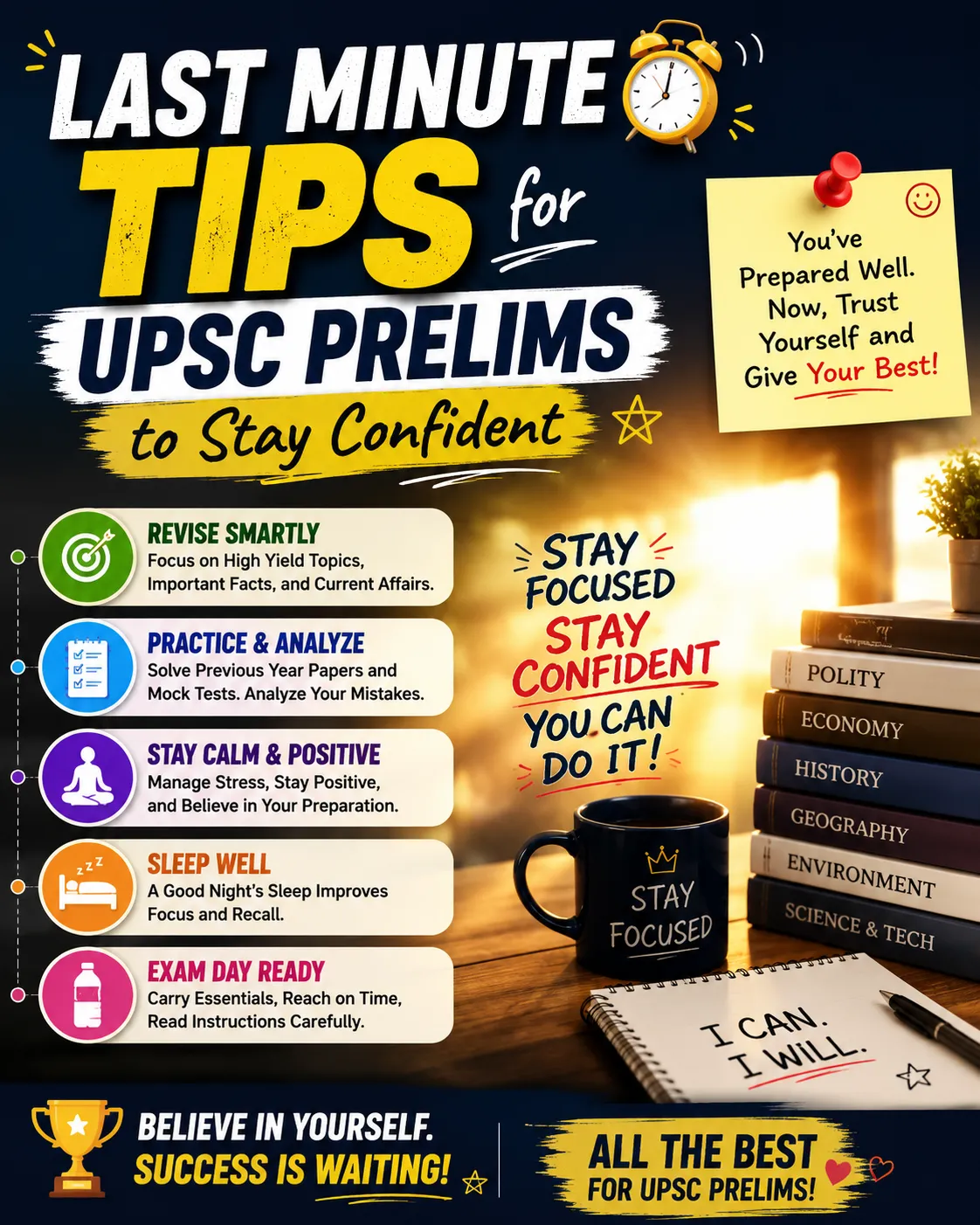

Struggling with exam anxiety? Discover practical last minute tips for upsc prelims to streamline your final revision, protect your mindset, and build confidence.
The final stretch before the UPSC Civil Services Preliminary Examination is a distinct psychological phase. You have spent months, possibly years, absorbing massive amounts of information from ancient Indian history to intricate space technology updates. Yet, as the exam date approaches, it is entirely normal to feel as though your mind is a completely blank slate.
When you look at your notes, names, dates, and constitutional articles can blur together. The temptation to panic-read a new 50-page current affairs compilation is incredibly strong.
However, the final days are not about acquiring new knowledge. They are about optimizing the knowledge you already possess and ensuring your mind is sharp enough to deploy it under pressure. This guide focuses on a practical last minute strategy for upsc prelims designed to help you organize your remaining time, steady your nerves, and approach exam day with a clear, capable mindset.
The Reality of the Final Week: Mindset Over Matter
At this stage, your biggest asset is not a secret shortcut; it is psychological stability. The UPSC Prelims paper is deliberately designed to test your resilience alongside your knowledge. It contains questions you will not know the answers to, options that look nearly identical, and twists in phrasing that require absolute focus. If you enter the exam hall sleep-deprived and anxious, your ability to eliminate options logically drops significantly.
Real confidence right now does not mean knowing every single fact in the syllabus. Confidence means trusting that your preparation will surface when you see a question, and knowing how to manage your energy when faced with the unfamiliar.
How to Revise for UPSC Prelims in Last Days
Your revision schedule right now needs to shift from deep study to high-yield retrieval trying to read textbooks cover-to-cover will only increase your stress levels. Instead, focus on a streamlined approach to how to revise for upsc prelims in last days.
1. Prioritize High-Yield Static Areas
Certain areas of the static syllabus yield a higher return on investment because the questions are typically direct and bound by definitive rules. Dedicate short, timed blocks to review:
- Polity: Key constitutional amendments, fundamental rights, directive principles, and emergency provisions.
- Modern History: Chronology of the Indian National Movement, important congress sessions, and major socio-religious reform movements.
- Economy: Core concepts like inflation, monetary policy tools (Repo rate, SLR), and banking terms rather than dense economic reports.
- Environment & Geography: National parks, wildlife sanctuaries recently in the news, major river systems, and mapping layouts.
2. The "Page-Flipping" Revision Method
Instead of reading word-for-word, look at your existing notes or highlighted sections. Spend no more than 2 to 3 minutes per page. Your goal is simply to trigger your visual memory. If you stumble upon a specific fact you cannot recall perfectly like a specific committee recommendation resist the urge to spend an hour researching it. Make a quick note, check the detail, and move on.
3. Handle Current Affairs with Zero New Material
If you have not read a specific current affairs document by now, leave it. Stick exclusively to the summaries or monthly compilations you have already marked up. Focus heavily on places in the news, international bodies, and major government schemes launched over the past year.
Last Minute Tips for UPSC Prelims: Actionable Strategies
When implementing a cohesive plan for upsc prelims last minute preparation, your actions should directly protect your decision-making capacity for exam day.
Sync Your Biological Clock
If you have been studying late into the night, you need to alter your routine immediately. Your brain needs to fire at maximum capacity during the exact hours of the exam: Paper 1 at 9:30 AM and Paper 2 (CSAT) at 2:30 PM.
- Sit at your study desk during these precise windows.
- Avoid taking afternoon naps during the week leading up to the exam.
- Spend these hours doing light revision or reviewing past question structures to train your mind to focus at this time.
Review PYQs Instead of Fresh Mock Tests
Solving a new full-length mock test three days before the exam is highly risky. An unusually difficult mock or an unfamiliar marking style can damage your confidence. Instead, read through the actual UPSC Previous Year Questions (PYQs) from the last five years.
- Look at the phrasing of the questions.
- Observe how UPSC constructs incorrect options (e.g., using extreme words like "all," "only," or "drastically").
- Familiarizing yourself with the official tone helps calibrate your mind to the actual examiner's logic.
Common Mistakes to Avoid in the Final 72 Hours
Even the most dedicated aspirants can compromise their performance by falling into common traps right before the exam. Recognizing these pitfalls early keeps your upsc prelims last minute preparation on the right track.
- Chasing the Unfamiliar: A friend might mention a new PDF or a predicted topics list. Ignore it. Trust your own sources. New information close to the exam rarely sticks and usually causes unnecessary doubt.
- Neglecting the CSAT Paper: Do not assume CSAT is a mere formality, even if you have a strong quantitative background. Take an hour or two to review basic math formulas, blood relation logic, and reading comprehension approaches. Ensuring you clear the qualifying mark safely keeps Paper 1 relevant.
- Over-Analyzing Mock Scores: Your performance in coaching institute mock tests does not dictate your final result. Mocks are tools for time management and error correction, not accurate predictors of your actual UPSC score.
- Neglecting Physical Logistics: Do not leave your printouts and travel arrangements until the final evening. Confirm your venue location, arrange your transport, print your admit card, and keep your black ballpoint pens ready well in advance.
Real Perspectives from the Field
Hearing how others navigate this specific window can provide practical perspective. Here are a few candid reflections from individuals who managed the pressure successfully.
"During my second attempt, I spent the last three days frantically reading a new environment summary. In the exam hall, I was so exhausted that I misread a basic polity question on Fundamental Rights. For my next attempt, I stopped studying at 5:00 PM the day before, walked around a park, and slept early. The mental clarity made a massive difference in how I tackled options."
— Ananya R., Cleared Prelims twice
"I used to get caught up in how many questions I needed to attempt based on what coaching forums said. On exam day, the paper was incredibly unconventional. Because I had spent the final week looking at past papers instead of forum predictions, I adjusted my strategy on the spot, kept my attempts conservative, and qualified safely."
— Devendra K., Selected in 2024
Frequently Asked Questions
1. How many questions should I ideally attempt in Paper 1?
There is no fixed, ideal number of questions. The number depends entirely on the difficulty level of the paper. If the paper is highly unconventional or difficult, a conservative attempt with high accuracy (around 75–80 questions) may be safer. If it is more straightforward, you might need to go higher. Rely on your elimination skills rather than a pre-determined target.
2. What should I do if the first ten questions of the booklet are completely unfamiliar?
Do not panic. Booklet sets are randomized. You may have simply received a tough section right at the front. Take a deep breath, skip them cleanly, and move to the middle or back of the paper. Finding a few familiar static questions will help settle your nerves and restore your momentum.
3. How do I balance revision between GS and CSAT in the last days?
Allocate around 80% of your revision time to General Studies static topics and high-yield current affairs, and 20% to CSAT. For CSAT, focus on practicing previous year passages and reviewing standard quant formulas to keep your logical reflexes sharp.
4. Is it advisable to study on the day right before the exam?
It is generally best to wind down your studies by noon on the day before the exam. Use the afternoon to organize your bag, verify your exam center location, and relax. Giving your brain a few hours of rest helps reduce fatigue and improves recall efficiency during the test.
5. How can I handle confusing options where two choices seem correct?
When down to two options, look for subtle qualifiers. Go back to the core text of the question and ensure you haven't overlooked words like "not," "incorrect," or specific timeline markers. If you have a reasonable, logical basis for picking one over the other based on your static knowledge, trust your instinct and take the calculated risk.
Conclusion
The UPSC Prelims is undoubtedly a rigorous test, but it is also a manageable one if you protect your mental focus. A solid last minute strategy for upsc prelims is not about performing miracles in the final hours; it is about protecting the foundation you have built over months of consistent study. Take care of your sleep, keep your final revision structured, and focus entirely on execution. The work you have put in is there give your mind the quiet space it needs to bring that knowledge to the surface.





























Sign in to leave a comment.