

Bright sunlight is not always the same. A clear afternoon can produce intense glare, while an overcast morning may feel much gentler. Walk under a tree and the scene changes again. Step inside a store, and a very dark sunglass lens may suddenly feel unnecessary.
This is where light adjustable sunglasses can offer an interesting solution. Instead of relying on one fixed level of darkness, these glasses are designed to adapt to changing light conditions or allow the wearer to select a different shade.
The basic idea is easy to understand. Think about the brightness control on a smartphone. You turn it up when the screen is difficult to see outdoors and turn it down when you are sitting in a dark room. Adjustable eyewear uses a similar idea, except the goal is to control how much visible light passes through the lenses.
Different products achieve this in different ways. Some lenses respond automatically to changes in light, while others allow the wearer to control the tint manually. Because these technologies are not identical, knowing how each one works can help you choose eyewear that actually fits your lifestyle.
What Are Light Adjustable Sunglasses?
Light adjustable sunglasses are eyewear designed to provide variable control over the amount of visible light passing through the lenses.
Traditional sunglasses have a fixed tint. Once the lenses are made, their basic shade does not change according to your preference. You choose the pair that seems appropriate for the conditions and wear them.
Adjustable designs take a more flexible approach.
Depending on the technology, the lenses may become darker or lighter automatically, or you may be able to change their shade yourself. The purpose is to make the glasses more useful across different lighting situations.
For example, imagine spending a morning walking outdoors. The sun is strong, so a darker setting feels comfortable. Later, you move into a shaded area and want more light. Instead of changing glasses, an adjustable system can give you another shade.
That convenience is the main attraction.
Why Fixed-Tint Sunglasses Can Be Limiting
A conventional pair of sunglasses has one major advantage: simplicity. You put them on and go.
The limitation appears when the environment changes.
Suppose you choose a very dark lens because you know you will spend part of the day under strong sunlight. That same lens may feel too dark when clouds arrive or when you move into shade.
Now imagine choosing a lighter lens instead. It may be comfortable in moderate brightness, but you might wish it were darker when direct sunlight becomes intense.
This creates a compromise.
Adjustable eyewear attempts to reduce that compromise by giving you more than one useful shade in the same pair.
It is similar to having a lamp with a dimmer switch rather than a lamp that is permanently stuck at one brightness level. You can select what works for the situation instead of accepting the same setting all day.
How Do Adjustable Lenses Change Shade?
There is no single method used in every adjustable sunglass.
Manual Adjustment
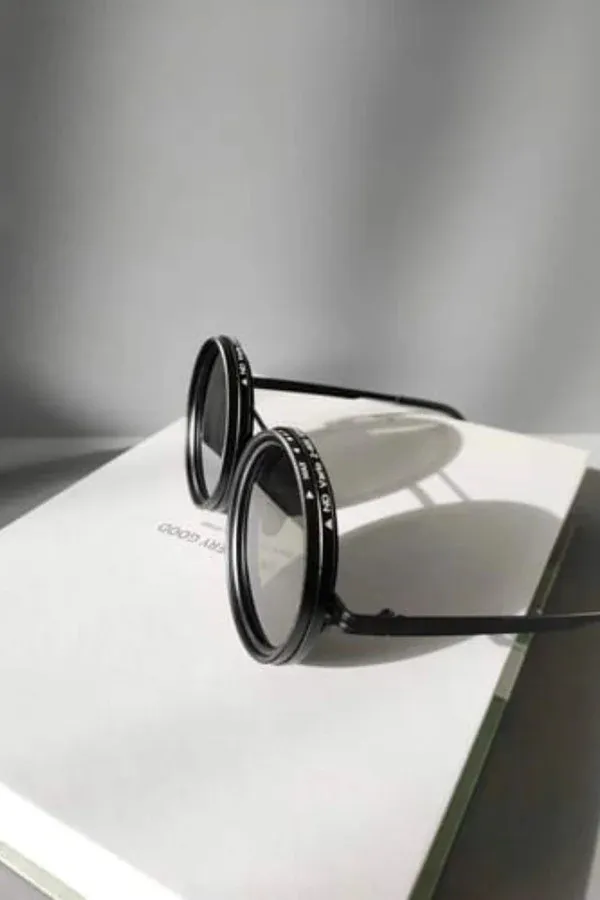
Some products allow the wearer to change the shade directly. A control mechanism may alter the lens system to provide different levels of light transmission.
The advantage is control. You decide when the lens becomes lighter or darker.
This can be useful when you know what you want. If the sun suddenly becomes stronger, you can select a darker setting. When conditions become milder, you can choose a lighter one.
Automatic Light Response
Other lenses are designed to respond to environmental light automatically.
Photochromic lenses are a familiar example of this concept. They contain materials that change their light transmission when exposed to certain wavelengths of light, becoming darker in suitable conditions and returning toward a clearer state when the activating light is reduced.
The transition is not necessarily instantaneous. How quickly a lens changes can depend on the specific technology, temperature, and surrounding conditions.
That means automatic lenses are convenient, but they should not be treated as if they behave like an instant electronic dimmer.
Electronic Adjustment
Some specialized eyewear uses electronic technology to change the optical properties of the lens.
These systems can offer controlled transitions and may allow specific settings. They can also require a power source or additional components, depending on the product.
This approach is more sophisticated than a basic tinted lens, so buyers should look at how the product is powered, how it is controlled, and how long it can operate between charges if applicable.
Adjustable Tint Is Not the Same as UV Protection
This is one of the most important points when buying any type of sunglasses.
A lens becoming darker does not automatically mean that it provides better ultraviolet protection.
Visible light is the light your eyes can see. Ultraviolet radiation is outside the visible range. Your eyes cannot judge UV protection simply by looking at the color of a lens.
The U.S. Food and Drug Administration explains that the amount of sunlight and UV radiation reduced by sunglasses depends on the physical, chemical, and optical properties of the lenses. In other words, lens appearance alone is not enough to determine protection.
The FDA also advises consumers not to confuse dark lenses with UV protection and notes that products labeled UV400 or 100% UV protection are intended to provide strong UV protection.
So, when comparing adjustable sunglasses, think about two separate questions:
- How much visible light can the lens control?
- What level of UV protection does the lens provide?
Both matter, but they are not the same thing.
Understanding ND Filter Sunglasses
The term nd filter sunglasses is connected to the idea of neutral-density filtering.
In photography, a neutral-density filter reduces the amount of light reaching a camera sensor without being designed to dramatically change the scene's colors. Imagine placing a controlled dimmer in front of a camera lens. The scene remains recognizable, but less light reaches the sensor.
That idea helps explain why the term ND appears in some eyewear discussions.
However, an ND designation should not be treated as a universal guarantee of a particular level of UV protection, darkness, or optical performance. Those characteristics depend on the actual lens.
For everyday buyers, the practical question is more important than the terminology: How much light does the lens reduce, what protection does it provide, and is it appropriate for the activity?
The Difference Between Adjustable and Photochromic Sunglasses
These two types are often confused.
Photochromic lenses automatically change their tint in response to certain environmental light conditions. You do not normally choose the exact shade yourself.
Adjustable sunglasses may instead allow direct control over the tint.
Think of the difference between automatic headlights and a manual dimmer.
Automatic headlights respond to their surroundings. A manual dimmer responds to your decision.
Neither approach is automatically superior. It depends on what you value.
If you want convenience and do not want to think about changing the lens, an automatic system may appeal to you. If you prefer deciding exactly when the shade changes, a manually adjustable design may be more suitable.
Some products may combine different technologies, so it is worth reading the product description carefully.
Why Changing Shade Can Be Useful Outdoors
Outdoor environments are full of changing light.
Consider a morning hike. The trail may begin in open sunlight, move through a wooded section, and eventually reach an exposed hilltop. A single fixed tint has to work across all three areas.
An adjustable lens gives you another option.
Cyclists can encounter similar changes. A route may include bright roads, tree-covered sections, reflective surfaces, and areas where the sunlight comes from different directions.
Golfers, runners, walkers, travelers, and people who spend time around water may also encounter rapidly changing conditions.
The benefit is not that adjustable glasses make sunlight disappear. They simply give you another way to manage visible brightness.
What About Glare?
Glare is different from ordinary brightness.
Imagine sunlight reflecting from a wet road. The road may produce a sharp reflection that feels more distracting than the general brightness of the sky.
Polarized lenses can reduce certain types of reflected glare. This is why polarization is commonly considered useful for activities involving roads, water, snow, and other reflective surfaces.
However, polarization and tint adjustment serve different purposes.
A darker lens may reduce overall brightness. Polarization can reduce particular types of reflected glare. A lens may have one feature, both, or neither.
If glare is one of your biggest concerns, check whether the adjustable sunglasses are polarized rather than assuming that variable tint will automatically solve the problem.
Benefits of Light Adjustable Sunglasses
One Pair for More Conditions
The biggest advantage is versatility.
Instead of choosing one permanent tint, you can have access to multiple levels of shading within one eyewear system.
That can be convenient for people whose daily routine includes a mixture of bright and moderate conditions.
Personalized Light Control
Everyone has slightly different preferences. One person may find a particular shade comfortable while another prefers more or less darkness.
Adjustable lenses provide greater flexibility instead of forcing everyone into the same fixed setting.
Convenient for Travel
Travel often means unpredictable lighting.
You might leave a hotel in bright sunshine, enter a museum, walk through a shaded street, and later return to an open outdoor area.
Carrying several pairs of sunglasses can become inconvenient. A variable lens can reduce the need to switch between different shades.
Useful for Outdoor Activities
People who spend significant time outside can benefit from being able to adapt their eyewear to changing conditions.
The value is particularly noticeable when an activity lasts for several hours and the sun's position changes during that time.
Less Guesswork
With fixed-tint sunglasses, choosing the right shade can involve some trial and error.
Adjustable systems reduce that problem because you have more flexibility after purchasing the glasses.
Potential Drawbacks to Keep in Mind
Adjustable eyewear is not perfect.
One possible drawback is complexity. A conventional sunglass has very little to operate. An adjustable model may contain additional components or require a particular adjustment method.
Electronic versions may also require charging or a power source, depending on their design.
Automatic lenses can have another limitation: they may not change at exactly the speed or intensity you expect. Environmental conditions can affect how they behave.
Price can also be higher than that of basic sunglasses because more advanced lens systems may cost more to produce.
There is also the question of necessity. If you spend nearly all your time in bright outdoor conditions, a well-made fixed-tint pair may already meet your needs.
More features are useful only when those features solve a real problem.
Choosing the Right Tint Range
Not every adjustable lens provides the same amount of variation.
Some products may offer only a few settings. Others may provide a broader range.
Before buying, consider your normal environment.
If you mainly need a small change between mild and strong sunlight, a modest adjustment range could be enough.
If your day includes indoor spaces, open sunlight, shade, and other dramatically different conditions, a wider range may be more useful.
Do not choose a product solely because it advertises "adjustable." Find out what the adjustment actually means.
A feature is only valuable when it provides the range you need.
What to Look for Before Buying
UV Protection
Check the manufacturer's stated UV protection. Do not assume that darker automatically means safer.
Tint Range
Find out the lightest and darkest settings available. This tells you how versatile the lens really is.
Adjustment Speed
If the glasses change automatically, find out how quickly the transition occurs under typical conditions.
Control Method
For manually adjustable products, the control should be practical. If changing the tint is difficult, the feature may become more annoying than helpful.
Lens Quality
Look for lenses designed to provide clear vision without unnecessary distortion.
Frame Comfort
Even an excellent lens is not useful if the frame feels uncomfortable after an hour.
Pay attention to the nose bridge, temples, weight, and overall fit.
Polarization
If reflected glare is a concern, determine whether polarization is included.
Durability
For active use, consider how well the frame and lens system can handle regular handling, storage, and outdoor use.
Light Adjustable Sunglasses for Driving
Driving can involve major changes in brightness.
You may begin on a shaded road, turn toward direct sunlight, pass beneath trees, or enter a covered parking area.
An adjustable lens can be useful in situations like these because it allows the wearer to respond to changes rather than relying on one fixed level of darkness.
However, drivers need to be particularly careful with lens darkness. Sunglasses intended for daylight use should not be assumed to be suitable for night driving.
The FDA's guidance notes that sunglasses intended for driving should meet relevant requirements for that use.
If you drive frequently, choose eyewear specifically suited to your driving conditions rather than simply selecting the darkest available setting.
How to Care for Adjustable Sunglasses
Proper care is fairly simple.
Keep the lenses clean using appropriate eyewear-cleaning materials. Avoid rubbing them with rough fabrics that can leave fine scratches.
Store the glasses in a protective case when they are not being worn. This is especially important for adjustable models because mechanical or electronic components may be more vulnerable to rough handling than a basic fixed lens.
If the glasses have a control mechanism, operate it as instructed rather than forcing it.
For electronic models, follow the manufacturer's charging and storage instructions.
Small habits like these can help preserve the performance of the eyewear over time.
Where Magnewear Fits In
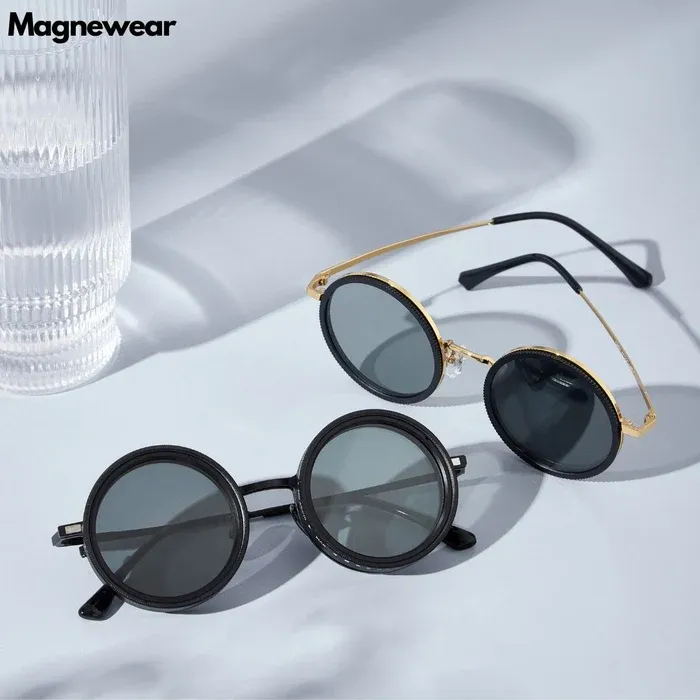
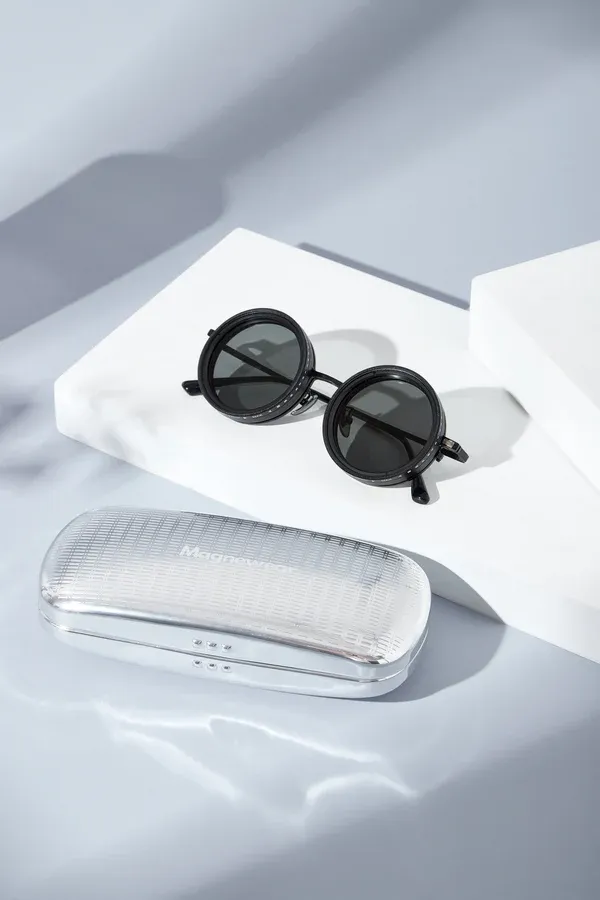
Magnewear is one brand associated with eyewear solutions that focus on flexible approaches to managing changing outdoor light. When considering any product in this category, it is still important to evaluate the actual specifications rather than choosing based only on the brand name.
Look at the lens technology, adjustment range, UV protection, frame design, and intended use. Those details tell you much more about whether a pair will suit your routine.
Are Adjustable Sunglasses Worth It?
For some people, absolutely.
If you regularly move between bright sunlight, shade, and moderate lighting, the ability to change lens darkness can be genuinely convenient.
The feature may be especially attractive to travelers, drivers, cyclists, outdoor workers, and recreational users who spend long periods outside.
But if your sunglasses spend most of their time in a drawer, an adjustable system may not provide much practical value.
The smartest approach is to start with your routine rather than the technology.
Ask yourself:
- Do my lighting conditions change frequently?
- Do I dislike carrying multiple pairs?
- Do I want direct control over lens darkness?
- Is glare a significant concern?
- Do I need prescription lenses?
- How important are weight and comfort?
Your answers can help determine whether adjustable eyewear makes sense.
Conclusion
Light adjustable sunglasses offer a flexible way to manage changing brightness without constantly switching between different pairs of eyewear.
Their main appeal is simple: the lens can provide different levels of light control, either through manual adjustment, automatic response, or specialized electronic technology. That flexibility can make everyday activities more convenient when lighting conditions change throughout the day.
Still, adjustable tint is only one part of a good pair of sunglasses. UV protection, lens quality, comfort, fit, polarization, durability, and the available shade range deserve equal attention.
Most importantly, never judge UV protection by lens darkness alone. A dark lens may reduce visible brightness while offering inadequate ultraviolet protection, so always check the manufacturer's specifications.
The best adjustable sunglasses are not necessarily the ones with the most features. They are the ones that provide the right combination of light control, protection, comfort, and practicality for the way you actually live.
Frequently Asked Questions
1. What are light adjustable sunglasses?
They are sunglasses designed to provide more than one level of lens darkness. Depending on the technology, the wearer may adjust the shade manually, or the lenses may respond automatically to changes in light.
2. Do adjustable sunglasses provide UV protection?
They can, but adjustability itself does not guarantee UV protection. Always check the product's stated UVA and UVB protection specifications before purchasing.
3. Are adjustable sunglasses the same as photochromic glasses?
Not necessarily. Photochromic lenses automatically react to certain light conditions. Other adjustable sunglasses allow the wearer to control the shade directly. The specific technology depends on the product.
4. Are polarized adjustable sunglasses available?
Some are. Polarization is designed to reduce certain types of reflected glare, while tint controls overall visible light. If glare is important to you, check whether the specific model includes polarization.
5. Are adjustable sunglasses good for driving?
They can be useful for daytime driving when the lens is appropriate for the lighting conditions. However, very dark sunglasses should not be used in situations where they reduce visibility, and adjustable eyewear should never be assumed to be suitable for nighttime driving.






















Sign in to leave a comment.