
For most of the last century, lighting design answered one question: Is the room bright enough? In 2026, that question will have changed. The people specifying lighting for Indian homes and workspaces are now asking a different one, is this light helping the people under it feel better, sleep better, and function better?
That shift has a name: human-centric lighting, or smart lighting solution design built around the biology of the people who use the space, not just the aesthetics of the room. It is one of the fastest-growing categories in residential and commercial automation, and it is quietly becoming one of the most requested upgrades we see at Immersive Technologies India.
The Biology Nobody Designs For
Every human being runs on a roughly 24-hour internal clock, the circadian rhythm that governs when we feel alert, when we feel sleepy, when our body releases melatonin, and even when our metabolism is most active. This clock isn’t set by a wristwatch. It’s set by light.
Specifically, it’s set by a photoreceptor in the eye called the ipRGC (intrinsically photosensitive retinal ganglion cell), which doesn’t process light for vision, it processes light for timing. Cool, blue-enriched light in the morning suppresses melatonin and signals “be alert.” Warm, amber-toned light in the evening allows melatonin to rise and signals “wind down. ” A conventional lighting installation, one warm-white color temperature, and one brightness level, on from dusk to bedtime, ignores this system entirely. It floods a bedroom with the same 3000K glow at 7 AM and 11 PM, working against the body’s clock both times.
This is the gap human-centric lighting is built to close.
What a Human-Centric Smart Lighting Solution Actually Does
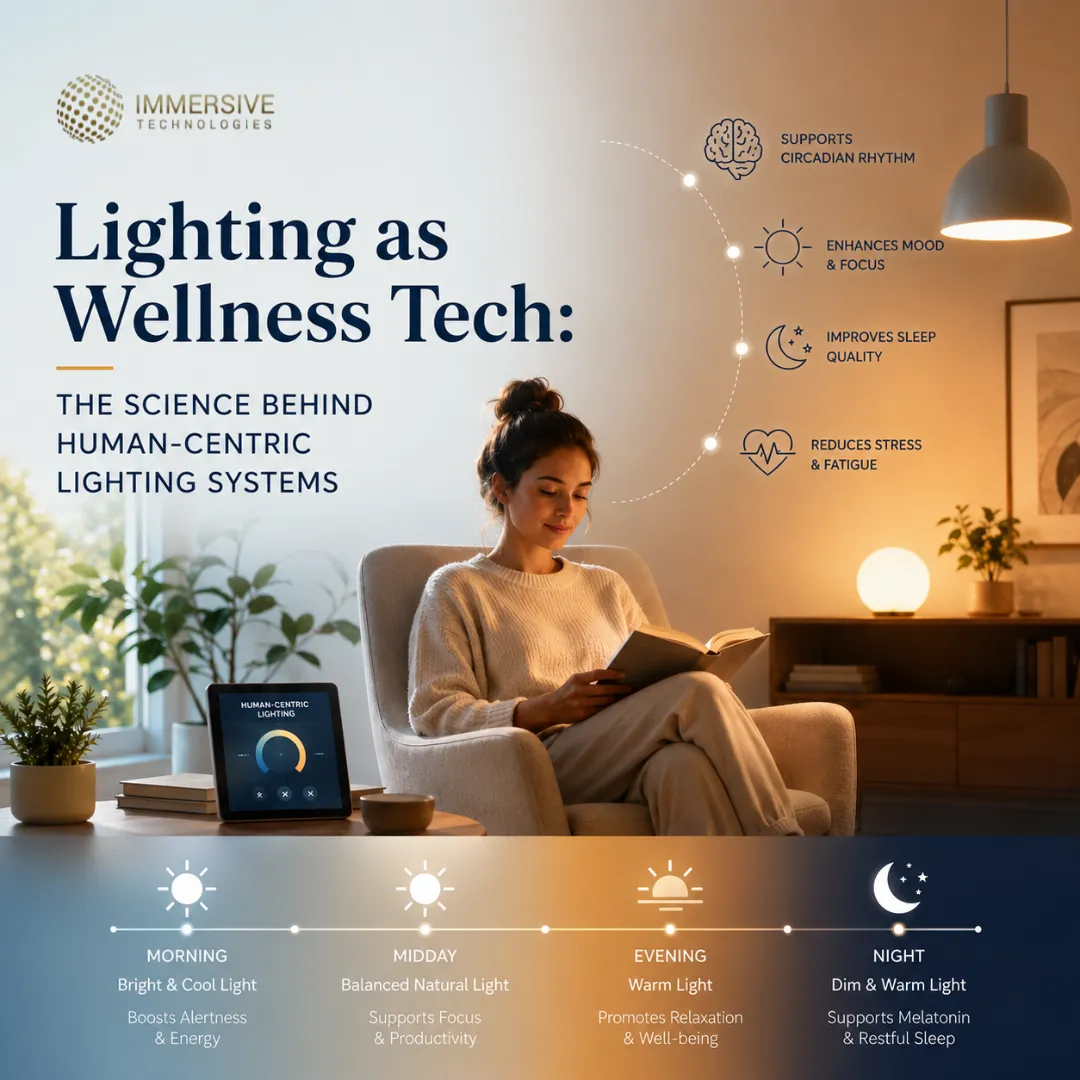
A properly engineered smart lighting solution doesn’t just dim and brighten on a timer. It shifts both intensity and correlated color temperature (CCT) across the day, mimicking the arc of natural daylight:
Morning (6–9 AM): Cooler, higher-CCT light (5000K–6500K) at higher lux levels to suppress residual melatonin and support alertness particularly valuable in Indian homes with limited direct morning sunlight due to high-rise shading or pollution haze.
Midday (10 AM–4 PM): Bright, neutral white (4000K–4500K) that supports focus, critical for home offices and study spaces, a segment that has only grown since hybrid work became permanent for many Gurugram and Noida households.
Evening (5–8 PM): A gradual shift toward warmer tones (2700K–3000K) as intensity tapers, easing the transition toward rest.
Night (post 9 PM): Very low-lux, amber-dominant light (under 2200K) in bedrooms and bathrooms, which allows melatonin production to proceed largely undisturbed.
This isn’t a set of manual scene changes. It runs on the same automation logic already familiar in smart home control, occupancy sensors, scheduled routines, and app-based overrides layered onto a lighting protocol capable of full tunable-white or RGBW output.
Why This Belongs in the DALI vs. 0-10V vs. Smart Bulb Conversation
Human-centric lighting isn’t a separate product category, it’s a design layer that sits on top of the protocol decision most homeowners are already weighing.
DALI systems are the most capable here, since DALI type 8 devices are purpose-built for tunable white and color control with individually addressable, feedback-capable fixtures and are the standard choice for villas, large-format homes, and premium developments where lighting is designed room-by-room.
0-10V dimming can support tunable white with the right driver architecture, but typically at a coarser control resolution, a reasonable middle ground for retrofit projects with budget constraints.
Smart bulbs (Wi-Fi or Zigbee-based) bring human-centric lighting within reach of apartment dwellers who can’t rewire, a fast-growing segment across Delhi NCR’s high-rise inventory, where full DALI retrofits aren’t always feasible.
The right choice depends on whether the project is new-build or retrofit and how granular the control needs to be a conversation worth having before fixtures are ordered, not after.
The Measurable Case: Sleep, Focus, and Energy
The wellness argument isn’t speculative. Occupational health research has consistently linked circadian-tuned lighting in offices to improved reported alertness and reduced afternoon energy dips, and residential circadian lighting has shown measurable improvements in sleep onset time when evening blue-light exposure is reduced. For Indian households increasingly conscious of screen-driven sleep disruption, smartphones, laptops, and late-night OTT viewing are now a near-universal evening habit, a bedroom lighting system that actively counteracts blue-light exposure rather than adding to it is a genuinely practical wellness intervention, not just a luxury feature.
There’s an efficiency dividend too. Occupancy-based dimming and scheduled CCT shifts reduce the tendency to run lights at full brightness around the clock, trimming electricity consumption in a country where power tariffs continue to climb across NCR discoms.
Designing It Into a Home, Not Bolting It On
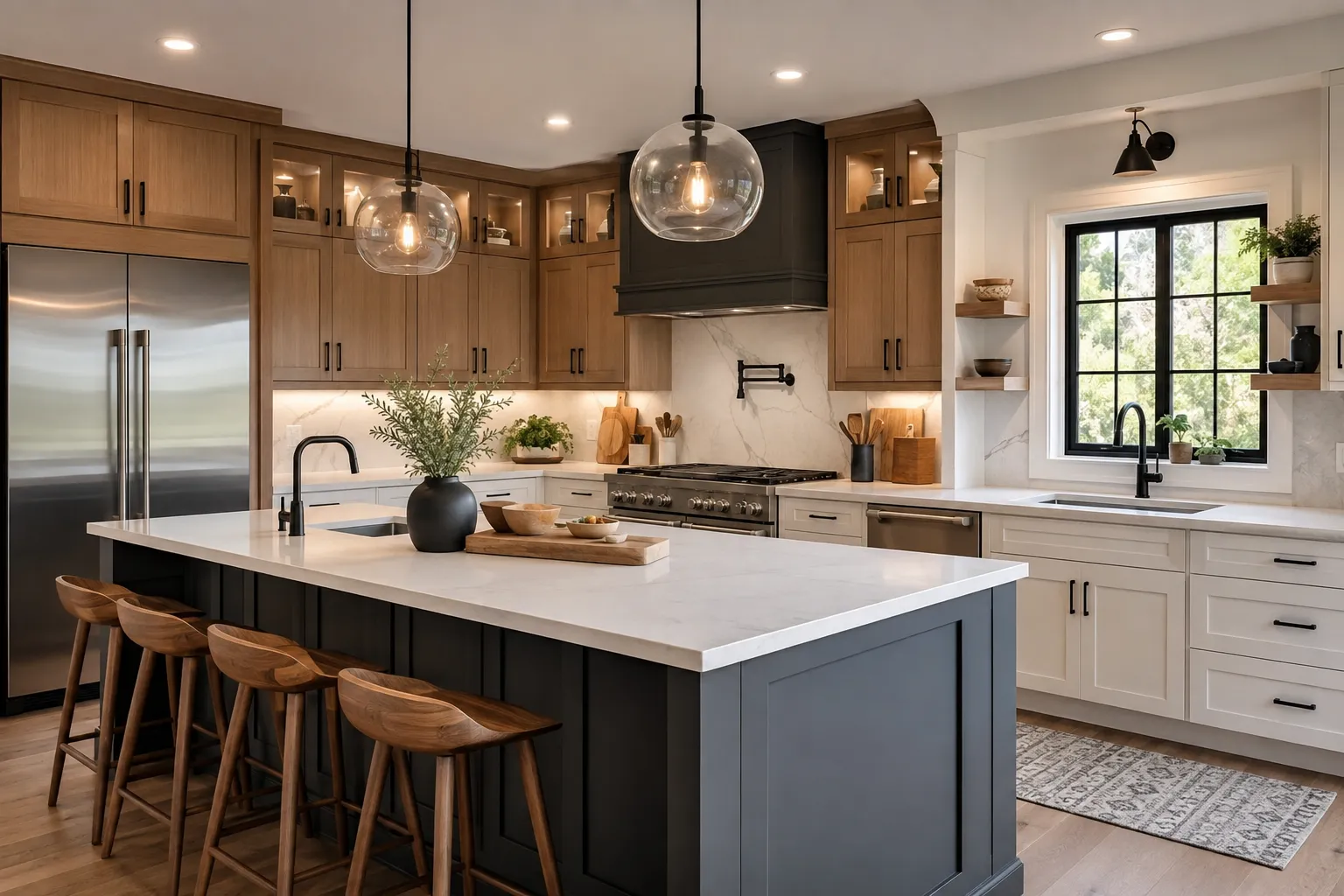
The homes and offices that get the most out of human-centric lighting are the ones where it’s planned at the design stage alongside layout, natural light access, and the rest of the automation ecosystem (climate, security, AV) rather than retrofitted room by room after the fact. Tunable-white fixtures, sensor placement, and scene programming all work better when they’re part of one coordinated system rather than a patchwork of add-ons.
At Immersive Technologies India, this is where we spend most of our design conversations with clients, not just “How bright should this room be?” But “How should this room’s light change across a day to actually support the people living in it?” That’s the real promise of a smart lighting solution in 2026: lighting that works with human biology instead of ignoring it.
Immersive Technologies India designs and integrates smart home, home theater, AV, security, and BMS systems across Gurugram, South Delhi, and Noida. To discuss a human-centric lighting design for your home or workspace, get in touch with our team.
















Sign in to leave a comment.