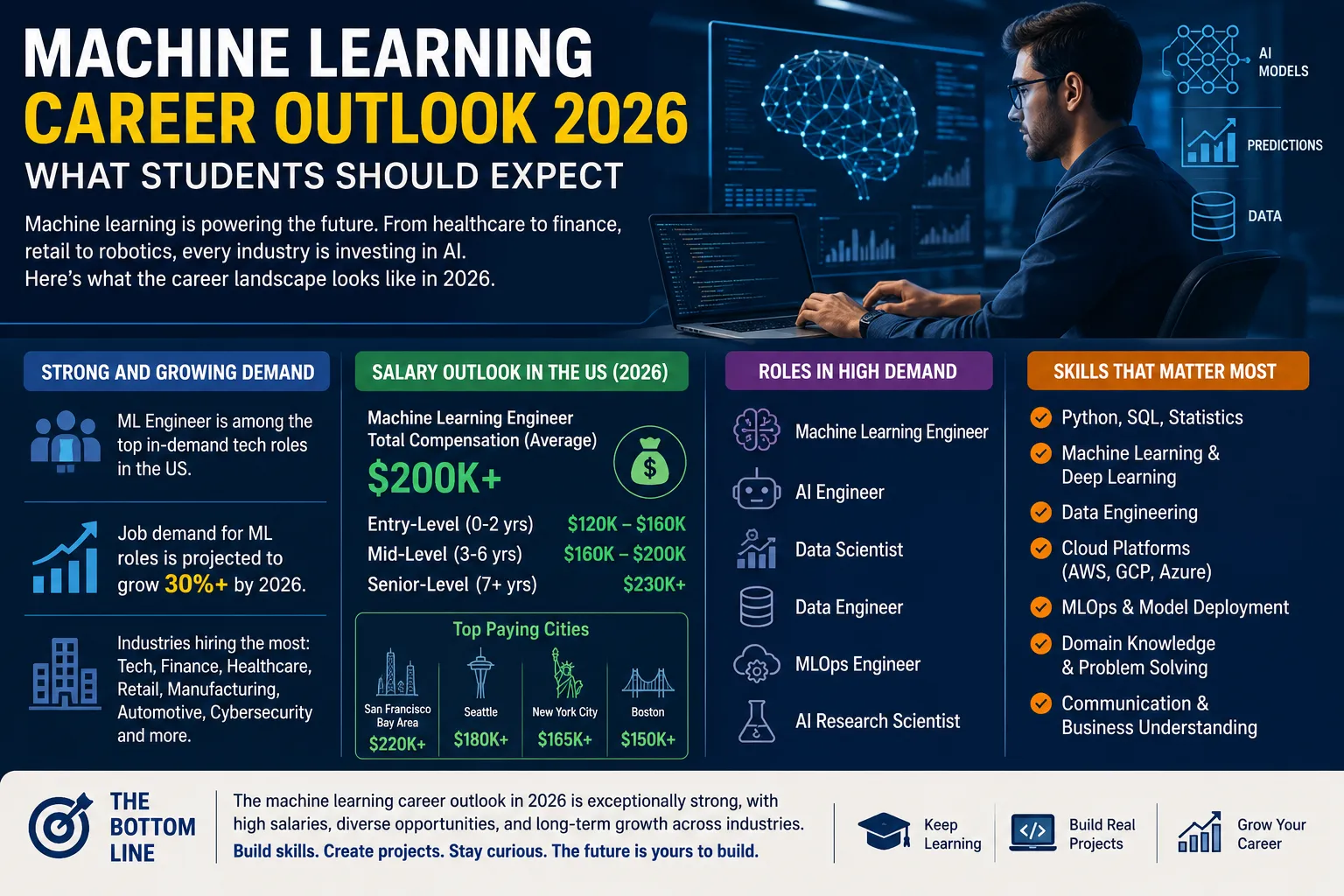

Artificial intelligence has moved from research labs into everyday business. Banks use it to detect fraud, hospitals rely on it to improve diagnoses, retailers predict customer demand with it, and manufacturers use it to reduce downtime. Behind these systems are machine learning professionals, making the machine learning career outlook one of the brightest opportunities for students planning their future in 2026.
The field is growing quickly, but it is also becoming more competitive. Companies are hiring aggressively, yet they are raising their expectations. Success no longer depends only on earning a degree. Employers want candidates who can build, test, and deploy machine learning solutions that solve real business problems.
AI Investment Is Fueling Strong Hiring Demand
Businesses are investing billions of dollars in artificial intelligence, and that investment is creating a steady demand for machine learning professionals.
According to the research, machine learning engineers are among the highest-paid technology specialists in the United States. Experienced professionals frequently earn total compensation well above $200,000, especially in major technology hubs where AI products are developed at scale. Even mid-level engineers enjoy salaries that exceed many traditional software development roles.
This demand is not limited to Silicon Valley.
Healthcare organizations need predictive analytics. Financial institutions require fraud detection models. Logistics companies optimize delivery routes through AI, while retailers forecast inventory using machine learning. Every industry now generates large amounts of data, creating opportunities for professionals who know how to turn information into business decisions.
Much like electricians became essential during the expansion of electricity, machine learning specialists are becoming essential as AI becomes part of everyday business operations.
The Best Jobs Are Becoming More Specialized
Not long ago, many companies hired general data scientists to perform a wide range of analytical tasks.
That approach is changing.
Organizations increasingly recruit specialists instead of generalists. Machine learning engineers focus on deploying AI models. Data engineers build the infrastructure that moves and stores information. Analytics engineers create reliable reporting systems, while decision scientists connect technical insights with business strategy.
For students, this shift creates an advantage.
Choosing a specialization early allows coursework, internships, and personal projects to support one clear career direction. Employers appreciate candidates whose experience matches the role they are hiring for instead of broad but shallow knowledge across many areas.
The result is a more focused career path and often a higher starting salary.
Practical Experience Now Outweighs Academic Prestige
One of the biggest messages from current hiring trends is that employers value demonstrated ability over university rankings.
Recruiters increasingly ask candidates to explain projects they have completed rather than simply reviewing their academic transcripts. They want to understand how applicants solved problems, selected algorithms, evaluated model performance, and communicated results to stakeholders.
Students can prepare for this reality long before graduation.
Building a portfolio with real datasets, publishing code on GitHub, participating in competitions, and completing internships all create stronger evidence of practical ability. Even classroom assignments can become valuable portfolio pieces when students expand them beyond the minimum requirements.
For learners tackling difficult concepts such as neural networks, deep learning, or predictive modeling, resources like Expertsmind.com, which connects students with experienced subject experts, can help clarify complex topics and strengthen project work that later becomes part of a professional portfolio.
Employers notice candidates who can demonstrate real experience, even if that experience began as a university assignment.
Is Machine Learning Still a Smart Career Choice?
Many students wonder whether AI will eventually automate the very jobs they hope to enter.
The research suggests the opposite.
While artificial intelligence is replacing repetitive analytical tasks, it also creates demand for professionals who can design, improve, monitor, and maintain AI systems. Companies still need experts who understand data quality, model performance, ethics, and deployment strategies. These responsibilities cannot simply be handed over to automated software.
The strongest candidates combine technical knowledge with business understanding. Knowing how to build an accurate prediction model is valuable, but explaining why it matters to an organization is what often separates outstanding professionals from average ones.
Continuous learning has also become part of the profession. Machine learning tools evolve rapidly, making curiosity and adaptability just as important as programming ability.
Students entering university today should view graduation as the beginning of their education rather than the finish line.
The machine learning career outlook remains exceptionally positive because organizations continue to expand their AI capabilities across every major industry. High salaries, strong job growth, and diverse career opportunities make machine learning one of the most rewarding technology careers available in 2026. Those who build practical skills, develop meaningful projects, and stay current with emerging technologies will be well positioned to thrive in an industry that continues to shape the future of business.































Sign in to leave a comment.