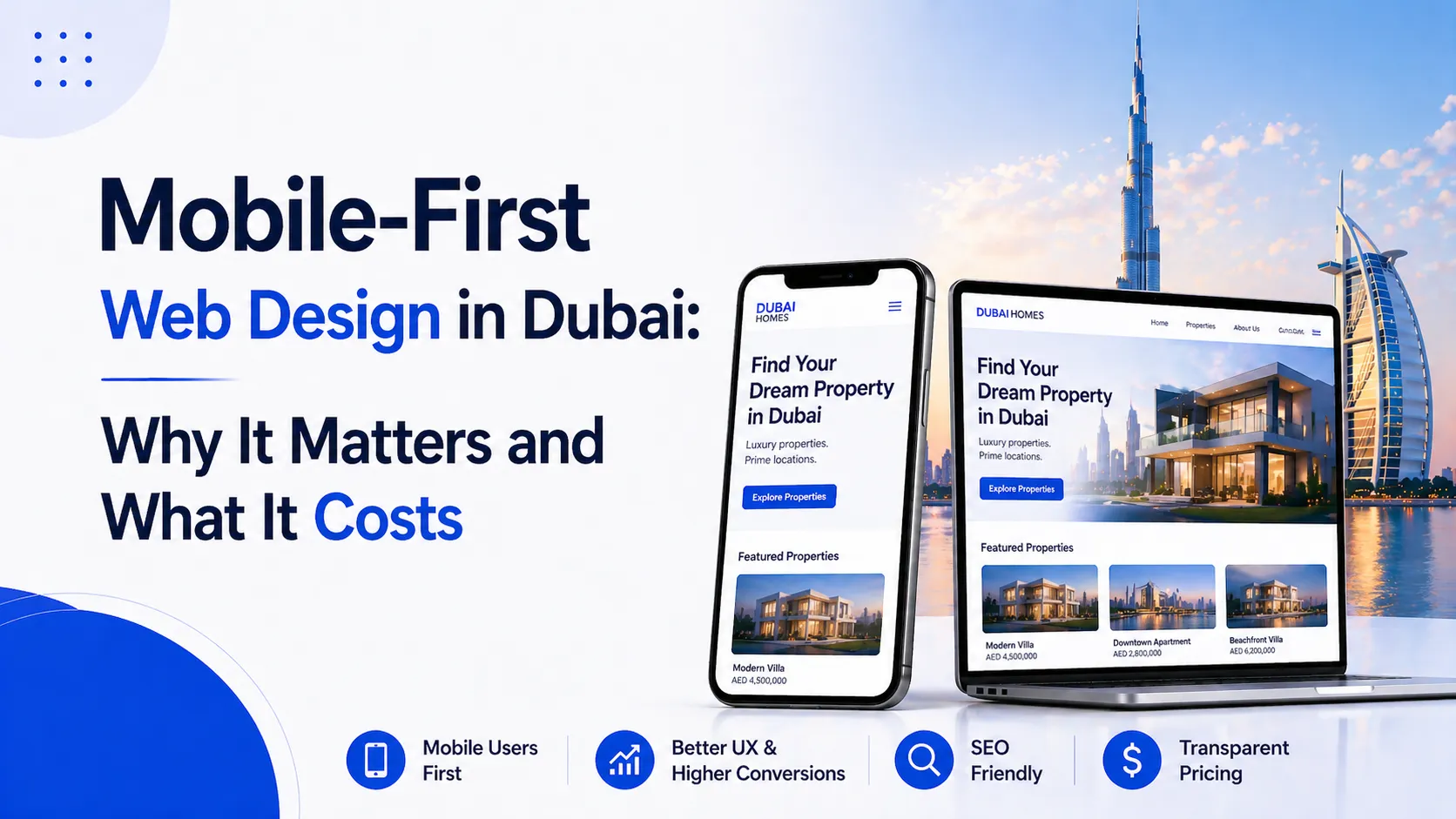

Here is a number worth sitting with: over 97% of people in the UAE own a smartphone. And over 70% of all web traffic in the country comes from mobile devices.
If your website was designed primarily for desktop,, even if it technically works on mobile — you are delivering a substandard experience to the majority of your visitors. In Dubai's market, where users have high expectations and competitors are just one tap away, a poor mobile experience does not just frustrate visitors. It loses them.
This guide explains what mobile-first web design actually means, why it matters specifically in the Dubai market, what it costs, and how to know whether your current website is meeting the standard.
What Does Mobile-First Web Design Actually Mean?
Mobile-first is a design philosophy, and a technical approach. It means designing and building a website starting with the smallest screen (mobile) and scaling up to tablet and desktop, rather than the traditional approach of designing for desktop and then trying to compress it down for mobile.
The difference matters more than it sounds.
A website designed desktop-first and then made "responsive" often produces a mobile experience that feels cramped, slow, or awkward, because the original design was never conceived for a small screen. Navigation elements are too close together. Text is too small. Images are oversized. Forms are difficult to fill in with a thumb.
A website designed mobile-first is built with the mobile user's experience as the primary consideration from the very beginning. Every design decision, button size, font size, navigation structure, image loading, and form layout is made with a mobile user in mind first. Desktop and tablet versions are then enhanced versions of that mobile foundation.
Why Mobile-First Matters More in Dubai Than Almost Anywhere Else
Dubai is one of the most mobile-connected cities in the world. The combination of high smartphone penetration, a young tech-savvy population, and a culture of on-the-go business and lifestyle activity means that mobile is not just how people browse casually, it is how they research products, compare services, request quotes, and make purchasing decisions.
Consider these UAE-specific realities:
- 97.6% smartphone penetration: virtually every potential customer in Dubai has a smartphone in their pocket
- 70%+ of web traffic in the UAE originates from mobile devices
- Google uses mobile-first indexing: it crawls and ranks the mobile version of your website, not the desktop version. If your mobile site is poor, your Google rankings suffer regardless of how good your desktop site looks
- UAE users abandon slow sites fast: research shows that 53% of mobile users leave a page that takes more than 3 seconds to load. In a market where expectations are high, patience is low
For Dubai businesses, a mobile-first website is not a premium option. It is the baseline.
How Mobile-First Design Affects Web Design Cost in Dubai
Mobile-first design does add cost to a web project, but the premium is smaller than most business owners expect, particularly when weighed against the cost of getting it wrong.
Here is how mobile-first considerations affect Web Design cost in Dubai:
| Cost Factor | Standard Responsive | Mobile-First |
|---|---|---|
| Design time | Base cost | +15–25% for mobile-first design approach |
| Development time | Base cost | +10–20% for mobile-optimised build |
| Performance optimisation | Optional add-on | Built into the process |
| Testing (cross-device) | Basic | Comprehensive across devices and screen sizes |
| Typical total premium | — | AED 2,000 – 8,000 on top of base project cost |
For a business website costing AED 12,000 built with genuine mobile-first principles, the mobile-first premium is typically AED 2,000–4,000. For a more complex eCommerce platform, it might add AED 5,000–10,000.
This cost is consistently justified by better user experience, stronger Google rankings, and higher conversion rates from mobile visitors, who represent the majority of your traffic.
For a full breakdown of how these costs fit into overall web design pricing in the UAE, this detailed guide on Website Development cost in Dubai gives you a complete picture across every website type and budget range.
What Mobile-First Web Design Includes in Practice
A genuinely mobile-first website in Dubai goes beyond simply making your desktop site shrink on a small screen. Here is what it actually involves:
Thumb-Friendly Navigation
On a mobile device, users navigate with their thumbs, not a mouse. Buttons need to be large enough to tap accurately (minimum 44x44 pixels). Navigation menus need to be accessible without requiring precise taps on tiny links. Key actions, call, WhatsApp, and contact form, should be reachable without scrolling.
Fast Load Times on Mobile Networks
Mobile users are not always on Wi-Fi. A website that loads quickly on a home broadband connection may load slowly on a 4G connection in a Dubai mall. Mobile-first development includes image optimisation, lazy loading, minified code, and caching, all configured specifically to perform on mobile network speeds.
Streamlined Mobile Layout
Desktop websites can carry navigation menus with multiple items, sidebars, wide content columns, and complex page structures. Mobile screens need a simplified, linear layout, one column, clear hierarchy, and progressive disclosure of information. A mobile-first designer makes these decisions deliberately, rather than compressing a complex desktop layout into a small screen.
Click-to-Call and WhatsApp Integration
In Dubai's business culture, WhatsApp is a primary communication channel. A mobile-first website should make it effortless for visitors to initiate a WhatsApp conversation or phone call with a single tap. This is one of the highest-converting features you can add to a Dubai business website, and it is only relevant on mobile.
Mobile-Optimised Forms
Long forms with many fields are abandoned at high rates on mobile. Mobile-first design means keeping forms short, using appropriate input types (numeric keyboard for phone numbers, email keyboard for email fields), and making form submission clear and frictionless on a touchscreen.
Arabic RTL Mobile Optimisation
For Dubai websites with Arabic language support, right-to-left layout on mobile requires specific design and development attention. Arabic text renders differently on mobile, and RTL layouts behave differently in mobile browsers than they do on desktop. Proper Arabic mobile optimisation is a separate consideration from desktop RTL implementation.
How to Test Whether Your Current Website Is Truly Mobile-Friendly
Before investing in a new build or redesign, assess where your current website stands:
Google's Mobile-Friendly Test: Google provides a free tool at search.google.com/test/mobile-friendly. Enter your URL, and it tells you immediately whether Google considers your site mobile-friendly and flags any specific issues.
Google PageSpeed Insights: Available at pagespeed.web.dev, this tool scores your website's performance on both mobile and desktop and provides specific, actionable recommendations. A mobile score below 70 indicates significant performance issues that are likely affecting both user experience and search rankings.
Manual Testing on Multiple Devices: Open your website on an iPhone, an Android phone, and a tablet. Navigate through the key pages. Try to use the contact form. Check that all buttons are tappable. Look for text that is too small, images that overflow the screen, or navigation that is difficult to use. What you experience is what your mobile visitors experience.
Google Analytics Mobile Traffic Report: In your Analytics dashboard, check what percentage of your traffic comes from mobile devices and compare the mobile bounce rate to the desktop bounce rate. If the mobile bounce rate is significantly higher, more than 15–20 percentage points, your mobile experience is underperforming.
Common Mobile Web Design Mistakes Dubai Businesses Make
Using full-size desktop images on mobile: A 2MB hero image that looks stunning on a widescreen monitor destroys mobile load times. Images should be served in appropriate sizes for the device, a technical implementation called responsive images.
Hiding content on mobile instead of redesigning for it: Some websites simply hide desktop elements on mobile rather than redesigning the experience. This reduces load time slightly but does nothing for user experience, and Google still crawls the hidden content.
Pop-ups that cover the full mobile screen: Google penalises websites with intrusive interstitials on mobile. A full-screen pop-up that is easy to dismiss on a desktop is impossible to close on a small screen, and it tanks both user experience and rankings.
Tiny tap targets: Links and buttons that are close together or too small to tap accurately force users to zoom in or accidentally tap the wrong element. This is one of the most common mobile usability failures in Dubai websites built without mobile-first principles.
No WhatsApp integration: Given how central WhatsApp is to business communication in the UAE, not having a WhatsApp click-to-chat button on a Dubai mobile website is a missed conversion opportunity.
Real Cost Scenario: Mobile-First Business Website in Dubai
Here is what a mobile-first business website investment looks like for a professional services firm in Dubai:
| Item | Cost (AED) |
|---|---|
| Mobile-first design (homepage + inner pages) | 10,000 |
| Development with performance optimisation | 8,000 |
| Arabic RTL mobile version | 3,500 |
| WhatsApp + click-to-call integration | 800 |
| Cross-device testing (10+ devices) | 1,500 |
| PageSpeed optimisation | 2,000 |
| Total | ~25,800 |
This is a mid-range investment for a genuinely mobile-optimised professional website. The alternative, a cheaper build that looks fine on desktop and passable on mobile, saves AED 5,000–8,000 upfront and costs considerably more in lost mobile conversions over its lifetime.
FAQs
Q1. Is mobile-first web design more expensive in Dubai?
Yes, but the premium is proportionate. Expect to pay 15–25% more than a standard responsive build for a genuinely mobile-first website. For most Dubai businesses, this adds AED 2,000–8,000 to a project, an investment that pays back through better mobile conversions and stronger Google rankings.
Q2. What is the difference between responsive design and mobile-first design? Responsive design means your website adapts to different screen sizes. Mobile-first means the design process starts with mobile as the primary experience. All responsive websites adapt to screens. Not all responsive websites are designed mobile-first, and the difference in quality is noticeable in practice.
Q3. Does Google really rank mobile websites differently?
Yes. Since 2019, Google has used mobile-first indexing for all websites, meaning it crawls and ranks the mobile version of your site. A website with a strong desktop experience but a poor mobile experience will rank based on its mobile performance. This makes mobile quality a direct SEO factor.
Q4. How do I know if my Dubai website is hurting my rankings because of mobile performance?
Check Google Search Console for mobile usability errors. Run PageSpeed Insights and compare your mobile score to your desktop score. If your mobile score is significantly lower, especially below 60, it is likely affecting your search rankings and should be addressed.
Q5. Should Arabic and English mobile experiences be designed separately?
The design approach can be shared, but the implementation needs separate attention. Arabic RTL on mobile has specific typography, layout, and interaction considerations that differ from English LTR. A web design agency experienced with bilingual Dubai websites will handle both within the same project scope.
Q6. What is the single most impactful mobile improvement a Dubai business can make? Page speed. A one-second improvement in mobile load time increases conversions by up to 27% according to Google research. If your website takes more than 3 seconds to load on mobile, fixing that single issue will have a measurable impact on leads and sales, often without any design changes at all.
Final Word
Mobile-first web design in Dubai is not a trend or a premium feature. It is the correct way to build a website for a market where the majority of your audience reaches you through a phone screen.
The Web Design Price in Dubai for a genuinely mobile-optimised website is higher than a standard build, but the gap between what you spend and what you gain back in mobile conversions, Google rankings, and user experience closes quickly.
Build for your audience. In Dubai, your audience is on mobile.

























Sign in to leave a comment.