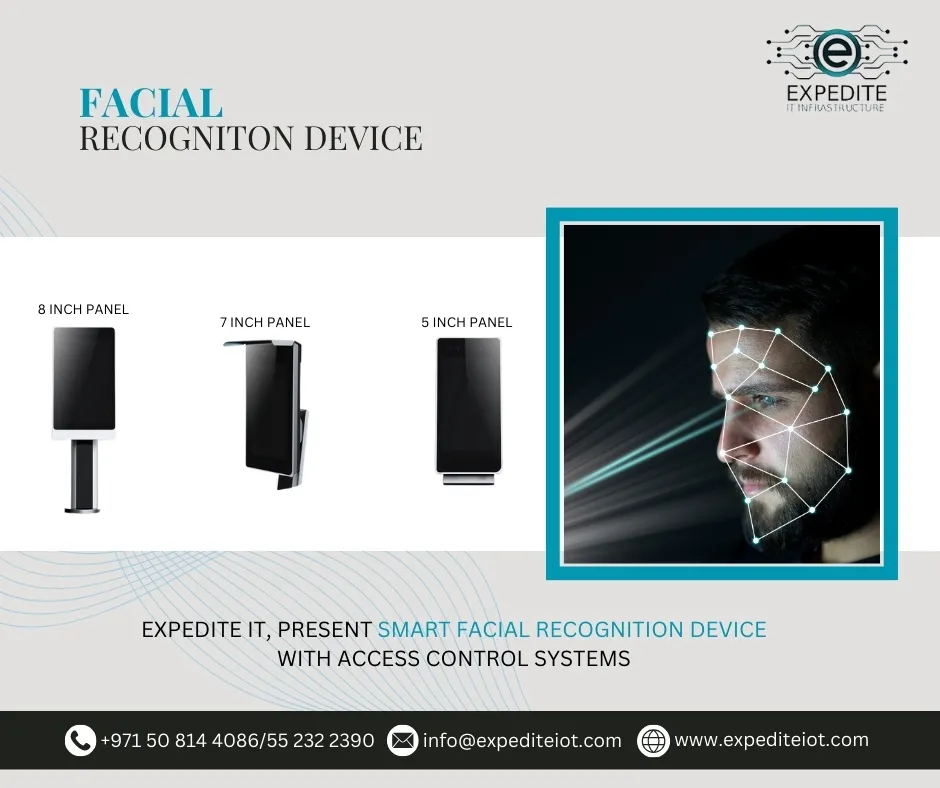

A Facial Recognition System has become the cornerstone of modern office access control across the UAE, replacing outdated swipe cards and PIN codes with fast, contactless, and highly secure biometric verification. As workplaces grow smarter, businesses in Dubai, Abu Dhabi, and beyond are adopting this transformative technology to safeguard assets, streamline entry, and meet international compliance standards. This guide explains how it works, why it matters, and how your organisation can deploy the right solution today.
What Is a Facial Recognition System and How Does It Work?
At its core, a Facial Recognition System is a biometric security platform that maps, analyses, and verifies a person’s facial geometry against a stored database to grant or deny access. The process is built on three sequential stages, each powered by deep-learning algorithms trained on millions of diverse facial datasets.
Stage 1: Face Detection
Face Detection is the first and most critical step. Infrared cameras or RGB sensors scan the entry point and detect the precise coordinates of a human face within the frame — even in low-light conditions or when the subject is wearing a cap or glasses. Advanced liveness-detection modules simultaneously distinguish between a live person and a printed photograph or screen replay, eliminating spoofing attempts before they begin.
Stage 2: Facial Identification
Facial Identification converts the detected face into a unique numerical “faceprint” by measuring distances between key landmarks — eyes, nose bridge, jawline, and cheekbones. This encrypted biometric template is then cross-referenced against the authorised-user database at speeds exceeding 50,000 comparisons per second, delivering a match result in under 0.3 seconds.
Stage 3: Facial Authentication
Facial Authentication is the decision layer. Once the system identifies a candidate match, it applies a configurable confidence threshold — typically 99.5% or above for high-security environments — to either unlock the door or trigger an alert. Multi-factor configurations can pair facial authentication with a mobile OTP or access card for dual-verification scenarios, meeting the strictest enterprise security policies.
Why UAE Businesses Are Adopting Biometric Access Control
The United Arab Emirates has positioned itself as a global smart-city benchmark, with government directives under UAE Vision 2031 and Dubai’s Smart Dubai initiative actively incentivising the integration of AI-powered security infrastructure. Corporations, free-zone operators, hospitality groups, and critical-infrastructure owners are all accelerating deployments for the following reasons:
- Zero-Touch Entry: Post-pandemic hygiene standards have made contactless verification a boardroom priority. Biometric entry eliminates shared surfaces entirely.
- Regulatory Compliance: UAE Labour Law and DIFC Data Protection Law 2020 require employers to maintain accurate attendance and access records; automated biometric logs satisfy both requirements seamlessly.
- Tailored Visitor Management: Visitor pre-registration via mobile app and automatic facial matching at reception desks reduces lobby congestion and removes manual guard dependency.
- Integration with Smart Building Ecosystems: Modern platforms connect with HVAC, elevator control, and CCTV systems to create a unified building intelligence layer.
- Real-Time Threat Alerts: Configurable watchlists trigger instant notifications to security operations centres when an unauthorised or flagged individual attempts entry.
Choosing the Right Facial Recognition Software
The intelligence behind any biometric deployment lives in its Facial Recognition Software. When evaluating platforms for UAE office environments, procurement teams should assess five key capability areas:
- Algorithm Accuracy (TAR/FAR Rates): Look for a True Acceptance Rate above 99% and a False Acceptance Rate below 0.001%. These NIST-benchmarked metrics determine real-world reliability.
- Edge vs. Cloud Processing: On-premise edge processing keeps biometric data within your facility, addressing UAE data-residency requirements; cloud hybrid models enable centralised multi-site management.
- Mask & Partial Occlusion Handling: Post-2020 workflows demand software capable of identifying individuals wearing face masks with greater than 97% accuracy.
- SDK & API Openness: RESTful APIs and well-documented SDKs allow seamless integration with existing HRM, payroll, and ERP platforms such as SAP or Oracle.
- Audit Trail & Reporting: Tamper-proof timestamped logs, exportable compliance reports, and GDPR/PDPL-aligned data retention policies are non-negotiable for regulated industries.
Hardware Overview: The Facial Recognition Device Landscape
Software capability only materialises when paired with the correct Facial Recognition Device. The UAE market offers several hardware categories, each suited to different deployment contexts:
Standalone Terminal Units
Wall-mounted terminals combine a high-resolution camera, infrared illuminator, processing SoC, and relay output in a single IP65-rated enclosure. These are ideal for single-door deployments at SME offices, server rooms, and executive suites. Operating temperatures up to 60°C make them well-suited to UAE outdoor installations.
Integrated Access Control Panels
For enterprise campuses with multiple entry points, facial recognition modules are embedded into or connected to centralised access control panels supporting Wiegand, OSDP, or RS-485 protocols. This architecture allows security teams to manage hundreds of doors from a single dashboard.
Turnstiles and Speed Gates
High-traffic lobbies in DIFC towers, logistics hubs, and manufacturing facilities benefit from bi-directional facial-recognition-enabled turnstiles that process up to 30 persons per minute while maintaining anti-tailgating detection.
Mobile Enrollment Stations
Portable kiosks enable rapid on-site enrolment of staff and contractors during large-scale projects or events, capturing high-quality biometric templates in under 10 seconds per person.
Deploying a Facial Recognition Solution in Your UAE Office: Step-by-Step
A successful Facial Recognition Solution deployment follows a structured methodology to ensure performance, compliance, and user adoption from day one.
- Site Survey & Security Audit: Evaluate entry points, lighting conditions, peak pedestrian flow, and existing infrastructure. Identify integration requirements with current CCTV, HRM, or ERP systems.
- System Design & Hardware Specification: Select camera resolution, field-of-view, processing architecture (edge/cloud), and relay output type based on site findings.
- Database Population & Enrolment: Capture high-quality facial templates for all authorised users. Best practice recommends three enrolment images per person under varied lighting conditions.
- Software Configuration & Threshold Calibration: Set confidence thresholds, define access schedules, configure anti-passback rules, and integrate watchlists.
- UAT & Performance Validation: Conduct user acceptance testing across demographic groups, lighting scenarios, and mask conditions before go-live.
- Staff Training & Change Management: Conduct briefing sessions, distribute quick-reference guides, and establish an IT helpdesk escalation path for end-user queries.
- Go-Live, Monitoring & Optimisation: Monitor False Rejection Rate in the first 30 days and fine-tune thresholds based on real-world performance data.
Facial Recognition System UAE: Compliance and Data Privacy Framework
Organisations deploying a Facial Recognition System UAE-wide must navigate a dual compliance landscape: federal biometric data regulations under the UAE Personal Data Protection Law (Federal Decree-Law No. 45 of 2021) and sector-specific mandates such as DIFC and ADGM data protection frameworks.
Key compliance practices include: obtaining explicit written consent from employees and visitors prior to enrolment; storing biometric templates in encrypted, access-controlled repositories separate from identity data; defining clear data retention periods (typically 12–24 months post-employment); and maintaining a Data Protection Impact Assessment (DPIA) for all high-volume deployments. Partnering with a certified integrator that has demonstrable UAE compliance experience significantly reduces legal exposure.
Facial Recognition System Dubai: Sector-Specific Applications
As the UAE’s commercial capital, Dubai hosts an especially diverse range of Facial Recognition System Dubai deployments across the following verticals:
- Financial Services (DIFC & Downtown): Banks and fintech firms use dual-factor facial authentication to secure trading floors, data centres, and executive boardrooms.
- Hospitality & Mixed-Use Developments: Five-star hotels on Sheikh Zayed Road deploy VIP facial recognition at club lounges and premium amenity zones for a frictionless guest experience.
- Logistics & Free Zones (JAFZA, DWC): Warehouse operators leverage high-throughput turnstile-integrated systems to manage thousands of shift workers across 24-hour operations.
- Healthcare: Hospitals and clinics use biometric access to restrict pharmaceutical storage areas and operating theatres to credentialled staff only.
- Government & Semi-Government Entities: Ministerial offices and public-sector buildings integrate national ID-linked biometric systems compliant with UAE PASS identity standards.
ROI and Total Cost of Ownership
Beyond security, the business case for biometric access control is compelling. Organisations typically report a 40–60% reduction in security-guard overheads at monitored entry points, a near-elimination of buddy-punching in attendance management, and measurable reductions in insurance premiums linked to demonstrable perimeter security upgrades. Hardware and software investments are commonly recovered within 18–24 months in mid-size organisations.
When comparing total cost of ownership against legacy card-based systems, factor in the ongoing cost of card issuance, replacement (average 15–20% annual card loss rate), and card-reader maintenance. Biometric templates, by contrast, never expire, cannot be lost, and cannot be shared — eliminating the single largest vulnerability in traditional physical access control.
Why Tektronix LLC Is Your Trusted Biometric Partner in the UAE
Tektronix LLC brings over a decade of field-proven experience delivering enterprise-grade facial recognition solutions across Dubai and the wider UAE. Our engineering team holds certifications from leading biometric hardware and software OEMs, and our project portfolio spans DIFC-regulated financial institutions, Dubai Municipality-approved facilities, and ISO 27001-certified data centres.
We offer end-to-end project ownership — from initial site survey through system design, certified installation, staff training, and 24/7 post-deployment support — ensuring your biometric access control investment delivers measurable performance from day one. Our SLA-backed maintenance contracts include firmware update management, algorithm recalibration, and annual DPIA review support.
Conclusion
The shift toward intelligent, contactless access control is not a future trend — it is the present operational standard for forward-thinking UAE organisations. By integrating a purpose-built Facial Recognition System with the right software platform, enterprise-grade devices, and a compliance-first deployment methodology, businesses across Dubai and the broader UAE can simultaneously strengthen security posture, reduce operational costs, and future-proof their facilities for the next decade of smart-city growth.
Whether you are retrofitting a single office entrance or designing a multi-site biometric network across the Emirates, choosing a certified local partner with demonstrable UAE deployment experience remains the single most important decision in your access control journey.
FAQs
1. How accurate is a Facial Recognition System in real-world UAE office environments?
Modern enterprise-grade systems achieve True Acceptance Rates exceeding 99.5% and False Acceptance Rates below 0.001% under controlled enrolment conditions. In UAE-specific deployments, performance is maintained across diverse demographic groups and remains consistent in high-ambient-light outdoor lobbies when appropriate infrared cameras are specified during the site survey.
2. Is storing employee biometric data legal under UAE law?
Yes, provided organisations obtain explicit informed consent from employees prior to enrolment, store templates in encrypted formats separate from personal identity data, define clear retention and deletion policies, and conduct a Data Protection Impact Assessment. The UAE Personal Data Protection Law (Federal Decree-Law No. 45 of 2021) and sector frameworks such as DIFC DPL 2020 govern biometric data handling, and non-compliance can attract significant penalties.
3. Can Facial Recognition Software integrate with our existing HRM and payroll system?
Yes. Leading platforms provide RESTful APIs and pre-built connectors for widely used HRM and ERP systems including SAP SuccessFactors, Oracle HCM, and Microsoft Dynamics 365. Attendance data — timestamped, device-tagged, and tamper-proof — is transferred automatically, eliminating manual timesheet reconciliation and the fraud risks associated with buddy-punching.
4. What is the typical installation timeline for a Facial Recognition Device deployment at a mid-size Dubai office?
A standard single-site deployment covering 3–5 entry points with 200–500 enrolled users typically requires 2–4 weeks from signed project order to go-live. This timeline encompasses site survey, equipment procurement, structured cabling, device installation, software configuration, database population, user acceptance testing, and staff training. Complex integrations with third-party systems or multi-site rollouts are scoped individually.
5. How does a Facial Recognition Solution handle employee who wear face masks or religious head coverings?
Current-generation algorithms are trained on partial-occlusion datasets and achieve greater than 97% identification accuracy for masked subjects by focusing on periocular features — the eye and upper-nasal region. For full-face coverings that leave only the eye area visible, systems can be configured for a fallback secondary verification method such as a mobile OTP or access card, ensuring inclusivity without compromising security integrity.






























Sign in to leave a comment.