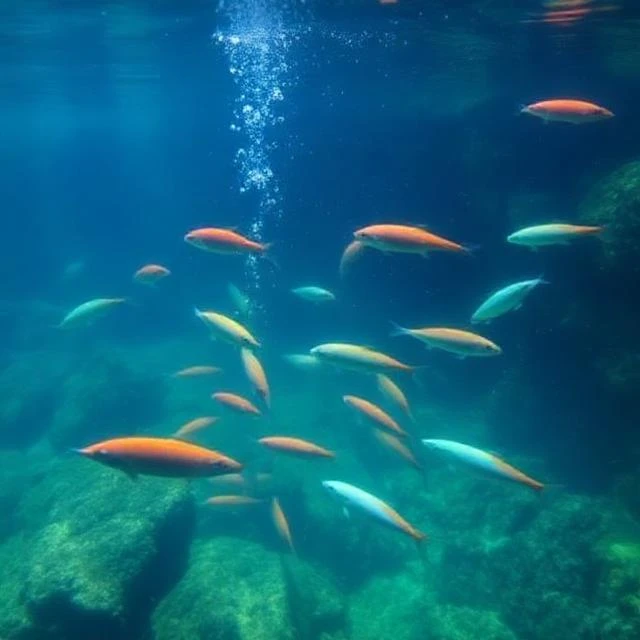
In the high-stakes world of American aquaculture, oxygen is the currency of survival. As the industry pivots toward high-density production to meet domestic demand, traditional aeration—the simple act of bubbling air through water—is reaching its physical limits. Standard bubbles are too buoyant, escaping to the surface before they can effectively transfer gas.
To overcome this, the industry is turning to nanobubble-based oxygenation systems for fish and shrimp farming, a technology that doesn't just add oxygen, but fundamentally changes the biological and physical environment of the tank.
1. The "Gas-Switching" Protocol: Engineering Dormancy for Survival
The most critical phase of the U.S. seafood supply chain is live transport. Whether moving shrimp from hatcheries to inland farms or transporting live fish to premium metropolitan markets, the "travel stress" leads to high mortality rates and metabolic waste buildup (ammonia) that degrades water quality.
Innovation has arrived in the form of a "Gas-Switching" protocol. By utilizing nanobubble generators capable of infusing different gases, operators can manipulate the metabolic state of the livestock:
- The Nitrogen Phase (Inducing Dormancy): Before transport, Nitrogen ($N_2$) nanobubbles are used to safely displace a controlled portion of dissolved oxygen. This induces a state of "metabolic sedation" or safe dormancy. In this state, the shrimp’s heart rate and respiration slow down significantly.
- The Oxygen Phase (Rapid Recovery): Upon arrival, the system switches to pure Oxygen ($O_2$) nanobubbles. Because nanobubbles have a high internal pressure and stay suspended for weeks, they provide a "supercharged" recovery environment, purging metabolic toxins and restoring energy levels instantly.
USA Application: This protocol is a game-changer for the live-seafood logistics between coastal hubs and inland states, with pilot studies showing a 40% reduction in mortality rates compared to traditional oxygen-packing methods.
2. The "Deep-Sea" RAS: Oxygenating the Vertical Frontier
As land costs rise, American aquaculture is moving upward. Vertical Recirculating Aquaculture Systems (RAS) utilize ultra-deep tanks to maximize yield per square foot. However, deep tanks create a massive aeration challenge: "Oxygen Stratification."
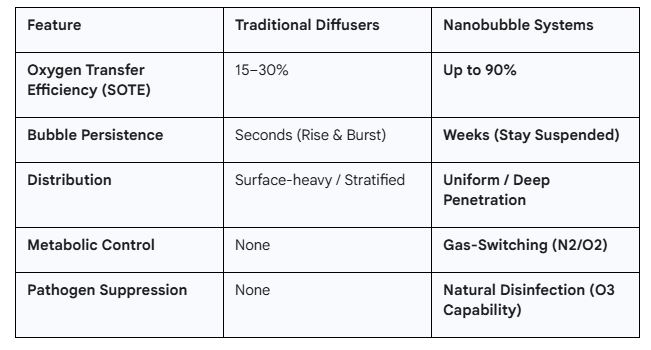
In a 20-foot deep tank, traditional macro-bubbles from a floor diffuser rise so quickly (due to buoyancy) that they only oxygenate the top few feet of the water column. This leaves the bottom—where shrimp often congregate—hypoxic (oxygen-depleted).
Nanobubbles solve the "Deep-Sea" problem through Neutral Buoyancy:
- Uniform Distribution: Because nanobubbles are governed by Brownian motion rather than buoyancy, they do not "rise." They stay suspended, moving laterally and vertically until the gas is fully dissolved.
+1
- Saturation Depth: They can be injected at the very bottom of deep tanks, maintaining a perfectly uniform $O_2$ profile from the floor to the surface.
- Biofilter Boost: In RAS systems, nanobubbles also penetrate the "biofilters" (where beneficial bacteria live), increasing the efficiency of ammonia-to-nitrate conversion by up to 60%.
3. Comparison: Traditional vs. Nanobubble Oxygenation
4. Biological Warfare: Pathogen Control without Chemicals
Beyond gas transfer, these systems act as a frontline defense against American aquaculture's biggest foe: Vibrio and other pathogens. When oxygenation systems are equipped with Ozone ($O_3$) nanobubbles, they provide a dual-action benefit.
The nanobubbles act as "disinfectant carriers," delivering ozone directly to the cell membranes of bacteria. This "Electro-Kinetic" attack reduces the need for antibiotics and chemical treatments, allowing U.S. farmers to market their product as "Clean Label" or organic-standard.
Conclusion: The Future is Small
The transition to nanobubble-infused oxygenation systems for fish and shrimp farming represents the "Smart" evolution of aquaculture. By mastering the ability to switch between nitrogen-induced dormancy and oxygen-rich recovery, and by solving the oxygenation limits of deep-tank vertical farming, the U.S. industry is securing a more resilient and profitable future. In the race to feed a growing population, the smallest bubbles are making the biggest splash.























Sign in to leave a comment.