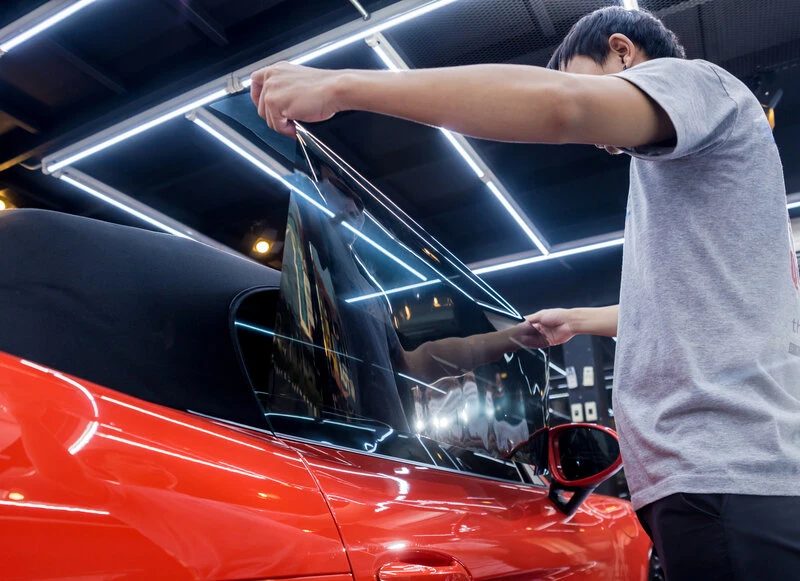
Let’s be brutally honest. You did everything right or so you thought. You heard “ceramic” was the magic word. You skipped the cheap dyed film, avoided the signal-blocking metallic stuff, and invested in what they promised was “premium ceramic tint.” You paid a pretty penny for it, too.
But here you are, a few months later. The sun’s out, and as you rest your arm on the window sill, that familiar, radiant warmth seeps through. It’s not the scorching inferno it once was, but it’s… present. A quiet, persistent reminder. Your interior is cooler, sure, but not cold. The AC is working less, but not little. A nagging thought whispers: Is this really it? Did I just pay a premium for a half-measure?
If this is your reality, take a deep breath. You’re not imagining things, and you didn’t necessarily get scammed. You likely got exactly what you paid for: a good ceramic tint. But here’s the secret the industry doesn’t shout about: In the world of heat rejection, ‘good’ ceramic is often the gateway drug. ‘Great’ is called nano-ceramic.
The difference isn’t just incremental; it’s a fundamental shift in how the film battles the sun. Understanding this shift is the key to finally getting the true, blissful cool you originally dreamed of.
The Ceramic Ceiling: Why Even Good Tint Has Limits
First, let’s diagnose the lingering warmth. Your high-quality ceramic tint works primarily through absorption. Think of its microscopic ceramic particles as an army of incredibly efficient, heat-hungry sponges. They are suspended in the film’s layers, and their job is to soak up infrared radiation (IR) the invisible light that carries heat like a desert soaks up rain. Learn more about maximizing your vehicle’s comfort with OC Tint Solutions.
This is brilliant technology. It’s non-metallic (so no signal interference), color-stable (no purple fade), and it absorbs a massive amount of that IR energy. But here’s the catch: Energy cannot be destroyed, only transferred.
What happens to all that heat the film sponges up? It has to go somewhere. The film dissipates it in two directions: some radiates back outward, away from your car, but a significant portion is also re-radiated inward, into your cabin. It’s a slower, less intense heat than direct IR, but it’s heat nonetheless. It’s like having a heatsink on your window—it’s managing the heat, but it’s still warm to the touch.
This is the "ceramic ceiling." There’s a physical limit to how much heat a film can absorb before it simply can’t hold anymore and becomes a thermal reservoir itself. You feel this as that radiant warmth through the glass.
The Nano-Ceramic Breakthrough: The Art of Rejection
Now, enter nano-ceramic. If ceramic technology is the sponge, nano-ceramic is the mirror and the sponge.
The "nano" prefix isn't just marketing jargon. It refers to the particle size—engineered at the nanometer scale (a billionth of a meter). This isn't just about making things smaller; it's about enabling a different physical behavior. At this scale, and through advanced multi-layer construction, nano-ceramic films don't just absorb IR—they actively reflect a substantial portion of it.
Imagine the film’s structure as a highly organized, layered defense system:
- The Outer Mirror Layer: The nano-particles are arranged to act like a selective, invisible shield. When IR radiation hits it, a portion is immediately bounced away, reflected back into the atmosphere before it can ever transfer its energy to the glass or the film.
- The Inner Sponge Layer: The remaining IR that isn’t reflected is then dealt with by the traditional, high-performance ceramic absorption technology.
This dual-action approach is a game-changer. By reflecting a chunk of the heat at the door, the film has less overall energy to manage. It doesn’t get as "saturated." This means less heat is ever transferred to the glass, and crucially, far less is re-radiated into your cabin.
The Difference You Can Actually Feel
This technical shift translates into sensations you can measure with your own skin.
1. The "Touch Test" Discrepancy.
Place your hand near the window of a car with a premium ceramic tint on a hot day. You’ll feel a noticeable radiant heat emanating from the glass itself. Now, do the same in a car with a high-end nano-ceramic film. The sensation is dramatically reduced. The glass feels closer to ambient air temperature. Why? Because less heat energy made it to the glass in the first place.
2. The Cabin Cool-Down Rate.
This is where nano-ceramic truly shines. Both films will result in a lower peak interior temperature. But the car with nano-ceramic will get to that lower temperature faster and maintain it with less effort from your AC. The thermal load on the entire cabin is simply lower. It’s the difference between turning off a space heater (ceramic absorption) and never having turned it on in the first place (nano-ceramic reflection).
3. Performance in a Lighter Shade.
Perhaps the most practical advantage: nano-ceramic technology often achieves its maximum heat rejection in a lighter, more transparent shade. You can get a 70% VLT (very light) nano-ceramic film on your windshield that rejects more heat than a 20% VLT (very dark) standard ceramic film on your side windows. This means you can stay completely legal, maintain pristine nighttime visibility, and still get the ultimate in heat protection. You are no longer trading clarity for coolness.
The Reality Check: Is It Worth the Upgrade?
Let’s talk numbers and nuance. High-end nano-ceramic films (brands like LLumar IRX, 3M Ceramic IR, or Xpel XR Plus) can cost 20-40% more than their already-premium ceramic counterparts (like LLumar CTX or 3M Crystalline).
Is it worth it? Consider your profile:
- Worth It If: You live in a desert or extreme summer climate. You own an electric vehicle (where reducing AC load directly increases your range).
- You have a black interior or a convertible. You are hyper-sensitive to heat. You want the absolute best clarity and heat rejection for your windshield. You plan to keep the car for 5+ years.
- Maybe Overkill If: You live in a temperate climate. Your current ceramic tint is 90% satisfactory. Your budget is strict. You lease your car or plan to sell it soon.
Think of it this way: Standard ceramic tint is like a high-quality down jacket—it’s incredibly warm by trapping your body heat. Nano-ceramic is like a modern, reflective alpine shell—it actively prevents the cold (or in this case, heat) from reaching you in the first place. For a winter stroll, the down jacket is perfect. For climbing K2, you want the shell.
The Final Verdict
If you paid for ceramic and still feel some heat, you didn't make a bad choice. You made a very good one. Ceramic tint is a massive leap over anything that came before it. But technology marches on.
Your lingering warmth isn't a failure; it's a signal. It’s the feeling of the "ceramic ceiling." Nano-ceramic is the next evolutionary step, designed to shatter that ceiling by changing the fundamental strategy from absorption to intelligent rejection.





























Sign in to leave a comment.