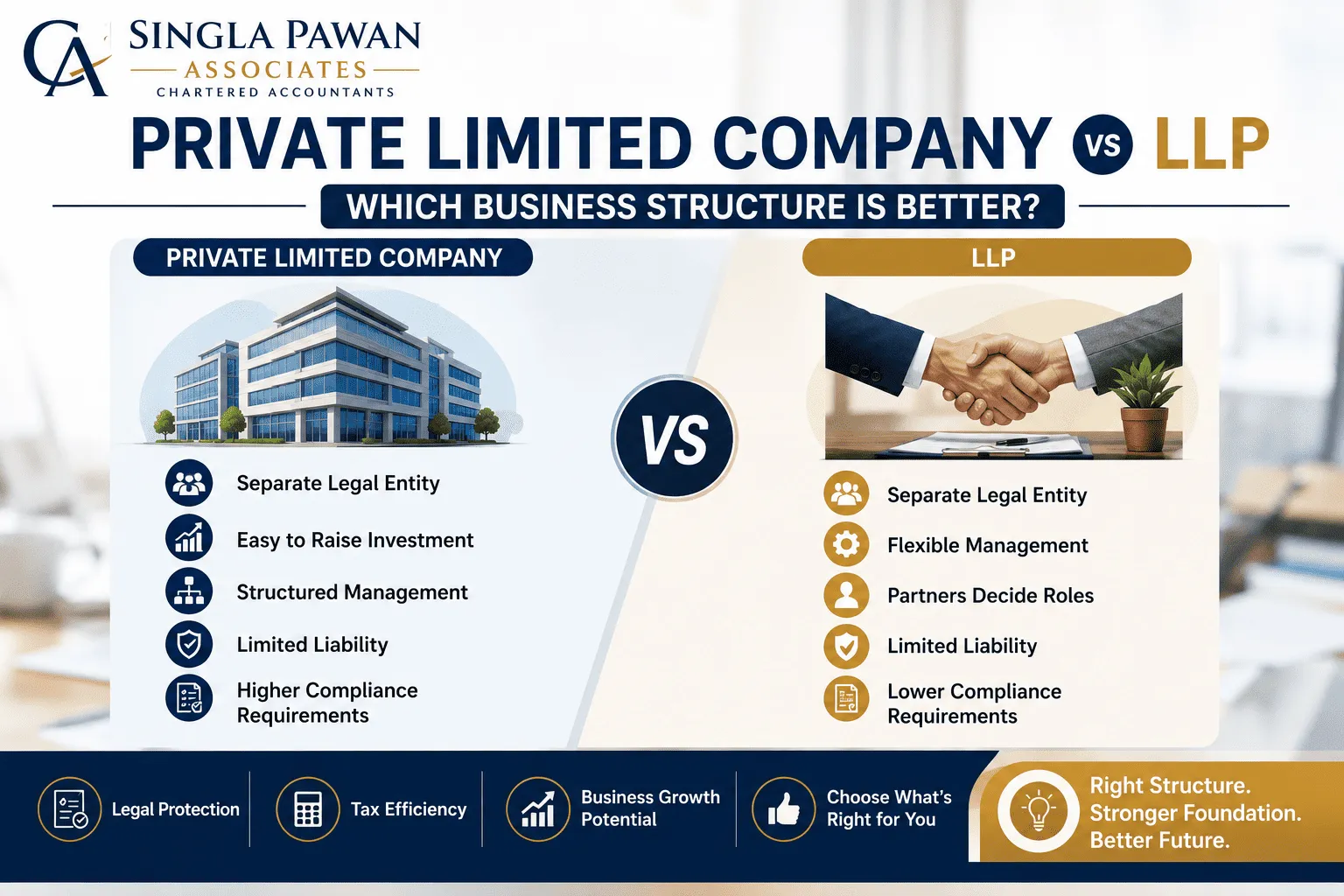

Choosing the right business structure is one of the most important decisions when starting a business in India. Two popular options are a Private Limited Company (Pvt Ltd) and a Limited Liability Partnership (LLP).
Both structures provide limited liability protection, but they differ in ownership, compliance, taxation, management, and funding options. The right choice depends on your business goals, number of partners, investment plans, and long-term vision.
What Is a Private Limited Company?
A Private Limited Company is a separate legal entity owned by shareholders and managed by directors. It is a popular structure for startups, growing businesses, and companies that plan to raise investment.
A Private Limited Company can have shareholders, directors, and employees, making it suitable for businesses that want a structured management system.
Key Features of a Private Limited Company
- Separate legal identity
- Limited liability for shareholders
- Ownership divided into shares
- Suitable for raising external investment
- Structured management through directors
- More regulatory and compliance requirements
What Is an LLP?
A Limited Liability Partnership combines features of a traditional partnership with limited liability protection.
An LLP is managed by partners according to an LLP agreement. It can be suitable for professional firms, consulting businesses, service providers, and businesses where the owners want flexibility in management.
Key Features of an LLP
- Separate legal entity
- Limited liability protection
- Flexible management structure
- Partners can decide their roles through an agreement
- Generally fewer compliance requirements than a Private Limited Company
- Suitable for businesses that do not require frequent external investment
Private Limited Company vs LLP
| Feature | Private Limited Company | LLP |
|---|---|---|
| Ownership | Shareholders | Partners |
| Management | Directors | Partners |
| Liability | Limited | Limited |
| Ownership Transfer | Generally easier through shares | Depends on LLP agreement |
| External Investment | More suitable | Less suitable |
| Compliance | Comparatively higher | Comparatively lower |
| Management Flexibility | More structured | More flexible |
| Suitable For | Startups and growing companies | Professional and service businesses |
1. Difference in Ownership
In a Private Limited Company, ownership is represented through shares. Shareholders own the company, while directors manage its operations.
In an LLP, ownership and management are generally connected to the partners and the terms agreed in the LLP agreement.
If you expect to bring in multiple investors or transfer ownership through shares, a Private Limited Company may provide a more suitable structure.
2. Difference in Compliance
A Private Limited Company generally has more formal compliance requirements. Companies need to maintain statutory records and complete required filings.
An LLP also has compliance requirements, but its structure can be more flexible and may be more suitable for businesses looking for comparatively simpler administration.
Businesses should consider the time and cost involved in maintaining compliance before choosing their structure.
3. Raising Investment
If your long-term plan is to raise funding from investors, a Private Limited Company is generally more suitable.
Investors can invest in a company in exchange for shares, making the structure familiar to venture capital firms, angel investors, and other investors.
An LLP can also accept investment under appropriate arrangements, but it may not provide the same structure for equity-based investment.
4. Management Flexibility
An LLP offers considerable flexibility because partners can define their responsibilities, profit-sharing arrangements, and management structure through the LLP agreement.
A Private Limited Company has a more formal structure involving shareholders and directors.
Therefore, businesses that want a flexible partner-led management model may prefer an LLP.
5. Liability Protection
Both structures provide limited liability protection when properly maintained.
In a Private Limited Company, shareholders generally have liability limited to their investment in the company.
In an LLP, partners generally have limited liability, subject to applicable law and circumstances.
This protection can be an important reason for choosing either structure instead of operating as an informal partnership or sole proprietorship.
6. Which Structure Is Better for Startups?
A Private Limited Company may be a better choice for startups that:
- Plan to raise external funding
- Want to issue shares
- Expect rapid business growth
- Want to bring in investors
- May eventually explore larger corporate opportunities
However, not every startup needs outside investment. If the business is primarily partner-owned and does not require equity funding, an LLP may also be worth considering.
7. Which Structure Is Better for Professional Businesses?
LLPs can be attractive for professional and service-based businesses where two or more professionals want to work together.
For example, consulting firms, professional service businesses, and other partner-driven businesses may prefer an LLP because of its flexible management structure.
However, the best structure depends on the nature and future plans of the business.
Private Limited Company or LLP: Which One Should You Choose?
There is no single answer that works for every business.
Choose a Private Limited Company if:
- You want to raise investment.
- You want a share-based ownership structure.
- You expect significant business growth.
- You want to bring in investors or shareholders.
- You prefer a formal corporate structure.
Consider an LLP if:
- The business is owned by a small group of partners.
- You want flexible management.
- You operate a professional or service-based business.
- You do not expect significant equity investment.
- You want a comparatively simpler business structure.
Why Professional Advice Matters
Choosing a business structure should not be based only on registration cost. You should also consider taxation, compliance, funding requirements, ownership, liability, business growth, and your long-term plans.
A Chartered Accountant can help you understand the financial and compliance implications before you register your business.
Singla Pawan Associates
Singla Pawan Associates provides accounting, taxation, compliance, and Chartered Accountant services for businesses and individuals.
If you are planning to start a business and are unsure whether a Private Limited Company or LLP is suitable for you, professional guidance can help you evaluate your business requirements and choose an appropriate structure.
Final Thoughts
Both Private Limited Companies and LLPs offer important advantages. A Private Limited Company is often suitable for businesses focused on investment, structured ownership, and expansion, while an LLP can be a practical option for partner-led businesses seeking flexibility.
Before making a decision, consider your business goals, investment plans, number of owners, compliance requirements, and long-term growth strategy.
Note: Business registration, taxation, and compliance rules can change and may depend on individual circumstances. Consult a qualified Chartered Accountant or professional advisor for advice specific to your business.





























Sign in to leave a comment.