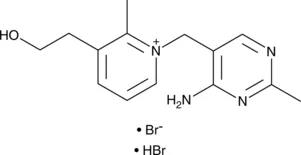

Pyrithiamine (hydrobromide) is a thiamine analogue that inhibits the metabolism of thiamine (vitamin B1)[1]. Pyrithiamine (hydrobromide) has high affinity to thiamine transporters in neurons, with a Kd of approximately 60 nM[2]. Pyrithiamine (hydrobromide) is also a substrate of thiamine pyrophosphate kinase (TPK) and can be converted into pyrithiamine pyrophosphate (PPP)[3]. Pyrithiamine (hydrobromide) can be used in microbial culture to inhibit the growth of microorganisms that require thiamine[4].
In vitro, Pyrithiamine (hydrobromide) (10μM) treated the HeLa cell line for 4 days, significantly reducing cellular nucleotide levels, and intracellular dATP, dCTP, dGTP and dTTP were all reduced[5]. Pyrithiamine (hydrobromide) (0.25mM) treated Neuro 2a cells, resulting in a strong reduction in intracellular ThDP levels, and the cells began to die after 48 hours [6].
In vivo, Pyrithiamine (hydrobromide) (250 or 500 μg/kg/day) treated mice by intraperitoneal injection for 4 weeks, causing thiamine deficiency, leading to cognitive dysfunction and neuropathological changes in wild-type mice, but it had no effect on existing mice. There is no corresponding effect on AD model mice with obvious cognitive impairment [7]. Pyrithiamine (hydrobromide) (0.5g/kg) was administered intraperitoneally to rats for 11 days, causing thiamine deficiency, leading to enlargement of the lateral ventricles and reduced levels of choline-containing compounds in the body [8].
References:
[1] Chauhan A, Srivastva N, Bubber P. Thiamine deficiency induced dietary disparity promotes oxidative stress and neurodegeneration[J]. Indian Journal of Clinical Biochemistry, 2018, 33: 422-428.
[2] Mulholland P J, Self R L, Stepanyan T D, et al. Thiamine deficiency in the pathogenesis of chronic ethanol-associated cerebellar damage in vitro[J]. Neuroscience, 2005, 135(4): 1129-1139.
[3] Liu J Y, Timm D E, Hurley T D. Pyrithiamine as a substrate for thiamine pyrophosphokinase[J]. Journal of biological chemistry, 2006, 281(10): 6601-6607.
[4]Brandenburger E, Gressler M, Leonhardt R, et al. A highly conserved basidiomycete peptide synthetase produces a trimeric hydroxamate siderophore[J]. Applied and Environmental Microbiology, 2017, 83(21): e01478-17.
[5]Tiwana G S, Prevo R, Buffa F M, et al. Identification of vitamin B1 metabolism as a tumor-specific radiosensitizing pathway using a high-throughput colony formation screen[J]. Oncotarget, 2015, 6(8): 5978.
[6]Sambon M, Napp A, Demelenne A, et al. Thiamine and benfotiamine protect neuroblastoma cells against paraquat and β-amyloid toxicity by a coenzyme-independent mechanism[J]. Heliyon, 2019, 5(5).
[7]Zhao J, Sun X, Yu Z, et al. Exposure to pyrithiamine increases β-amyloid accumulation, Tau hyperphosphorylation, and glycogen synthase kinase-3 activity in the brain[J]. Neurotoxicity research, 2011, 19: 575-583.
[8]Zahr N M, Sullivan E V, Rohlfing T, et al. Concomitants of alcoholism: differential effects of thiamine deficiency, liver damage, and food deprivation on the rat brain in vivo[J]. Psychopharmacology, 2016, 233: 2675-2686.
Protocol of Pyrithiamine (hydrobromide)
Cell experiment [1]:
Cell lines HeLa cells
Preparation method Cells were incubated for four days in 10μM Pyrithiamine (hydrobromide) in low thiamine medium prior to irradiation.
Reaction Conditions 10μM; 4 days
Applications dATP, dCTP, dGTP and dTTP were all reduced in cells treated with Pyrithiamine (hydrobromide).
Animal experiment [2]:
Animal models AD model mice、WT mice
Preparation method mice were randomly divided into four groups respectively: control group, Pyrithiamine(hydrobromide) 250μg/kg/day group (hereafter the PT250 group), Pyrithiamine(hydrobromide) 500μg/kg/day group (PT500 group) and diet-induced TD group. The mice in TD group were fed a pelleted thiamine-depleted diet for four weeks. The control and PT groups received a normal thiamine-containing diet for 4 weeks. PT250 and PT500 groups received a daily intraperitoneal injection of Pyrithiamine(hydrobromide) (250 or 500μg/kg/day) for 4 weeks.
Dosage form 250 or 500μg/kg/day; i.p.
Applications Pyrithiamine(hydrobromide) treatment significantly impairs the cognitive functions of wild-type mice, but has no corresponding effects on ADmodel mice that already have obvious cognitive impairment.
References:
[1]Tiwana G S, Prevo R, Buffa F M, et al. Identification of vitamin B1 metabolism as a tumor-specific radiosensitizing pathway using a high-throughput colony formation screen[J]. Oncotarget, 2015, 6(8): 5978.
[2]Zhao J, Sun X, Yu Z, et al. Exposure to pyrithiamine increases β-amyloid accumulation, Tau hyperphosphorylation, and glycogen synthase kinase-3 activity in the brain[J]. Neurotoxicity research, 2011, 19: 575-583.
Chemical Properties of Pyrithiamine (hydrobromide)
Cas No. 534-64-5 SDF
Chemical Name 1-[(4-amino-2-methyl-5-pyrimidinyl)methyl]-3-(2-hydroxyethyl)-2-methyl-pyridinium, bromide, monohydrobromide
Canonical SMILES CC1=[N+](CC2=C(N)N=C(C)N=C2)C=CC=C1CCO.[Br-].Br
Formula C14H19N4O•HBr•Br M.Wt 420.1
Solubility 5mg/mL in PBS (pH 7.2) Storage Store at -20°C
General tips Please select the appropriate solvent to prepare the stock solution according to the solubility of the product in different solvents; once the solution is prepared, please store it in separate packages to avoid product failure caused by repeated freezing and thawing.Storage method and period of the stock solution: When stored at -80°C, please use it within 6 months; when stored at -20°C, please use it within 1 month.
To increase solubility, heat the tube to 37°C and then oscillate in an ultrasonic bath for some time.
Shipping Condition Evaluation sample solution: shipped with blue ice. All other sizes available: with RT, or with Blue Ice upon request.
























Sign in to leave a comment.