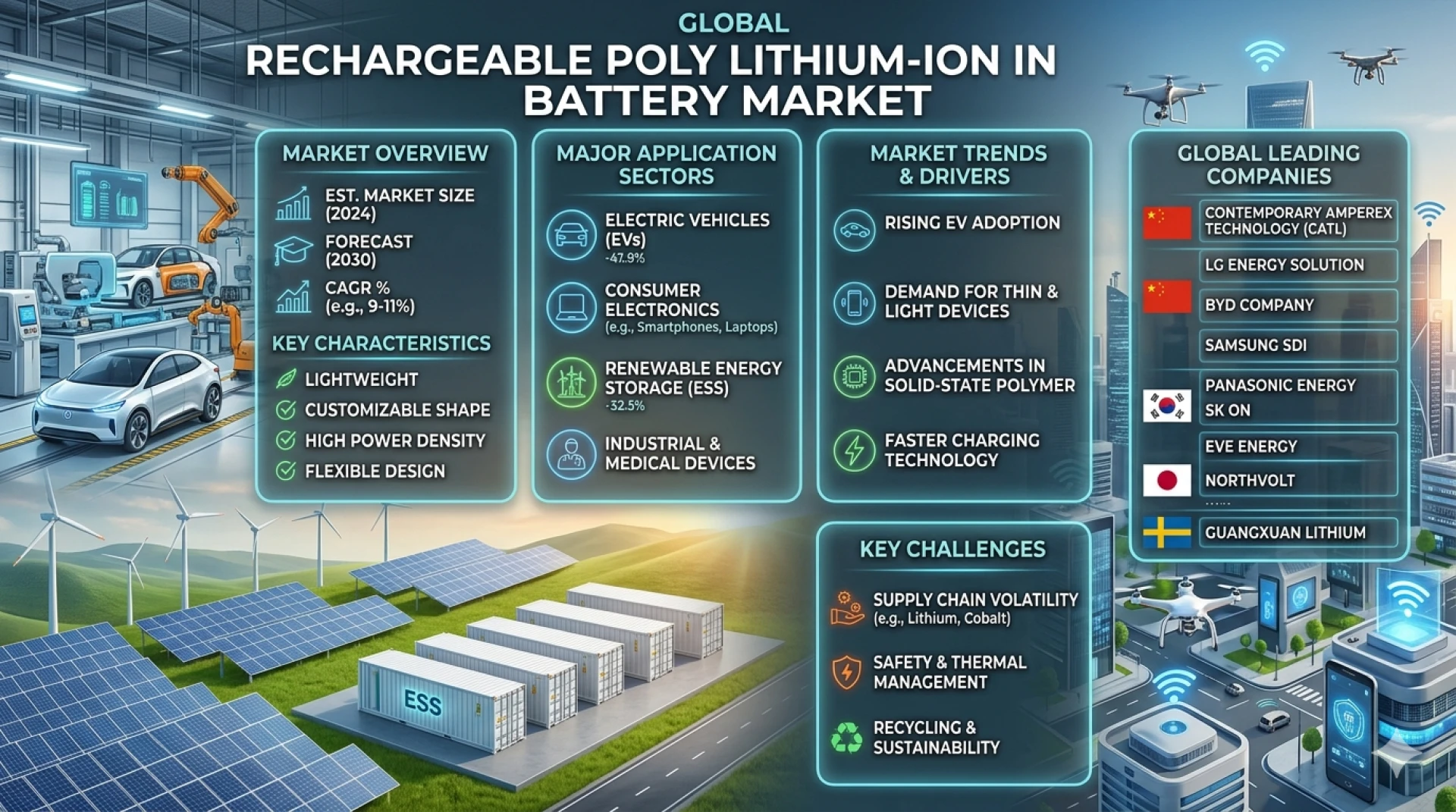

The global rechargeable poly lithium-ion (Li-Poly) battery market is witnessing strong and sustained growth, fueled by the rapid expansion of electric vehicles (EVs), consumer electronics, and renewable energy systems. According to Grand View Research, the market was valued at USD 144.99 billion in 2024 and is projected to reach USD 252.99 billion by 2030, growing at a CAGR of 9.5%.
These batteries are increasingly preferred due to their high energy density, lightweight structure, flexible design, and longer lifecycle, making them a cornerstone technology for modern energy storage solutions.
Market Overview & Growth Drivers
The rechargeable poly lithium-ion battery market is being shaped by multiple macro and technological factors:
- Electric mobility revolution: The rapid adoption of EVs, supported by government incentives and emission regulations, is a major growth catalyst.
- Consumer electronics boom: Rising demand for smartphones, laptops, tablets, and wearables continues to drive large-scale battery consumption.
- Renewable energy integration: Increasing deployment of solar and wind energy systems is boosting the need for efficient energy storage solutions.
- Technological advancements: Improvements in battery chemistry, safety, and cost efficiency are accelerating adoption across industries.
In simple terms: everything that needs portable or stored energy is pushing this market forward.
Market Trends & Strategic
The rechargeable poly lithium-ion battery market is intensifying across several fronts:
- EV dominance: The shift toward electric mobility is the biggest structural driver
- Energy transition: Batteries are becoming essential for renewable energy ecosystems
- Cost decline: Economies of scale are making batteries more affordable
- Innovation race: Solid-state and next-gen chemistries are reshaping competition
- Supply chain challenges: Dependence on lithium, cobalt, and nickel remains a critical risk
The competitive intensity is rising as companies race to scale production, secure raw materials, and innovate faster than rivals.
Application Insights
The market is segmented across several key applications:
Electric Vehicles (EVs)
The EV segment dominates the market, accounting for over 33% revenue share in 2024 and expected to grow at the fastest pace.
Li-Poly batteries are ideal for EVs due to:
- High energy output
- Fast charging capability
- Long operational life
Consumer Electronics
Devices such as smartphones, laptops, and wearables heavily rely on Li-Poly batteries because of their compact size and superior performance.
Power & Energy Storage
The power segment is gaining momentum due to:
- Growing demand for backup power systems
- Increased deployment in renewable energy storage
- Rising need for grid stabilization solutions
Industrial Applications
Industrial uses include:
- Telecom infrastructure
- Data centers
- Medical devices
- Remote power systems
Structure Insights
Rechargeable poly lithium-ion batteries are categorized into two primary structures:
Cylindrical Cells
- Held over 55% market share in 2024
- Known for durability, cost efficiency, and standardized design
- Widely used in EVs, electronics, and power tools
Prismatic Cells
- Compact and space-efficient
- Ideal for applications requiring slim battery designs
- Increasingly used in EVs and renewable energy storage
Both formats are evolving with improvements in thermal stability, energy density, and safety features.
Regional Insights
Asia Pacific (Market Leader)
- Accounted for over 31% market share in 2024
- Key countries: China, Japan, South Korea, India
- Growth driven by:
- Strong manufacturing ecosystem
- High EV adoption
- Expanding consumer electronics market
North America
- Driven by EV growth, renewable energy adoption, and technological innovation
- Strong investments in battery manufacturing and recycling
Europe
- Rapid growth due to:
- Strict environmental regulations
- Expansion of EV infrastructure
- Focus on energy transition and sustainability
Gain deeper insights on the market: Rechargeable Poly Lithium-ion Battery Market Report
Key Companies Profile
The market is highly competitive, with established players and emerging companies shaping innovation and supply chains:
Sony Corporation
A pioneer in lithium-ion battery technology, Sony continues to lead in consumer electronics and advanced battery solutions with strong R&D capabilities.
Sanyo (Panasonic Group)
Known for high-performance lithium-ion batteries, Sanyo focuses on automotive and industrial applications, particularly in EV battery systems.
Maxell Holdings
Maxell specializes in energy storage solutions for consumer electronics and industrial applications, emphasizing reliability and durability.
Olympus Corporation
A key player in medical and imaging devices, Olympus integrates advanced battery technologies into precision equipment.
Motorola Solutions
Motorola leverages Li-Poly batteries in communication systems and industrial devices, ensuring long-lasting and efficient power supply.
Fujifilm Holdings
Fujifilm applies battery technology in imaging devices and healthcare solutions, supported by strong innovation capabilities.
Nikon Corporation
Nikon integrates lithium-ion battery technology into imaging and optical products, focusing on performance and compactness.
Koninklijke Philips N.V.
Philips utilizes Li-Poly batteries in healthcare devices, emphasizing safety, reliability, and long lifecycle.
Eastman Kodak Company
Kodak incorporates rechargeable battery technologies in imaging and printing systems.
Nippon Chemicals & Emerging Players
Companies like YOK Energy, Shenzhen Honcell Energy Co. Ltd., and LiPol Battery Co. Ltd. are expanding aggressively, focusing on niche applications and cost-efficient manufacturing.
Conclusion
The rechargeable poly lithium-ion battery market is no longer just a segment of the energy industry, it is the backbone of the global transition toward electrification and sustainability.
From powering smartphones to enabling electric vehicles and stabilizing renewable energy grids, these batteries are central to the future of energy.
The companies that control technology, scale manufacturing, and secure supply chains will dominate the next decade of this rapidly evolving market.
#LithiumIon #BatteryMarket #EnergyStorage #EVRevolution #CleanEnergy #BatteryTechnology #MarketResearch #Renewables #FutureOfEnergy #Sustainability




















Sign in to leave a comment.