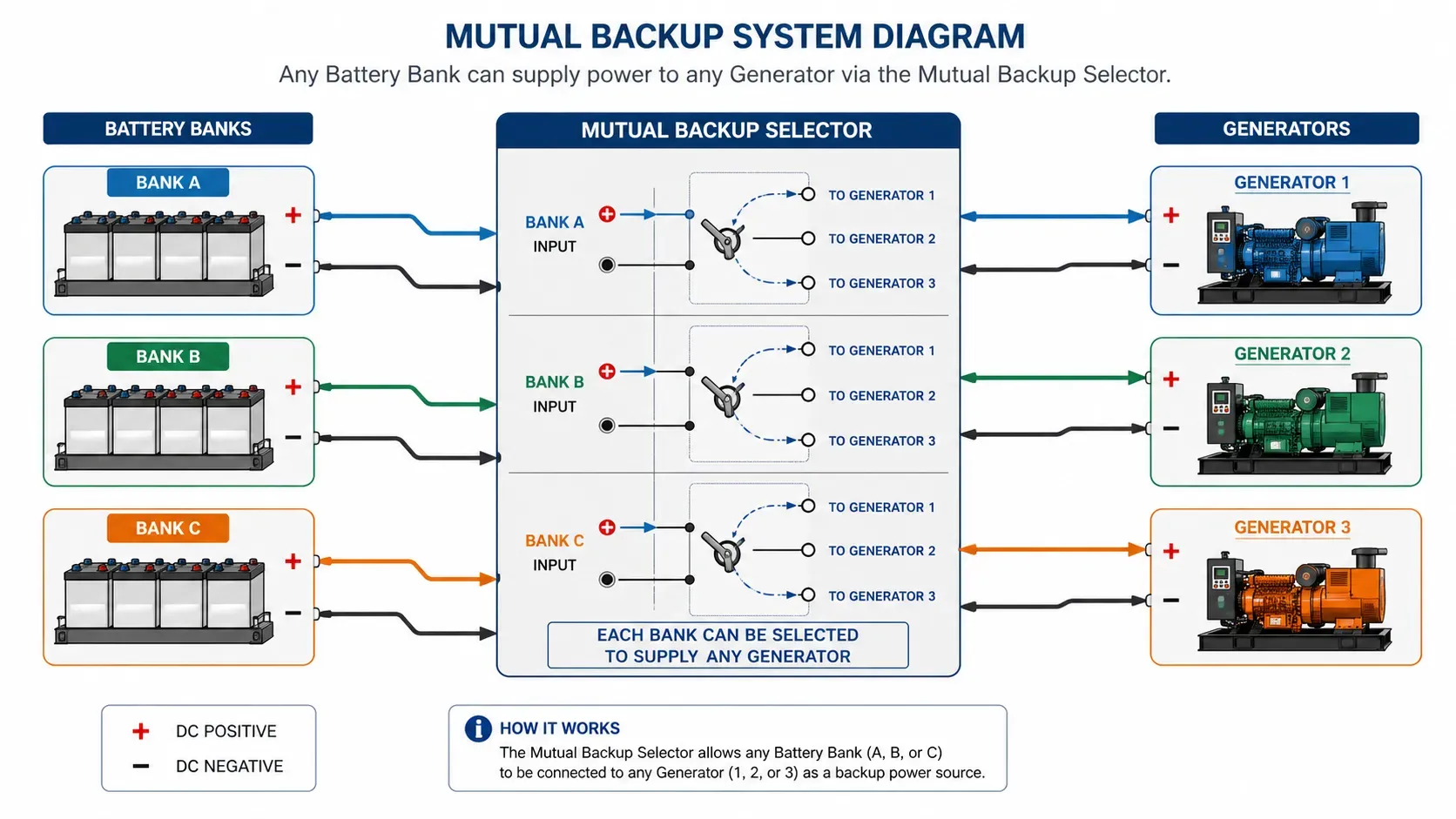

In the engine room, reliability is the only currency that matters. Most marine generators rely on a dedicated marine starting battery bank to provide the high-amperage burst required to turn the engine over. The traditional setup is simple: one generator, one battery bank. However, more shipowners are now moving toward a "mutually redundant" configuration where three separate battery banks can support any of the three generators.
While this requires additional cabling and selector switches, the long-term benefits for safety and operational efficiency are significant. Let’s explore why this interconnected approach is becoming a preferred standard.

Eliminating the Single Point of Failure
The primary argument for interconnecting starting systems is risk mitigation. In a standard setup, if the battery bank for Generator No. 1 fails—whether due to a dead cell, a charging fault, or extreme cold—that generator is effectively immobilized. For many vessels, the generator starting system is the only way to bring power back to a dead ship.
By allowing the battery banks to act as mutual backups, you eliminate this single point of failure. If one bank is compromised, the crew can simply switch the supply to bank two or three. This ensures that a single "consumable" item does not prevent a massive piece of machinery from doing its job.
Optimizing Spare Parts and Inventory
Batteries are, by nature, wear-and-tear items. A lead-acid starting battery has a finite lifespan and will eventually lose its ability to hold a charge under the heavy load of a starter motor.
In a non-redundant system, a vessel might feel the need to carry two or three full sets of spare batteries to ensure every generator is covered. By implementing a cross-connection system:
- Reduced Inventory: You can safely carry fewer spare units because any functional bank on the ship can start any engine.
- Cost Efficiency: Reducing the number of spares on board reduces the capital tied up in inventory and avoids the problem of "shelf-life" expiration for unused batteries.
Reducing the Maintenance Burden
Maintenance is a constant task for shipboard engineers. Traditional vented batteries require regular electrolyte checks and terminal cleaning. Even when using a high-quality maintenance-free marine battery, such as the BB brand offered by HZH Marine, the crew still needs to monitor charging voltages and perform load tests.
When systems are interconnected, the workload is streamlined. Instead of managing three isolated islands of power, the crew manages a cohesive network. This setup also allows for easier rotation; an engineer can take one bank offline for a deep-cycle maintenance charge without leaving a generator unprotected, as the other two banks can step in to provide the emergency starting power.
Technical Considerations: Cables vs. Complexity
Admittedly, this setup requires more heavy-duty cabling and robust isolation switches to prevent accidental short circuits or "parasitic" drains between banks. However, when compared to the cost of a delayed departure or a failed PSC inspection due to a dead generator, the investment in a few extra meters of copper and a selector panel is negligible.
Ultimately, a redundant battery redundancy strategy is about peace of mind. It ensures that when the "Start" button is pressed, the power is there—regardless of which specific battery bank is providing it.























Sign in to leave a comment.