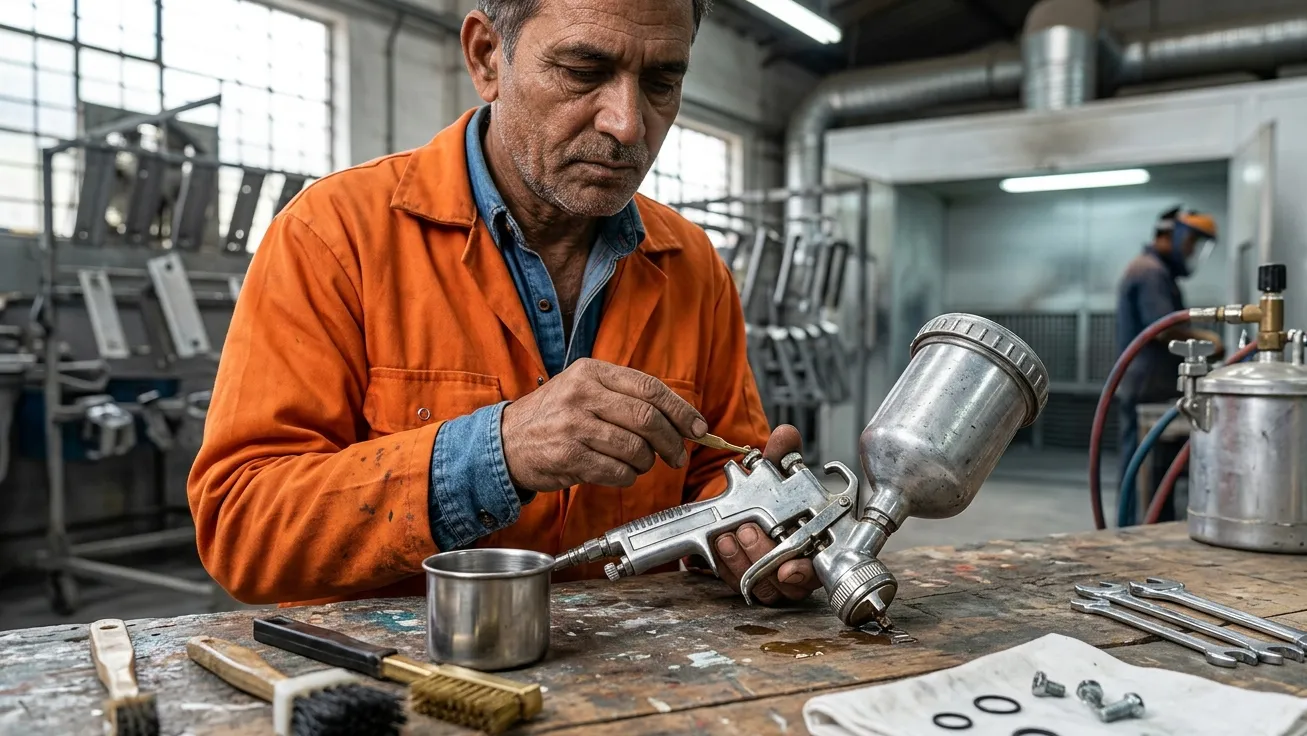

In a high-output industrial facility or a busy automotive body shop, your spray gun is the absolute bridge between a raw product and a premium finish. When a precision-engineered tool like an HVLP or a robust gravity-fed gun operates smoothly, it feels like an extension of your own hand. However, because these tools are built to handle tough industrial materials day in and day out, it is easy to mistake physical ruggedness for mechanical invulnerability.
The reality is that a spray gun is a highly sophisticated piece of fluid-dynamics engineering. The tolerances inside the fluid tip, needle seating, and air cap are measured in fractions of a millimeter. When maintenance habits slip, those tolerances vanish. As a Leading Industrial Equipment Manufacturer in India, we frequently see high-end finishing setups fail prematurely not due to manufacturing defects, but because of well-intentioned maintenance mistakes that inadvertently destroy the tool.
Let’s look at five of the most expensive maintenance missteps your workshop might be making, and how to correct them before they impact your bottom line.
1. Leaving the Entire Gun Submerged in Solvent Over Night
It seems logical at first glance: if paint dries inside the gun, why not just drop the entire assembly into a bucket of thinner or lacquer solvent at the end of the shift to keep it pristine?
This is perhaps the fastest way to ruin an industrial spray gun. While the metal body of the gun handles aggressive solvents easily, the internal components do not. Modern spray guns rely on a series of specialized Teflon packings, rubber O-rings, and air-distribution seals to isolate the fluid passage from the pneumatic airflow.
Over time, prolonged soaking forces solvents deep into these internal air passages. The chemical exposure swells, distorts, and eventually dissolves these delicate seals. Once an internal air seal decomposes, pressurized air leaks backward into the fluid line, leading to erratic, pulsing spray patterns that are incredibly difficult to diagnose.
2. Using Metal Wires or Nails to Clear Clogged Nozzles
When a nozzle gets blocked mid-job by a chunk of semi-dried pigment or a thick topcoat, the natural human impulse is to grab whatever is sharp and close at hand a paperclip, a welding wire, a sewing needle, or a common nail and poke it through the orifice.
This quick fix is an incredibly expensive shortcut. The fluid orifice and the microscopic atomization holes on the horns of your air cap are precision-machined to exact geometries. Poking a hardened steel wire or nail through these openings scratches, gouges, and warps the perfectly round shape of the hole.
An invisible scratch on the interior wall of a 1.4mm nozzle alters the aerodynamics of the tool. It creates low-pressure zones that distort your spray fan, resulting in heavy, off-center shapes (like a crescent or a teardrop) rather than an even, uniform oval.
3. Treating the Needle Packing Nut Like a Head Bolt
When paint begins to seep slowly out of the back of a spray gun right behind the trigger mechanism, it means the fluid needle packing is losing its seal. To fix this, operators often grab a heavy wrench and tighten down the packing nut as hard as they can.
Over-tightening the needle packing nut is a major mistake. Cranking this nut down applies excessive physical pressure to the Teflon seal, squeezing it tightly against the shaft of the fluid needle.
This creates immense mechanical friction. Instead of snapping back smoothly when you release the trigger, the needle sticks in a partially open position. This causes the gun to continuously weep paint from the nozzle even when your hand is completely off the trigger, ruining workpieces with accidental drips and causing premature wear on both the needle and the fluid tip seat.
4. Skipping Lubrication (Or Using the Wrong Type)
A spray gun has multiple moving metal parts working under constant spring tension, including the fluid needle, the air valve stem, and the trigger pivot points. Operating these parts completely dry accelerates metal-on-metal wear, leading to a choppy trigger pull that makes it very difficult to feather or modulate your paint application.
Even worse than skipping lubrication is using a standard garage lubricant like WD-40 or a generic automotive oil. These regular lubricants contain heavy silicone or petroleum bases.
When your painting material passes through the gun, it picks up microscopic traces of this migrating silicone. The moment that silicone hits your wet paint film on a car panel or industrial component, it causes a severe finishing defect known as "fish-eyes" small, crater-like dimples where the paint is chemically repelled by the oil residue. Fixing a fish-eye problem requires sanding the entire component back down to bare substrate and starting completely over.
5. Storing the Gun Wet or Improperly Assembled
When the closing bell rings, it is tempting to quickly rinse the gun, throw the wet pieces back together while they are dripping with solvent, and hang it up until the next morning.
Leaving volatile solvents trapped inside a tightly closed gun body can cause moisture from the surrounding air to condense inside the fluid passages. This trapped moisture triggers oxidation and corrosion on internal threads, even if the needle is made of high-grade stainless steel. Furthermore, assembling a gun while the internal spring components are wet can cause the fluid needle to bind or stick to the interior walls of the nozzle as the residual solvent evaporates overnight, leading to a frozen trigger the next morning.
Protect Your Investment
High-quality industrial equipment is built to last, but its longevity is directly tied to the respect it receives on the cleaning bench. By training your team to treat their spray guns like high-precision instruments rather than basic hand tools, you drastically reduce your expenditure on replacement parts, minimize material waste, and eliminate unexpected rework.
When your workshop partners with a trusted, engineering-first Leading Industrial Equipment Manufacturer in India, you gain access to the durable equipment and technical knowledge required to keep your production lines moving seamlessly, turning out flawless finishes day after day.
























Sign in to leave a comment.