When specifying a point level detection instrument for an industrial application, one of the most practical questions an instrumentation engineer can ask is whether a single technology can serve across different media types. Replacing four different instruments with one proven technology reduces procurement complexity, simplifies spare parts inventory, and lowers total installed cost. The capacitive level switch is one of the few point level technologies that genuinely delivers on this promise capable of detecting liquids, solids, slurries, and granular materials within a single instrument family.
This article examines the technical basis for that capability, the engineering considerations that govern its application across different media, and the limitations that define where capacitive technology works best.
The Core Detection Principle
To understand why a capacitive level switch can detect both liquids and solids, it is necessary to understand what the instrument actually measures.
A capacitive level switch does not measure weight, pressure, or optical properties. It measures capacitance — the ability of two conductors separated by an insulating medium to store electrical charge. The fundamental relationship governing capacitance is:
C = ε × (A / d)
Where C is capacitance, ε is the dielectric constant of the medium between the conductors, A is the effective electrode area, and d is the distance between electrodes.
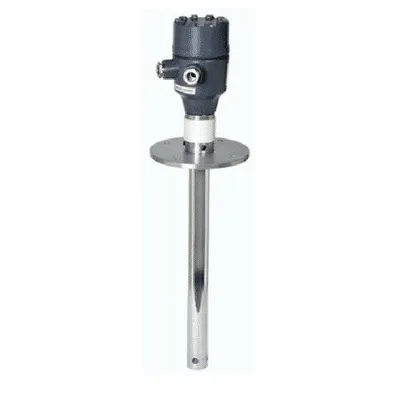
In a capacitive level switch, one electrode is the probe itself and the second electrode is either the vessel wall in the case of a single-electrode design or a reference electrode built into the probe assembly. The medium between these electrodes is initially air or vapor, which has a dielectric constant of approximately 1.0.
When process material, whether liquid, powder, or granule contacts or approaches the probe, the dielectric constant between the electrodes changes. Since the dielectric constant of virtually all process materials exceeds that of air, capacitance increases. The instrument's internal oscillator circuit detects this capacitance shift and triggers the output relay when the change exceeds a defined threshold.
This detection mechanism is fundamentally indifferent to the physical state of the material liquid, solid, or slurry provided the material has a dielectric constant sufficiently higher than air to produce a detectable capacitance shift.
Detecting Liquids: How It Works in Practice
For liquid level detection, capacitive switches are among the most straightforward instruments to apply. Most liquids water, aqueous solutions, acids, alkalis, solvents, oils, and hydrocarbons have dielectric constants well above 1.0, producing a clear and reliable capacitance shift upon contact with the probe.
Water and aqueous solutions have dielectric constants in the range of 40 to 80, producing large, easily detectable capacitance changes. This makes capacitive switches highly reliable for water-based process applications.
Hydrocarbon liquids — oils, fuels, and solvents have lower dielectric constants, typically in the range of 2 to 10. The capacitance shift is smaller but still well within the detection capability of a properly configured instrument. Sensitivity adjustment available on most modern capacitive switches allows the detection threshold to be tuned to the specific medium.
Conductive liquids behave differently from non-conductive ones. In conductive media, the liquid itself acts as the second electrode, and the probe's insulating coating serves as the dielectric. Capacitive switches used with conductive liquids must have insulated probes bare metal probes in conductive media will short-circuit rather than produce a capacitance-based output.
Interface Detection between two immiscible liquid phases such as oil floating on water is achievable with capacitive switches where the dielectric constants of the two phases differ sufficiently. This makes them useful for interface alarms in separator vessels and storage tanks.
Detecting Solids and Bulk Materials: The Technical Case
Bulk solid detection is where the capacitive level switch differentiates itself most clearly from competing technologies. Float switches cannot operate in solids. Conductivity probes require conductive media. Tuning fork switches work well in many solids but face limitations with fine, low-density powders that may not provide sufficient mechanical damping.
The capacitive switch, by contrast, relies only on the dielectric properties of the material not its conductivity, density, or ability to damp mechanical vibration.
Powders and fine granules — flour, cement, sugar, PVC powder, pharmaceutical excipients typically have dielectric constants in the range of 1.5 to 5.0, depending on bulk density and moisture content. The relatively low dielectric contrast with air requires higher sensitivity settings, but modern capacitive switches handle these materials reliably with appropriate calibration.
Coarse granules and pellets — plastic pellets, grain, coal, gravel have higher effective dielectric constants due to their denser packing and often present fewer detection challenges than fine powders.
Hygroscopic materials that absorb atmospheric moisture present an interesting advantage for capacitive detection — moisture content increases the effective dielectric constant, making the material easier to detect. However, this also means that variations in moisture content can shift the apparent detection point if the instrument is not calibrated at representative conditions.
Material Bridging — a common problem in silos and hoppers where bulk solids bridge across the vessel above the probe is a limitation that affects all point level technologies in solids service, including capacitive switches. Probe placement at the vessel wall rather than center, and selection of an appropriate probe length, mitigates but does not eliminate this risk.
Slurries and Mixed-Phase Media
Slurries mixtures of solids suspended in liquid represent a particularly demanding application for many level technologies. Float switches jam. Vibrating forks can become coated and provide false readings. Displacer switches suffer from density-dependent errors.
Capacitive level switches handle slurries effectively because the detection principle responds to the combined dielectric properties of the mixture rather than requiring physical movement or mechanical interaction with the medium. As long as the slurry's effective dielectric constant is sufficiently higher than air, reliable detection is achievable.
The primary challenge with slurries is probe buildup material adhering to the probe surface after the level recedes. If buildup is conductive and remains on an insulated probe, it can simulate a high-level condition and produce false outputs. Active build-up compensation circuits available in higher-specification capacitive switches continuously monitor for this condition and adjust the detection threshold accordingly, significantly reducing false trip rates in sticky or adhesive media.
Key Advantages Across Media Types
The capacitive level switch's cross-media capability is underpinned by several technical advantages that make it a versatile choice for engineers working across diverse process conditions:
- No moving parts — detection relies entirely on electrical measurement, eliminating mechanical wear regardless of media type
- Adjustable sensitivity — the detection threshold is configurable to match the dielectric properties of the specific process material
- Insulated and bare probe options — insulated probes for conductive media, bare metal for non-conductive applications
- Wide temperature and pressure range — suitable for high-pressure reactors, cryogenic vessels, and high-temperature process equipment
- Compact probe designs — available in short insertion lengths for small vessels and extended lengths for deep tanks and silos
- No calibration required for high-dielectric liquids — water and aqueous solutions produce such large capacitance shifts that factory default settings are typically sufficient
Limitations That Engineers Must Account For
Despite its versatility, the capacitive level switch has boundaries that must be respected during application engineering:
Low dielectric constant materials — liquefied gases such as LNG and liquid nitrogen have dielectric constants very close to 1.0. The capacitance shift upon contact is minimal, and standard capacitive switches may not provide reliable detection without specialized high-sensitivity designs.
Foam detection — foam layers present an intermediate dielectric condition between air and liquid. Depending on foam density and composition, a capacitive switch may or may not trigger at the foam surface rather than the true liquid level below. In foam-prone applications, probe placement and sensitivity settings require careful engineering.
Heavy coating in viscous media — highly viscous liquids such as molasses, bitumen, or adhesives can coat the probe so heavily that the instrument remains in the triggered state even after the level recedes. Build-up compensation and regular maintenance intervals must be factored into the application design.
Grounding requirements — capacitive switches in non-conductive vessels with non-conductive media require a reference ground path. Failure to provide proper grounding results in unreliable detection. Probe designs with integrated reference electrodes address this requirement for challenging installations.
Selection Guidance for Cross-Media Applications
When specifying a capacitive level switch for an application involving multiple media types or uncertain material properties, the following parameters are essential:
The dielectric constant of the process material or its expected range must be established before instrument selection. Most manufacturers provide minimum detectable dielectric constant specifications for their instruments. For materials with dielectric constants below 2.0, specialist advice should be sought.
Probe material selection must account for chemical compatibility across all media the instrument may contact including cleaning agents in CIP applications. Stainless steel, Hastelloy, titanium, and PTFE-coated probes cover the majority of industrial applications.
For applications switching between liquid and solid service such as a vessel used alternately for liquid batch processing and powder storage the sensitivity setting must be verified against both media types to ensure reliable detection in each condition.
PCD Flowmeter offers a range of capacitive level switches engineered for reliable detection across liquids, solids, and slurries, with application-specific configuration support for demanding industrial environments.
Conclusion
The answer to the question is unambiguously yes a capacitive level switch can detect both liquids and solids, and it does so through the same fundamental principle in both cases: the change in capacitance caused by the difference in dielectric constant between air and the process material.
What makes this technology genuinely versatile is not merely that it works across media types, but that it does so without moving parts, without calibration complexity in high-dielectric applications, and with a sensitivity range that can be tuned to match materials as different as water and dry cement powder.
For instrumentation engineers seeking a reliable, low-maintenance point level solution across diverse process media, the capacitive level switch represents one of the most technically sound and practically proven choices available in modern industrial instrumentation.























Sign in to leave a comment.