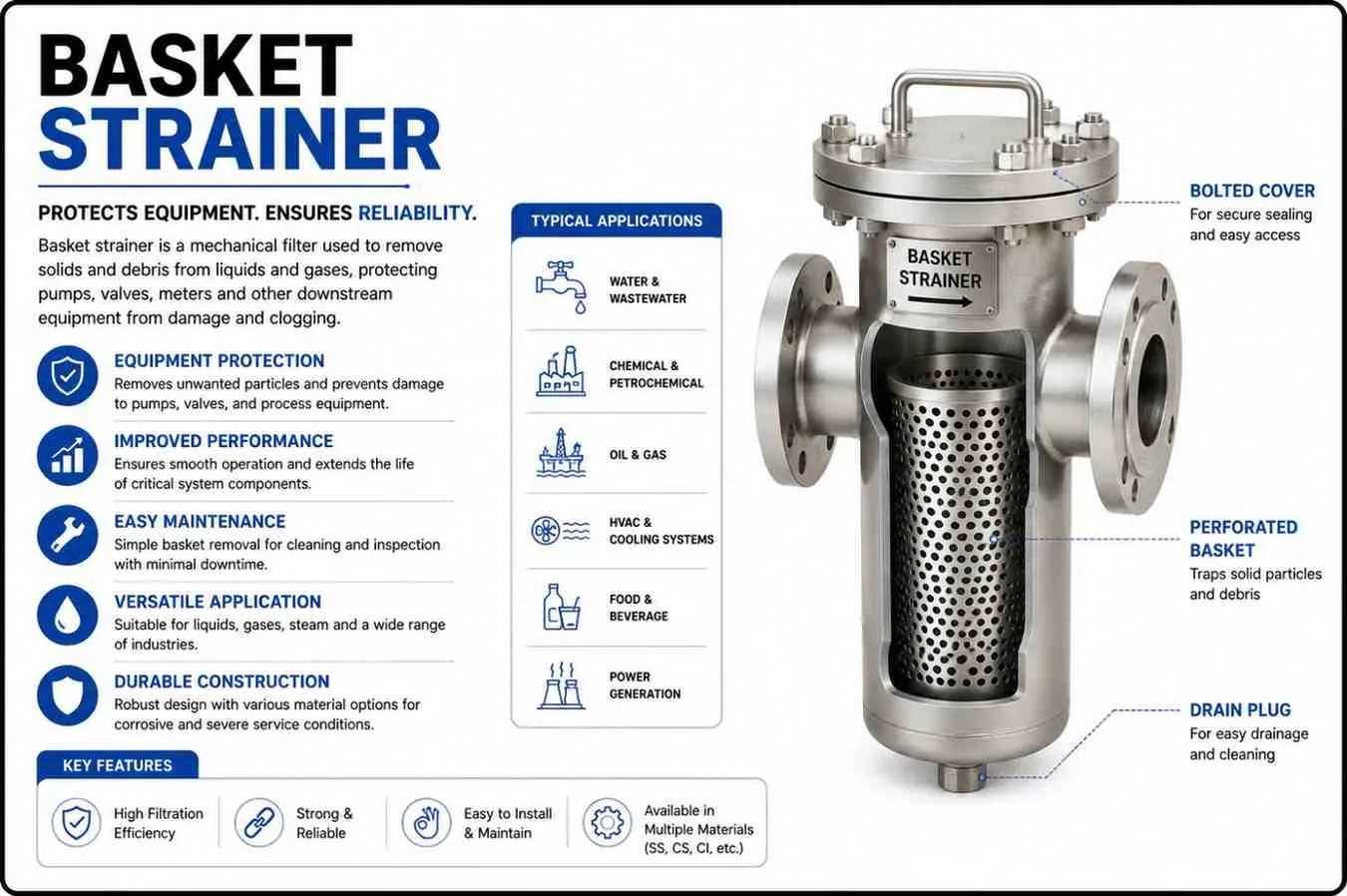
If you're setting up a pipeline system, one wrong filter choice can damage your pumps, clog your valves, and cost you thousands in downtime. A basket strainer removes solid particles from liquids efficiently, handles high flow rates, and is easy to clean but it's not always the right fit. This guide breaks down how a basket strainer compares to other industrial filters so you can make the right call for your process.
What Is a Basket Strainer?
A basket strainer is a mechanical filtration device installed in pipelines to catch solid particles debris, rust, scale, or any foreign matter before they reach sensitive downstream equipment.
It has a simple design. Fluid flows in through the inlet, passes through a perforated or mesh basket, and exits clean through the outlet. The trapped particles stay inside the basket until you clean or replace it.
No chemicals. No complex mechanisms. Just physical filtration is reliable and straightforward.
How It Differs from Other Industrial Filters
Here's where most buyers get confused. Not every filter works the same way and each has a specific job it does best.
Basket Strainer vs Y-Strainer
A Y-strainer is shaped like the letter Y and is typically used for smaller pipe sizes and lower flow volumes.
Basket strainer wins when:
- You have high flow rates and large pipe diameters
- You need to hold more debris without frequent cleaning
- Horizontal pipeline installation is required
Y-strainer wins when:
- Space is tight and pipe size is small
- You're dealing with steam or gas lines
- Continuous operation with minimal cleaning is needed
Bottom line Y-strainers are for light-duty, low-volume applications. Basket strainers are built for heavy industrial workloads.
Basket Strainer vs Duplex Strainer
A duplex strainer is essentially two basket strainers side by side with a switchover valve.
Basket strainer wins when:
- Occasional shutdowns for cleaning are acceptable
- Budget is a concern duplex setups cost more
- The process doesn't run 24/7
Duplex strainer wins when:
- Your process runs continuously with zero tolerance for downtime
- Switching between baskets during operation is critical
Bottom line If your plant can't stop, go duplex. If it can pause briefly for cleaning, a single basket strainer is perfectly fine.
Basket Strainer vs Cartridge Filter
Cartridge filters use replaceable filter elements and offer much finer filtration down to 1 micron or less.
Basket strainer wins when:
- You're dealing with large particles and high flow rates
- You want a reusable, low-cost filtration solution
- Frequent element replacement is not practical
Cartridge filter wins when:
- Ultra-fine filtration is needed pharmaceutical, semiconductor, or food-grade processes
- Particle sizes are very small and a mesh basket won't catch them
Bottom line Basket strainers handle coarse filtration. Cartridge filters handle fine filtration. In many setups, both are used together basket strainer first, cartridge filter second.
Basket Strainer vs Bag Filter
Bag filters use fabric filter bags inside a housing and are great for fine to medium filtration.
Basket strainer wins when:
- You need to handle large debris loads without frequent changes
- High flow capacity is a priority
- Easy basket cleaning is preferred over bag disposal
Bag filter wins when:
- Finer filtration is needed than a mesh basket can provide
- Disposable filtration is preferred over cleaning
- Liquid clarity is critical like in paint or coating applications
Bottom line Bag filters offer finer filtration but generate more waste. Basket strainers are more practical for high-volume industrial pipelines.
Basket Strainer vs Self-Cleaning Filter
Self-cleaning filters use automatic backwash or scraping mechanisms to clean themselves without stopping flow.
Basket strainer wins when:
- Budget matters — self-cleaning filters are significantly more expensive
- Particle load is manageable with periodic manual cleaning
- Simple, low-maintenance operation is preferred
Self-cleaning filter wins when:
- Very high solid loads make manual cleaning impractical
- Fully automated and unmanned operation is required
Bottom line Self-cleaning filters are powerful but expensive. Basket strainers are the cost-effective choice for most standard industrial applications.
When Should You Choose a Basket Strainer?
After all these comparisons, the basket strainer comes out on top when:
- Your pipeline is horizontal and carries liquid at high flow rates
- You need to protect pumps, valves, meters, and heat exchangers from debris
- Periodic manual cleaning is manageable in your operation
- You want a durable, reusable, and cost-effective filtration solution
- Your fluid contains coarse to medium-sized solid particles
Industries That Rely on Basket Strainers
- Water Treatment — Protecting pumps and filters from sand, silt, and debris
- Oil & Gas — Keeping pipelines and refinery equipment clean
- Chemical Processing — Filtering aggressive fluids before they reach sensitive equipment
- Food & Beverage — Removing particles from raw liquids before processing
- Pharmaceuticals — Pre-filtration before fine filtration stages
- Power Plants — Protecting cooling water systems and boiler feed lines
What to Look for When Buying a Basket Strainer
Before you order, check these:
Mesh size — Determines what particle size gets filtered. Coarser mesh for large debris, finer mesh for smaller particles.
Material — Stainless steel for corrosive fluids, carbon steel for general use, PTFE-lined for aggressive chemicals.
Pressure and temperature rating — Always match to your system's operating conditions.
End connections — Flanged, threaded, or welded depending on your pipeline setup.
Basket capacity — Larger basket = less frequent cleaning. Important for high-debris applications.
Final Thoughts
There's no single "best" industrial filter only the right one for your specific process. But for most heavy-duty liquid pipelines that need reliable, cost-effective, and easy-to-maintain coarse filtration, a basket strainer is hard to beat.
If you're looking for a quality basket strainer built for real industrial conditions, PCD Flowmeter offers a range of options designed for different pipe sizes, flow rates, and fluid types with the durability and performance your process demands.







![The Benefits of Using a CNC Touch Probe [Infographic]](https://writeupcafe.com/data/post/1677697/bfdf3e040e67936848aa232d2dfe3d03.jpg.webp)






Sign in to leave a comment.