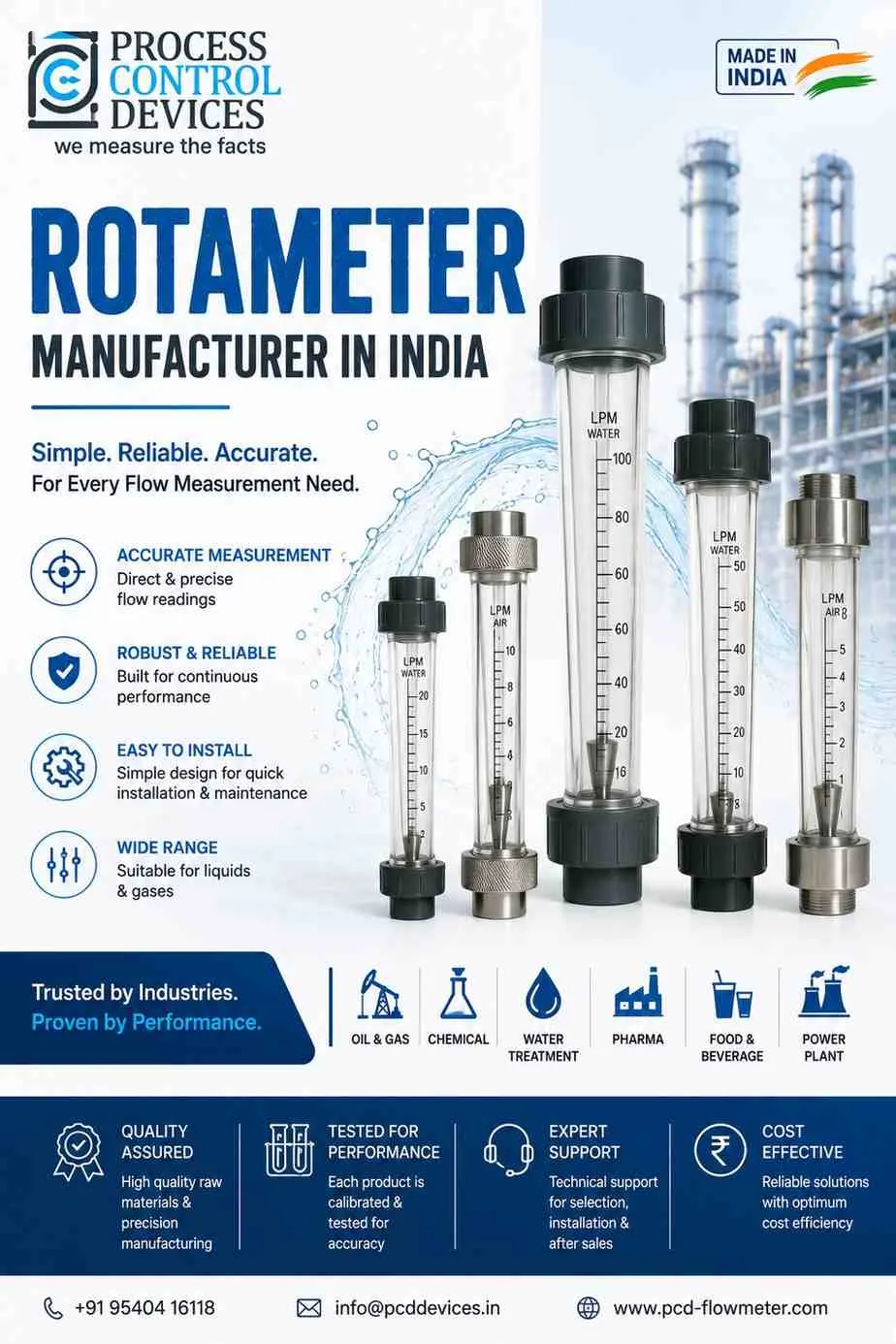

India's industrial sector has grown exponentially over the past two decades, and with it, the demand for precise, reliable flow measurement instrumentation. Among the various flow measurement devices used across process industries, the rotameter continues to hold a significant place valued for its simplicity, durability, and cost-effectiveness.
For procurement engineers, instrumentation specialists, and plant managers sourcing rotameters in India, understanding the technology, its industrial relevance, and what separates a quality manufacturer from a mediocre one is critical to making the right purchasing decision.
What is a Rotameter?
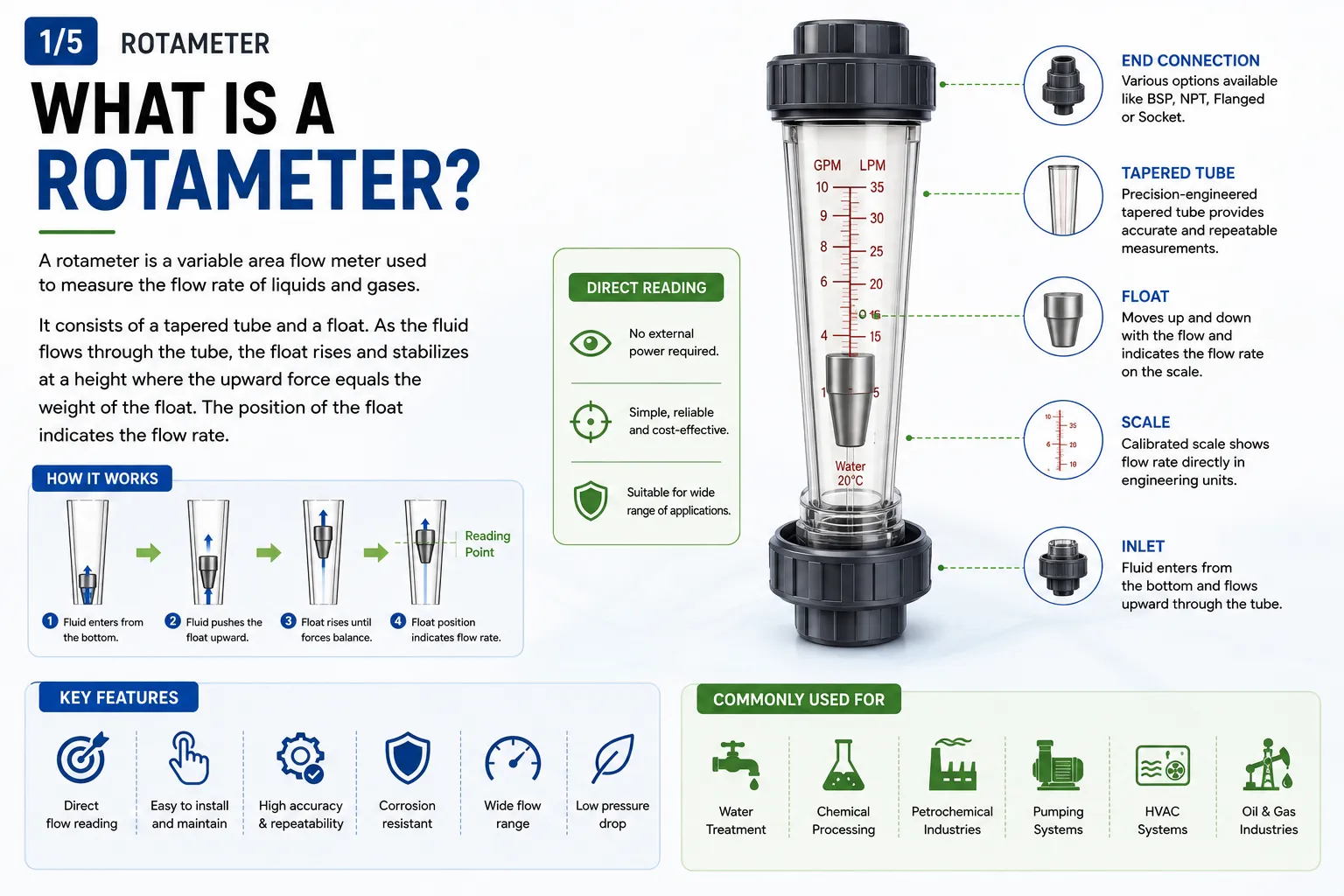
A rotameter, technically known as a variable area flow meter, is a device that measures the volumetric flow rate of liquids and gases. It operates on a simple mechanical principle a float rises or falls inside a vertically mounted tapered tube in response to fluid flow. The position of the float directly indicates the flow rate on a calibrated scale.
Unlike electronic flow meters, rotameters require no external power source in their basic form, making them inherently reliable in remote or hazardous locations where electrical infrastructure is limited.
Working Principle
The rotameter works on the balance between two opposing forces:
- Upward force — the drag and buoyancy exerted by the flowing fluid on the float
- Downward force — the gravitational pull on the float
As flow increases, the float rises higher in the tapered tube, increasing the annular area between the float and tube wall until equilibrium is reached. The float stabilizes at a height corresponding to the flow rate, which is read directly from the graduated scale on the tube.
This elegant mechanical balance requires no moving parts beyond the float itself, which contributes to the rotameter's long service life and minimal maintenance requirements.
Construction and Materials
Rotameters are manufactured in a variety of configurations and materials depending on the application:
- Glass Tube Rotameters — Used for low pressure, non-corrosive, and transparent fluid applications. Offer direct visual reading and are common in laboratory and light industrial use.
- Metal Tube Rotameters — Designed for high pressure, high temperature, or opaque and corrosive fluid applications. Typically equipped with magnetic or mechanical followers to externally indicate float position.
- Plastic Tube Rotameters — Used for corrosive chemicals where glass is unsuitable and pressure ratings are moderate.
Float materials commonly include stainless steel, Hastelloy, titanium, and PTFE-coated options for aggressive media compatibility.
Key Industries and Applications
Rotameters serve a broad spectrum of industrial applications across India:
Pharmaceuticals and Biotechnology rely on rotameters for precise control of purified water, solvents, and process gases in GMP-compliant manufacturing environments.
Chemical and Petrochemical Plants use them for monitoring acid flows, solvent dosing, and utility services such as cooling water and nitrogen purging.
Water Treatment and Environmental applications include monitoring chemical dosing chlorine, alum, and coagulants in municipal water and effluent treatment plants.
Oil and Gas facilities deploy rotameters for instrument air, seal gas, and utility fluid monitoring where simplicity and reliability are prioritized over electronic complexity.
Power Plants use rotameters extensively in cooling water circuits, chemical dosing systems, and demineralized water lines.
Food and Beverage manufacturers rely on hygienic rotameters for CIP water flow, CO₂ monitoring, and ingredient dosing.
Why India is a Significant Rotameter Manufacturing Hub
India has emerged as a globally competitive center for flow meter manufacturing, particularly rotameters, for several reasons:
The country has a strong base of precision engineering and machining industries, particularly in Gujarat, Maharashtra, and Tamil Nadu. This industrial ecosystem supports in-house manufacturing of glass tubes, metal components, and float assemblies to international standards.
Indian manufacturers have increasingly adopted international quality certifications ISO 9001, ATEX, and PESO approvals making their products acceptable for export and use in regulated industries. Cost competitiveness without compromising on quality has made Indian-made rotameters attractive not just domestically but in Middle Eastern, African, and Southeast Asian markets.
What to Look for in a Rotameter Manufacturer in India
Not all manufacturers offer the same level of quality, customization, or after-sales support. Here is what industry professionals should evaluate:
Calibration Capability — A reliable manufacturer must have in-house calibration facilities traceable to national or international standards. Field-calibrated rotameters that have not been factory-verified are a common source of measurement error.
Material Traceability — For critical applications, material test certificates (MTCs) for wetted components should be readily available. This is non-negotiable in pharmaceutical and chemical industries.
Customization — Standard off-the-shelf rotameters rarely fit every application. Look for manufacturers who can offer custom float designs, non-standard connections, special coatings, and extended ranges.
ATEX / Flameproof Options — For hazardous area installations in oil, gas, and chemical plants, manufacturers should offer certified explosion-proof or intrinsically safe transmitter options.
Technical Support — A manufacturer's value extends beyond the product itself. Access to application engineers who can assist with proper sizing, installation guidance, and troubleshooting is a significant differentiator.
PCD Flowmeter is one such manufacturer offering a comprehensive range of rotameters built for demanding industrial environments, with a focus on accuracy, material quality, and application-specific customization.
Advantages of Rotameters in Industrial Settings
- No external power required in mechanical versions inherently safe for hazardous areas
- Simple, robust construction with minimal maintenance
- Direct visual indication without need for secondary instrumentation
- Wide range of materials available for corrosive and high-temperature media
- Cost-effective compared to electronic flow meters for straightforward applications
- Easy to install and replace without process shutdown in many configurations
Limitations Engineers Must Account For
- Must be installed vertically with upward flow installation flexibility is limited compared to other meter types
- Accuracy is typically ±1% to ±2% of full scale not suitable for high-precision custody transfer
- Viscosity and density changes in the process fluid affect float position and require correction factors
- Glass tube versions are fragile and unsuitable for high-pressure or thermal shock conditions
- Not ideal for pulsating flows float oscillation reduces reading accuracy
Sizing and Selection Considerations
Correct rotameter sizing is critical. An oversized rotameter will operate at the low end of its range where accuracy is poor. An undersized one risks float instability or damage.
Key parameters required for proper sizing include fluid type, density, and viscosity at operating conditions, minimum and maximum flow rates, operating pressure and temperature, and connection size and type. For gas applications, actual operating pressure and temperature must be used not standard conditions to avoid significant sizing errors.
Conclusion
The rotameter remains one of the most enduring and practical flow measurement solutions available to Indian industry. Its mechanical simplicity, broad material compatibility, and low total cost of ownership make it a first-choice instrument for countless applications where high-end electronic meters would be overkill.
For engineers and procurement professionals sourcing rotameters in India, the key lies in partnering with a manufacturer who combines technical depth, calibration integrity, and genuine application expertise because in flow measurement, the instrument is only as good as the knowledge behind it.













![The Benefits of Using a CNC Touch Probe [Infographic]](https://writeupcafe.com/data/post/1677697/bfdf3e040e67936848aa232d2dfe3d03.jpg.webp)







Sign in to leave a comment.