
I've watched more than a few production lines hit the same wall. The mixer itself is fine. The formulation is sound. But batch-to-batch output drifts, and nobody can point to exactly why. After enough years in plastics and compounding operations, I've come to believe that the control system sitting behind the mixer is where most of that drift originates, and it's the part of the equipment conversation that gets the least attention during procurement.
High-intensity mixers run fast. Tip speeds above 30 meters per second, temperature spikes within seconds of startup, and discharge windows measured in fractions of a minute. At that pace, a control system isn't optional infrastructure. It's the difference between a process you can repeat and one you're always trying to chase.
The Real Function of a Control System in High-Intensity Mixing
Control systems on mixing equipment are often described in terms of what they monitor: speed, temperature, time, and torque. That's accurate, but it undersells what a well-designed system actually does. The more useful framing is that a control system translates process knowledge into repeatable machine behavior.
When I set a target friction temperature on a high-intensity mixer, say, 110°C for a PVC dry blend, the control system's job is to reach that point consistently regardless of ambient variation, slight differences in raw material lot quality, or fluctuations in line voltage. That requires more than a thermocouple and a timer. It requires a control architecture that reads multiple inputs simultaneously and adjusts mixing parameters accordingly.
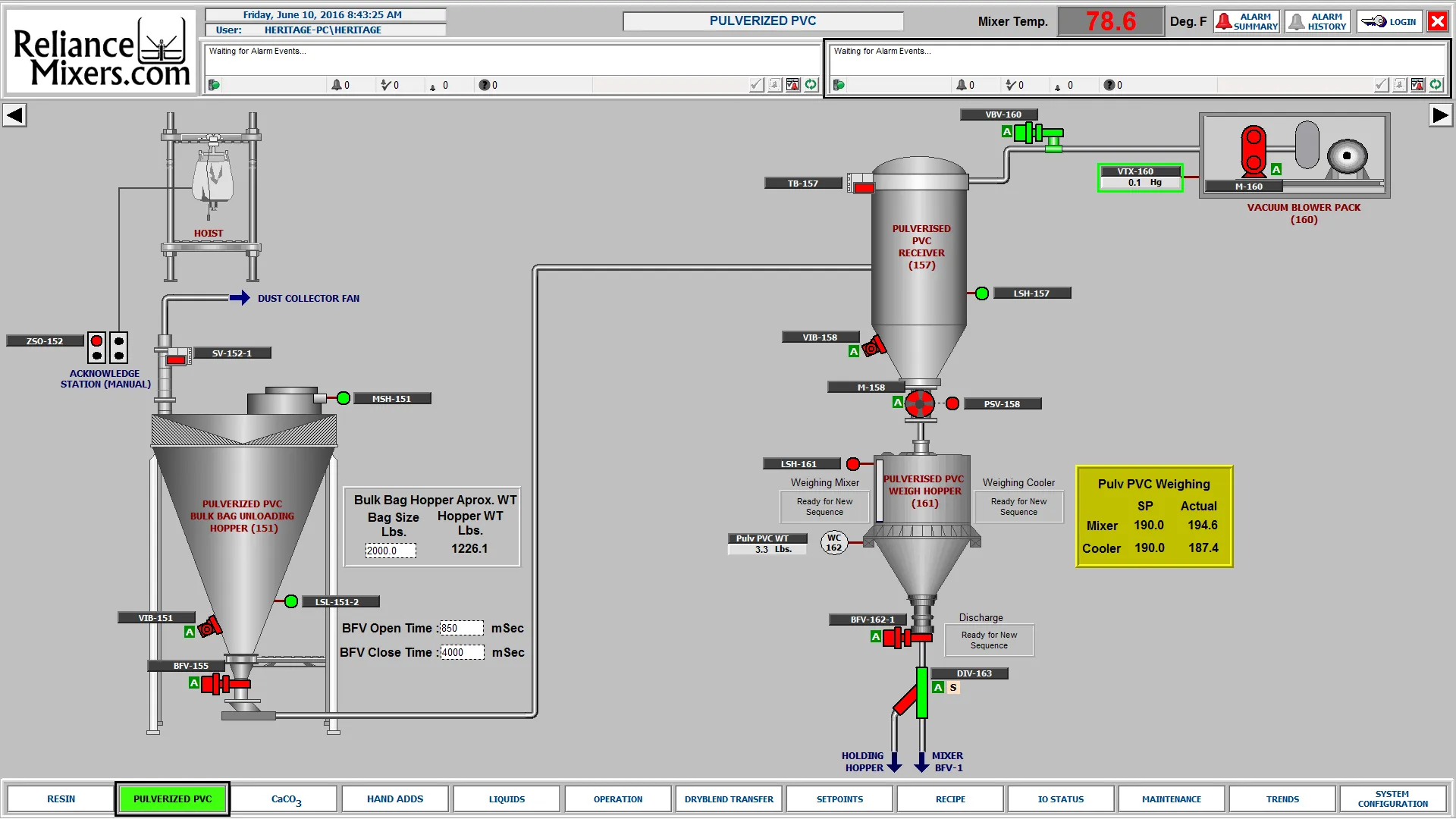
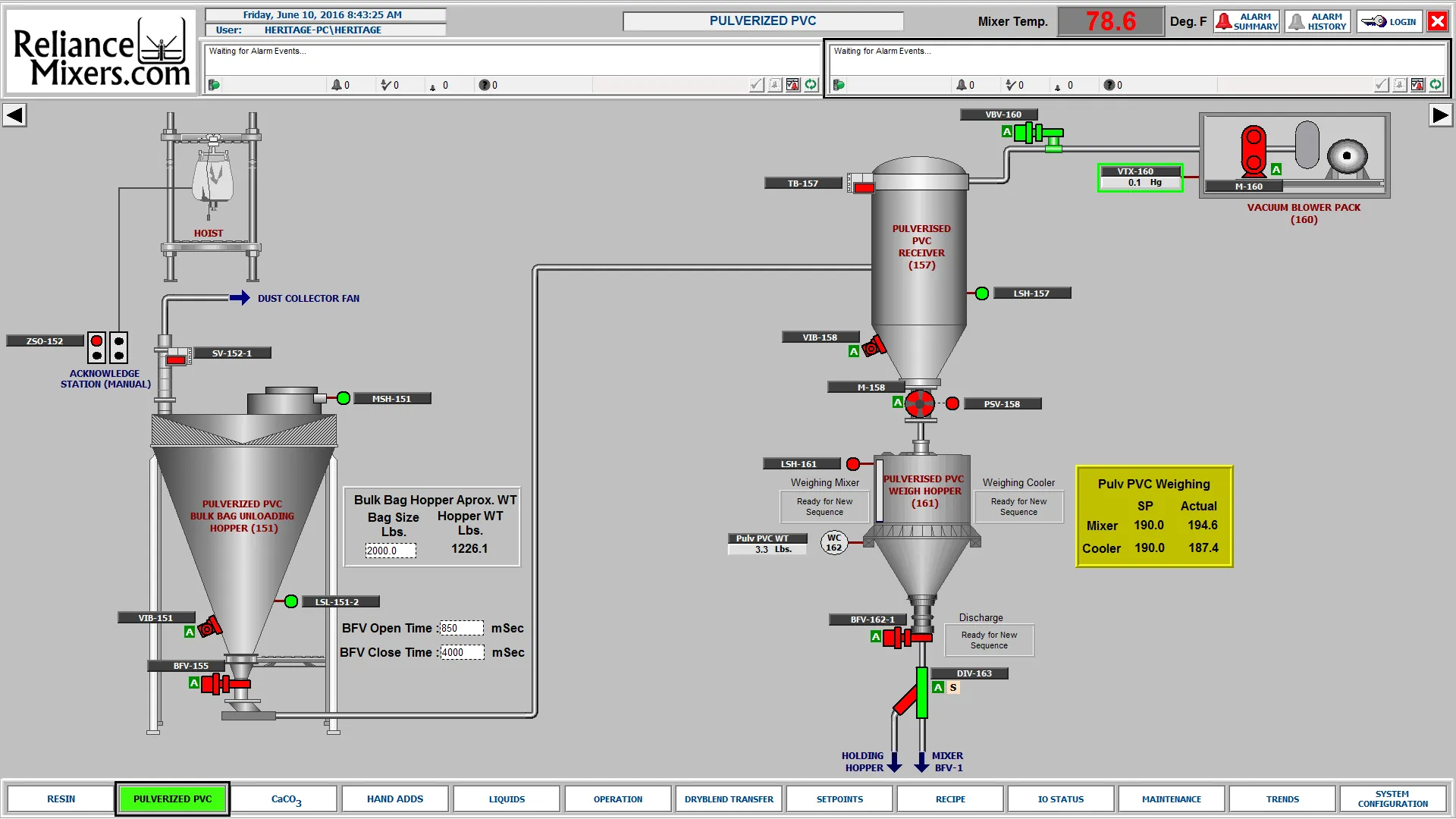
Reliance Control Systems, developed specifically for their high-intensity mixer product line, approaches this through integrated parameter management rather than isolated setpoint monitoring. The practical effect is that operators aren't manually compensating for material-to-material variation within a single recipe. The system holds the process conditions, and the operator manages exceptions. That's a meaningful distinction in a high-throughput environment.
Why Manual Override Culture Creates Quality Risk
Here's something I've seen at facilities running older or underspecified control platforms: operators develop workarounds. A batch running hot gets cut five seconds early, and a slower-to-disperse pigment gets an extra rotor pass. These interventions might produce an acceptable product on any given day, but they introduce variability that's invisible to the quality system because it's never formally documented.
The problem isn't the operators. They're compensating for a system that doesn't give them enough process feedback to make precise adjustments. They're making judgment calls where the equipment should be making controlled responses.
Modern control systems for high-intensity mixers solve this by logging every variable across every cycle. Speed ramp profiles, time-to-friction-temp, discharge temperature, cycle duration – all of it captured and accessible. Over time, that data becomes a process fingerprint for each formulation. When quality drifts, the logs tell you when and where the deviation started, not just that it happened.
Sequence Control and the Mixing Cycle
One area where control system sophistication matters considerably is sequence management during the mixing cycle. A high-intensity mixer for compounding applications typically runs through several distinct phases: initial low-speed blending to incorporate dry ingredients, a ramp to high-speed dispersion, a temperature-triggered hold phase, and then discharge. Getting the transitions between these phases right, and getting them right every cycle, is entirely a control system responsibility.
If the transition from ramp to hold is based on time rather than being triggered by temperature, it introduces a potential vulnerability. Batches that heat up faster than average, such as when the mixer has already been running for several cycles and the vessel is still warm, may exit the high-shear phase before dispersion is fully achieved. Conversely, batches that heat more slowly may remain in the phase too long and overshoot the target. In either case, the resulting product falls out of specification, and without cycle-level logging, the root cause can be difficult to identify.
Temperature-triggered sequencing is more precise, but only if the control system can act on the signal quickly enough at the speeds a high-intensity mixer operates. This is a hardware-and-software problem, not just a settings problem, and it's worth asking about specifically when evaluating equipment.
Integration with Downstream Equipment
A control system that operates in isolation from the rest of the production line creates its own category of problems. Discharge timing, for example, matters significantly in systems where the cooling mixer is running continuously. If the high-intensity mixer discharges into a cooling mixer that isn't ready to receive material, you get temperature spikes in the cooling phase that are difficult to recover from.
Well-designed control systems for high-intensity mixing applications support handshake signals between equipment, essentially communication between the mixer and downstream units to coordinate discharge and receipt of material. Whether this runs through a PLC network or a more centralized SCADA layer depends on plant architecture, but the capability needs to be there.
Reliance's control systems for their high-intensity mixer configurations are built with this kind of integration in mind, which reflects an understanding that the mixer is one node in a production sequence, not a standalone machine.
What to Actually Ask When Evaluating Control System Capability
If you're in the position of specifying or approving mixing equipment, these are the questions worth pushing on: Does the system trigger phase transitions on process conditions or on time? What parameters are logged per cycle, and how is that data accessible? Can the control platform communicate with upstream and downstream equipment? What's the operator interface like? Does it require technical knowledge to interpret, or can a line operator respond to it in real time?
The answers matter more than the brand name on the panel. A well-engineered control system makes the mixer more valuable. An underspecified one limits what an otherwise capable machine can do.



















Sign in to leave a comment.