
Every manufacturer has faced this moment — when every formulation is perfect on paper, the raw materials are premium, and the production line is optimized, yet somehow, batch quality keeps fluctuating. Some runs come out flawless. Others? Not so much.
And that’s when the real frustration begins.
High-intensity mixing applications push equipment, processes, and people to their limits. High torque, fast cycle times, strict temperature control, zero tolerance for inconsistencies — everything has to work in perfect sync. One delay, one parameter drift, one uncontrolled spike, and the entire batch becomes a costly lesson.
This is exactly why manufacturers across industries are rethinking how their approach to control in high-intensity mixing, not as a support function, but as a core production strategy.
The Real Challenge Isn’t Mixing — It’s Controlling the Chaos
High-intensity operations demand far more than powerful motors and rugged mechanical design. The real challenge is managing variables that shift in real time: torque loads, heat generation, shear forces, cycle speed, and material flow behavior.
Without intelligent automation, manufacturers often face:
- Unstable product quality across batches
- Overheating and thermal degradation
- Increased machine wear and frequent breakdowns
- Operator-dependent performance
- Rising energy and maintenance costs
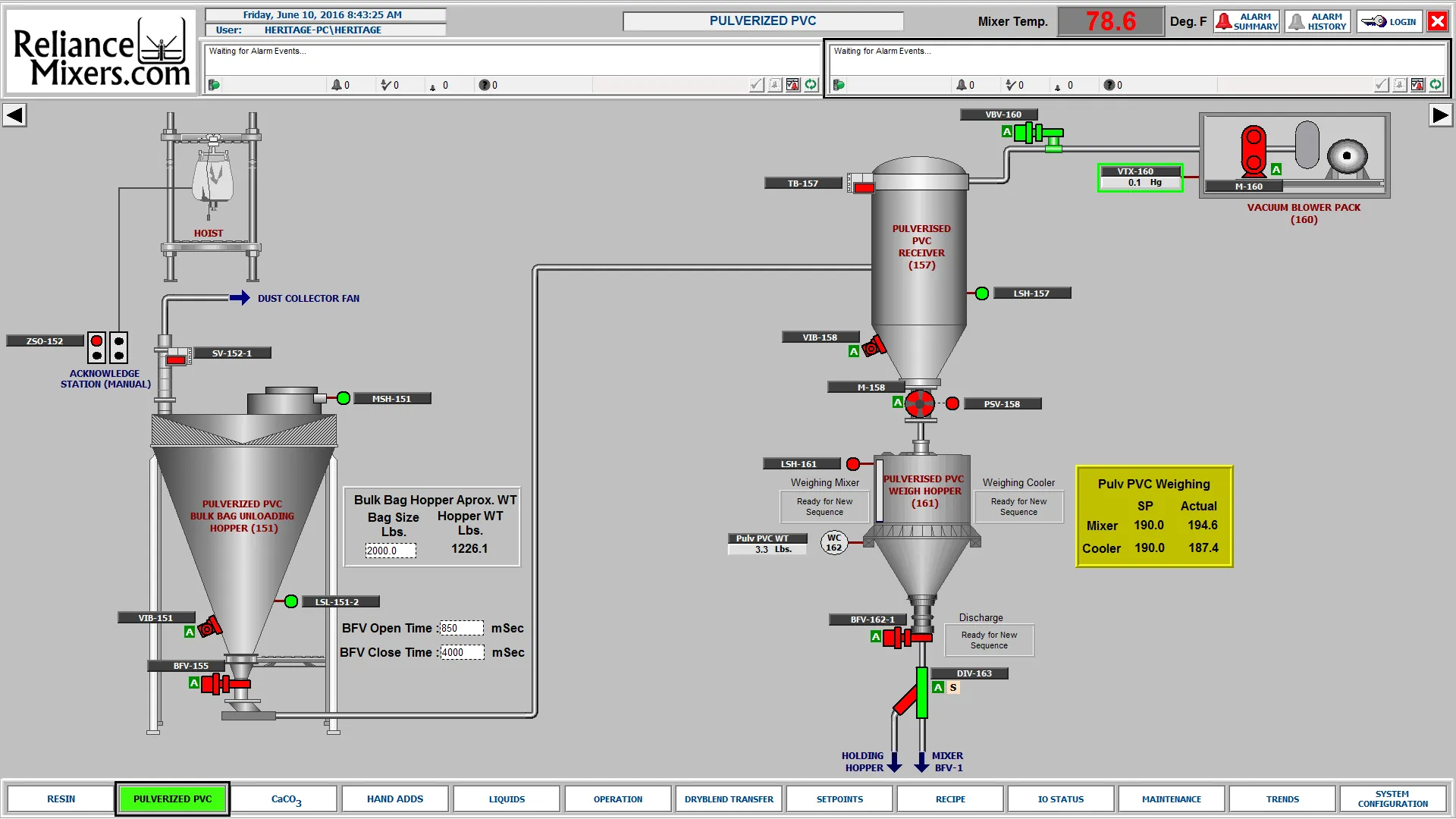
That’s where advanced industrial automation and Reliance Mixers control systems come into play. delivering a level of precision, responsiveness, and process stability that conventional setups simply cannot match.
In high-speed, high-shear environments, control systems don’t just regulate machines; they protect product integrity, operator safety, and production profitability.
Quick Reality Check: How Smart Is Your Mixing Line?
Before we go deeper, let’s do a quick self-check. Answer honestly:
- Do you still rely on manual adjustments during production?
- Do your batch results vary between shifts or operators?
- Do temperature spikes occasionally catch your team off guard?
- Do breakdowns happen “unexpectedly” but far too often?
If you answered yes to even two of these, your mixing process may be operating below its real potential, and that gap is where intelligent control systems make their biggest impact.
Where High-Intensity Mixing Demands a Different Approach
A high-intensity mixer isn’t just faster equipment. It’s a completely different operating environment.
Here, materials undergo aggressive mechanical action, rapid dispersion, and intense energy input, all of which require tight real-time control. This is where traditional PLC setups, basic timers, and fixed-speed drives begin to show their limitations.
Advanced systems focus on:
- Dynamic torque monitoring
- Automated temperature compensation
- Real-time speed modulation
- Predictive fault detection
- Data-driven batch consistency
When these elements work together, mixing becomes predictable, repeatable, and scalable — regardless of formulation complexity or production volume.
The Control Layer That Transforms Mixing Into Manufacturing Intelligence
This is where Reliance Control Systems stand out, not just as automation platforms, but as process optimization engines.
With roots dating back to 1982 and a legacy built on the principle of “Reliability in Every Batch,” Reliance brings more than four decades of real-world industrial mixing and automation expertise to every control architecture it designs.
Instead of treating control panels as simple operational tools, modern designs integrate process analytics, adaptive algorithms, and intelligent feedback loops. The result? Equipment that learns, adapts, and improves with every batch.
Manufacturers benefit from:
- Faster cycle times without compromising product integrity
- Lower scrap and rework rates
- Reduced operator dependency
- Consistent quality across multi-shift operations
- Actionable production insights
And when control systems are purpose-built for mixing, rather than retrofitted from generic automation, the difference in output reliability becomes unmistakable.
Why Manufacturers Are Shifting Toward Integrated Mixing Control Platforms
The most forward-looking plants are no longer purchasing machines in isolation. They’re investing in complete mixing ecosystems, where mechanics, software, and automation are designed to work together from day one.
That’s exactly the philosophy behind platforms powered by Reliance Mixers control systems, where engineering, automation logic, and field-tested mixing expertise come together into a single cohesive solution.
Instead of reacting to problems, these systems anticipate them.
Torque overload? Automatically compensated.
Thermal spikes? Instantly regulated.
Material inconsistency? Detected early and corrected mid-cycle.
This proactive control environment dramatically reduces downtime, stabilizes production quality, and extends equipment lifespan, creating long-term operational resilience.
Turning Control Into Competitive Advantage
In high-intensity manufacturing, control precision directly translates into commercial performance.
Better control means:
- Faster time-to-market
- Higher batch acceptance rates
- Predictable production planning
- Reduced quality disputes
- Greater customer trust
And when your control architecture is backed by over four decades of specialized industrial mixing expertise, that confidence multiplies. This is where Reliance’s engineering heritage quietly becomes a strategic asset, shaping systems that perform not only in controlled environments but under the real-world pressures of industrial manufacturing.
For manufacturers exploring advanced automation strategies, the difference becomes clear when they experience how seamlessly intelligent control integrates into their production flow. You can explore the approach behind these systems here: https://www.reliancemixers.com/control-systems/
Final Thoughts: Control Is No Longer a Technical Choice — It’s a Strategic One
High-intensity mixing environments are becoming faster, more complex, and far less forgiving. As material formulations evolve and quality expectations tighten, manufacturers are discovering that mechanical power alone is no longer enough to stay competitive.
What increasingly separates consistent performers from constant troubleshooters is the intelligence with which their processes are controlled. Real-time monitoring, adaptive automation, and data-backed decision-making are no longer “nice to have”; they’re becoming foundational to sustainable manufacturing.
For production teams navigating rising material costs, tighter tolerances, and shorter delivery windows, investing in smarter control strategies isn’t about upgrading machines. It’s about building process stability, operational confidence, and long-term scalability.
And in high-intensity mixing, that shift from reactive control to intelligent process management is often the mo ment where manufacturing truly starts to scale.























Sign in to leave a comment.