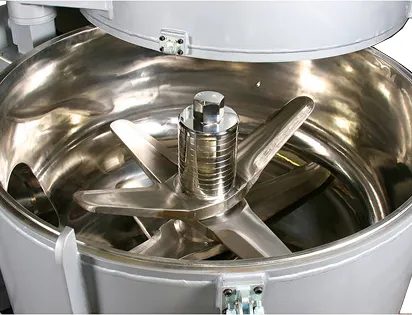

Powder processing is one of the most demanding mixing challenges in industrial manufacturing. Whether blending dry pigments for color concentrates, compounding specialty powders, or preparing formulations for powder coating lines, the mixing method directly determines product quality, batch consistency, and production efficiency.
Container mixers have become the preferred solution across these applications, not because they are the most powerful mixing technology available, but because they are the most appropriate one. For powders that require gentle, complete, contamination-free blending, the tumbling action of a container mixer delivers results that shaft-driven and high-shear systems fundamentally cannot.
Why Conventional Mixers Fall Short in Powder Applications
Traditional mixing equipment, such as ribbon blenders, paddle mixers, and high-intensity shaft-driven systems, was designed around mechanical agitation. Internal tools move through the material, generating shear forces and friction to distribute components.
For many applications, this works well. For powders, it creates problems.
Dry powder particles are fragile. They carry electrostatic charges, maintain specific particle size distributions, and in the case of powder coatings, have resin properties that determine how the finished coating adheres, flows, and cures. Mechanical agitation generates heat. Heat alters resin structure. Friction degrades particle charge. Impact fusion binds particles together rather than dispersing them.
The result is a blend that looks mixed but performs inconsistently, with gloss variations, coverage defects, and application failures that trace directly back to the mixing process.
Container mixers for powder blending solve this by removing mechanical agitation from the equation entirely.
How Container Mixers Work
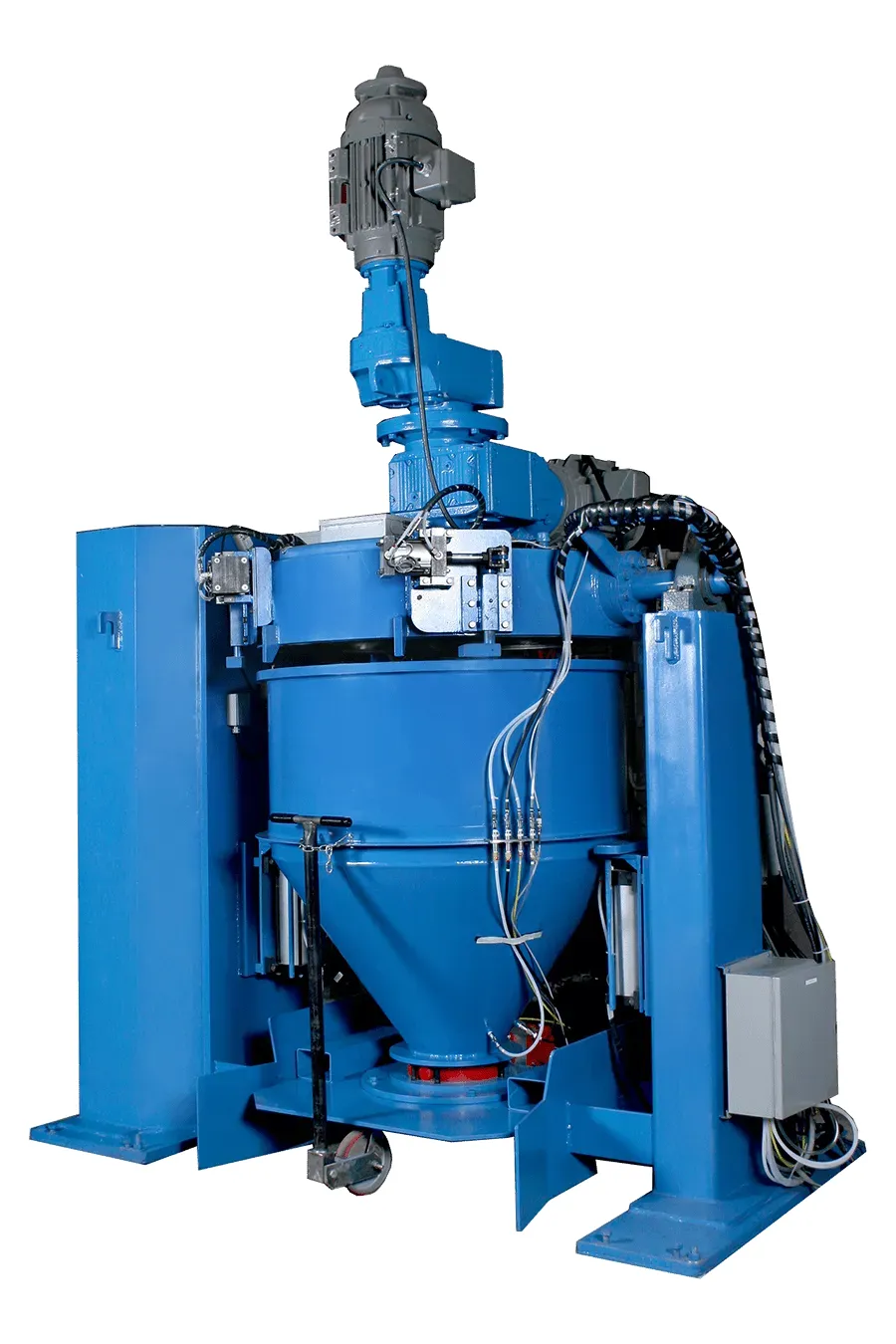
A container mixer operates on a fundamentally different principle. Rather than driving tools through stationary material, the entire mixing vessel rotates. The powder tumbles, folds, and recirculates through a controlled motion pattern that achieves complete homogeneity without applying shear, heat, or impact energy to the material.
The container is loaded, sealed, and mounted onto the mixer drive. As the vessel rotates, gravity and motion move every particle through the blend. There are no internal shafts, no mixing tools inside the container, and no surfaces for powder to accumulate on between batches.
This design has three direct consequences for powder processing:
Complete homogeneity: every particle contacts every other particle through the full mixing cycle, achieving uniform distribution of all components, including low-inclusion additives and specialty pigments.
Zero heat generation: with no friction-generating tools and no shear forces, the powder’s temperature remains stable throughout blending, preserving resin integrity and particle charge characteristics.
Near-zero product retention: because there are no internal components, the container discharges completely. Cross-contamination between batches is eliminated by design rather than by cleaning effort.
Powder Blending Application Across Industries
The powder blending requirements across industries vary considerably in material density, particle fragility, inclusion levels, and batch size. Container mixers address this range through vessel geometry, rotation speed, and configuration options rather than through changes to the mixing principle itself.
For dry pigment blending and colour concentrate production, the gentle tumbling action disperses colorants uniformly throughout the carrier powder without generating the ultrafines that compromise downstream processing. Low-inclusion pigments achieve the same distribution as high-inclusion components because the rotation pattern moves all material equally.
For specialty chemical powders, adhesive base powders, and pharmaceutical excipients, container mixing preserves the flow characteristics and particle morphology that determine how the powder performs in its end application.
For masterbatch and toner production, container mixers provide the batch-to-batch consistency that colour accuracy demands. The same vessel, the same rotation parameters, and the same mixing duration produce the same result every time, a repeatability that shaft-driven systems cannot reliably match as tools wear over time.
Why Powder Coating is the Most Demanding Blending Application
Powder coating is technically one of the most demanding blending applications in industrial manufacturing, and it illustrates precisely why container mixer technology matters.
A powder coating formulation contains resin, hardener, pigment, flow additives, and specialty components, each contributing specific properties to the finished coating. Performance depends on how uniformly those components are distributed and whether their individual properties remain intact after blending.
Using a container mixer for powder coating addresses both requirements simultaneously. The tumbling action distributes all components uniformly without generating the friction heat that softens resin particles and causes impact fusion. The premature bonding of resin and hardener renders a batch unusable before it reaches the application line.
Colour changeovers, one of the most time-consuming and contamination-prone operations in powder coating production, are reduced to a straightforward process. The container is removed, cleaned externally, and replaced. No internal components require disassembly. No residual powder accumulates in shaft housings or tool assemblies. The next colour runs clean from the first batch.
What to Look for When Selecting a Container Mixer
Selection criteria differ between general powder blending and powder coating applications, though both share common requirements.
For powder blending, prioritise vessel size range, rotation speed control, and the ability to handle varying bulk densities within the same system. Flexibility across material types reduces capital investment as product lines evolve.
For powder coating specifically, prioritise discharge completeness, colour changeover time, and the depth of application engineering support from the manufacturer. A system that performs well with one coating chemistry may require configuration adjustments for another, particularly when moving between smooth and textured finishes or between standard and functional coating types.
In both cases, the manufacturer's application experience matters considerably. Container mixing for powder applications is not a generic technology; vessel design, rotation parameters, and discharge configuration should reflect the specific demands of the material being processed.
Reliance Mixers has been engineering container mixer systems for powder blending and powder coating applications since 1982, with installations across North America and global markets – building systems designed specifically for powder processing requirements, not adapted from general-purpose equipment.
Conclusion
Container mixers represent the technically correct solution for powder blending and powder coating applications, purpose-built for materials where particle integrity, blend uniformity, and contamination-free processing are non-negotiable.
For powder coating manufacturers, the specific demands of resin stability, electrostatic charge preservation, and colour changeover efficiency make the container mixer's design advantages directly measurable in production outcomes. For powder blending applications across pigments, specialty chemicals, and colour concentrates, the same gentle tumbling action delivers the repeatability and consistency that product quality depends on.
Selecting the right system with appropriate vessel geometry, discharge design, and application engineering support is the foundation of a powder processing operation built for consistent, long-term performance.






















Sign in to leave a comment.