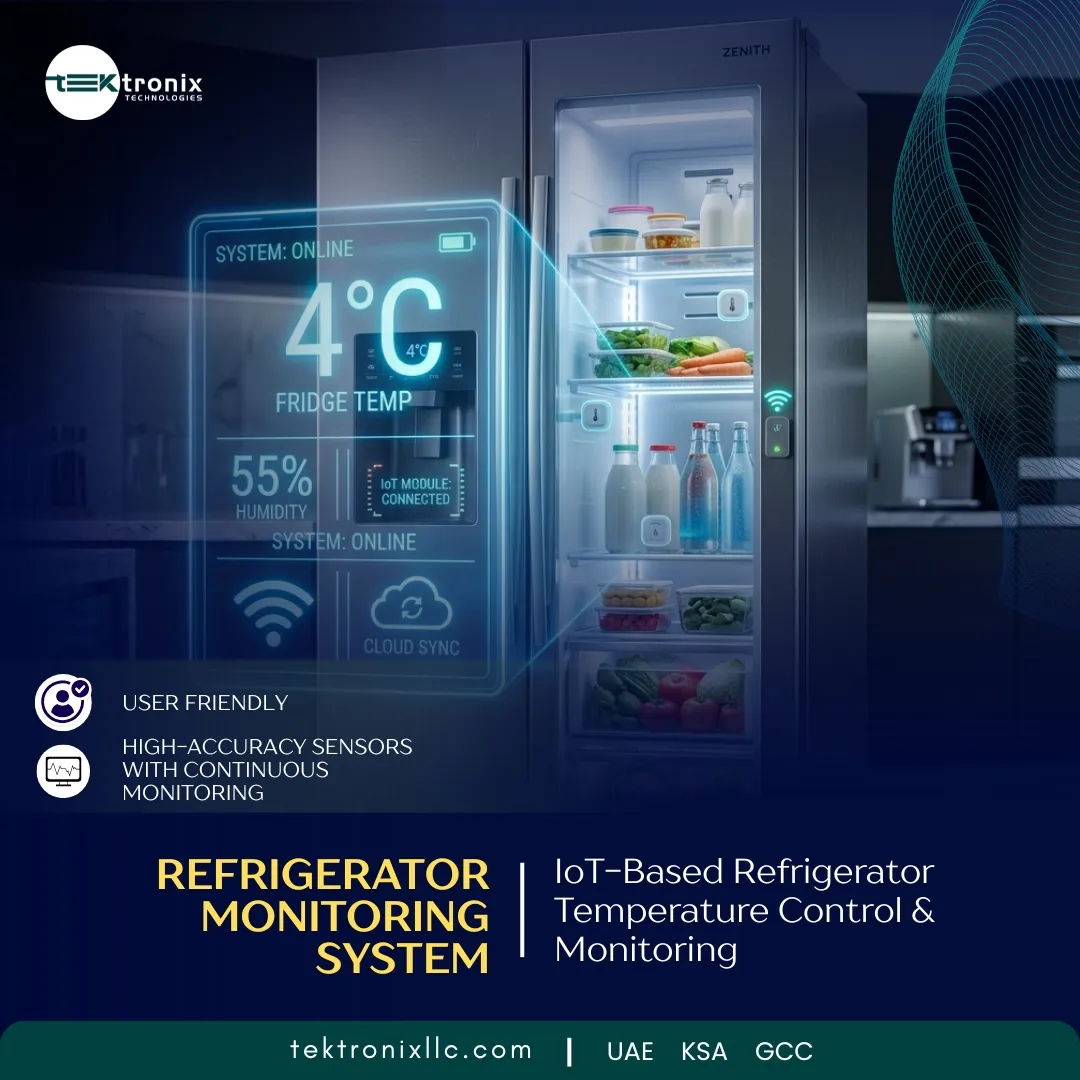

Effective Refrigerator Monitoring is the single most consequential food-safety investment a restaurant operator can make in Qatar and across the Gulf Cooperation Council. When cold-chain integrity fails — even briefly — perishable inventory spoils, regulatory violations follow, and, most critically, diners face the risk of foodborne illness. This guide examines the technologies, standards, and best practices that define compliant, intelligent refrigeration management for the GCC hospitality sector, and explains how Tektronix LLC's Refrigerator Monitoring Solutions are purpose-engineered for the region's demanding climate and regulatory environment.
1. The Cold-Chain Imperative: Why Qatar & GCC Restaurants Cannot Afford to Cut Corners
Qatar's Ministry of Public Health (MoPH), the UAE's Food Safety Department, Saudi Arabia's Saudi Food and Drug Authority (SFDA), and their GCC counterparts all mandate that perishable foods be stored within tightly defined temperature bands. Ambient summer temperatures in the Gulf regularly exceed 45 °C, placing extraordinary thermal stress on refrigeration equipment — stress that dramatically compresses the window between a minor compressor fault and a full-scale spoilage event.
The consequences of non-compliance extend well beyond the cost of discarded inventory. Regulatory inspectors in Qatar and across the GCC now conduct unannounced visits and require documentary evidence — timestamped logs, alert histories, and calibration certificates — that temperatures were maintained continuously. Manual paper logs, still common in smaller operations, cannot satisfy this evidentiary standard. The shift to automated, cloud-connected monitoring is therefore not merely a technology upgrade; it is a compliance necessity.
Key risk factors unique to the GCC that elevate cold-chain stakes:
- Extreme ambient heat: External temperatures that are among the highest recorded globally accelerate refrigerant breakdown and compressor wear, increasing equipment failure rates.
- High-volume hospitality load: Qatar's hotel, restaurant, and catering (HoReCa) sector — among the fastest-growing in the region — creates peak door-open frequencies that destabilise cabinet temperatures during service periods.
- Hajj and major events seasonality: Sudden demand surges during Ramadan, national holidays, and international sporting events push refrigeration systems to their operational limits precisely when monitoring is most critical.
- Supply chain complexity: GCC restaurants source ingredients internationally, meaning cold-chain gaps can occur at multiple handoff points before produce even reaches the kitchen refrigerator.
- Regulatory harmonisation trajectory: GCC member states are actively aligning food safety standards with Codex Alimentarius and ISO 22000, raising the bar for documentation and traceability year on year.
2. Temperature Monitoring Solutions: From Analogue to Intelligent Systems
The evolution of Temperature Monitoring Solutions over the past decade has transformed what is possible for restaurant operators in the GCC. Where first-generation systems relied on bi-metallic strip thermometers read and recorded by hand, today's solutions deliver continuous, automated, wireless monitoring with sub-minute reporting intervals and instant anomaly notification.
2.1 The Limitations of Manual Monitoring
Manual temperature checks — even when conducted diligently every two hours — leave substantial gaps during which silent failures can progress undetected. A compressor that begins failing at 2:00 a.m. in an unmonitored walk-in cooler may have allowed product temperatures to climb to 12 °C by the time staff arrive at 6:00 a.m., well above the 4 °C maximum for chilled ready-to-eat foods specified by GCC food safety authorities. Manual logs are also vulnerable to transcription error, falsification, and illegibility — all of which undermine their evidential value during regulatory audits.
2.2 Wireless Sensor Networks
Modern temperature monitoring architectures for restaurants deploy wireless sensor nodes inside each refrigerated unit — reach-in coolers, walk-in chillers, blast freezers, and display cases alike. These nodes communicate temperature and humidity readings to a central gateway over low-power wide-area networks (LPWAN), Wi-Fi, or Zigbee mesh, depending on the facility's infrastructure. The gateway relays data to a cloud platform where it is timestamped, stored, and made available for real-time dashboarding and historical reporting.
Tektronix LLC engineer’s sensor deployments that account for the specific thermal profile of each unit — placing probes at the warmest point in the cabinet (typically near the door gasket) to ensure worst-case temperature measurement, in line with best-practice guidance from international food safety bodies.
3. Smart Sensors: The Intelligence Layer of Modern Cold-Chain Management
Smart Sensors are the physical foundation on which all other monitoring capabilities are built. Unlike conventional thermocouples or bimetallic probes, smart sensor nodes integrate multiple measurement modalities — temperature, relative humidity, door open/close status, and in advanced deployments, energy consumption — into a single compact device. They are self-calibrating, battery-backed against power outages, and designed to operate reliably in the high-humidity, high-temperature ambient conditions typical of GCC commercial kitchen environments.
Characteristics that distinguish food-grade smart sensors for GCC restaurant applications:
- IP67 or higher ingress protection: Full dust-tight and submersion-resistant ratings essential in wash-down kitchen environments.
- HACCP-compliant accuracy: Measurement accuracy of ±0.3 °C or better, meeting the precision requirements of Hazard Analysis Critical Control Point (HACCP) plans mandated by Qatar MoPH and the SFDA.
- Extended battery life: Minimum two-year battery autonomy with low-battery alerting, ensuring continuous operation between maintenance visits.
- Tamper-evident design: Physical and digital tamper indicators that preserve the integrity of logged data for regulatory submissions.
- Multi-parameter monitoring: Simultaneous temperature and humidity sensing to detect condensation risk and optimise preservation conditions for different food categories.
Tektronix LLC's smart sensor portfolio for GCC restaurant clients is validated against EN 12830 and NIST traceable calibration standards, providing the independent technical credibility that health authorities require when reviewing cold-chain documentation.
4. Remote Temperature Monitoring: Visibility Without Boundaries
Remote Temperature Monitoring liberates restaurant managers, food safety officers, and facility management teams from the need to be physically present to verify cold-chain status. Via a web portal or mobile application, authorised personnel can view real-time temperatures across every monitored unit in a single restaurant, a hotel's multiple F&B outlets, or an entire chain of locations spanning Qatar and the broader GCC — from a single dashboard, at any time, from any device.
For multi-site restaurant groups — a rapidly growing business model across Doha, Riyadh, Dubai, and Abu Dhabi — remote visibility delivers compounding operational value:
- Centralised food safety governance: Head office quality assurance teams can monitor compliance across all sites in real time without relying on self-reported data from site managers.
- After-hours incident detection: Failures that occur outside staffed hours — which, given the GCC's extended trading hours and 24-hour hospitality concepts, still represent a meaningful risk window — are detected and escalated automatically.
- Pre-opening compliance verification: Commissioning checklists for new restaurant openings can include live temperature verification, reducing the risk of regulatory issues in the critical first weeks of operation.
- Franchise quality assurance: International food and beverage franchise operators can enforce brand-standard cold-chain protocols across franchisee locations without on-site visits.
Tektronix LLC's remote monitoring platform is hosted on enterprise-grade cloud infrastructure with 99.9% uptime SLAs, end-to-end TLS encryption, and data residency options that satisfy Qatar's emerging data sovereignty requirements.
5. Temperature Data Loggers: The Evidential Backbone of HACCP Compliance
Temperature Data Loggers are the record-keeping engine of a compliant cold-chain management system. Every temperature reading captured by deployed sensors is time-stamped and stored in a tamper-evident, audit-ready format that satisfies the documentary requirements of GCC food safety regulators. Historically, data loggers were standalone USB devices that required manual retrieval and data transfer; modern cloud-connected loggers eliminate this friction by transmitting records automatically to a secure cloud repository.
What GCC health inspectors expect from temperature logs:
- Continuous recording at defined intervals: Qatar MoPH guidelines and equivalent GCC standards generally expect temperature records at minimum every 30 minutes during storage periods, with no unexplained gaps.
- Calibration traceability: Each logger must have a current calibration certificate traceable to a national or international measurement standard, with calibration intervals typically not exceeding 12 months.
- Exportable reports in inspector-ready formats: PDF and CSV export functionality enabling rapid production of temperature histories covering any requested date range during an inspection visit.
- Long-term retention: Minimum 12-month data retention is the regional norm, with some GCC jurisdictions requiring up to three years for high-risk food categories.
Tektronix LLC's cloud logging platform automatically generates HACCP-formatted temperature reports on a daily, weekly, or monthly schedule, delivering them by email to designated food safety managers — ensuring documentation is always current, regardless of staff turnover.
6. Temperature Alerts: From Detection to Resolution in Minutes
Temperature Alerts are the operational nerve centre of any effective monitoring deployment. The moment a sensor reading breaches a pre-configured threshold — whether a walk-in cooler climbs above 4 °C, a blast freezer drifts above -18 °C, or a display case shows sustained door-open conditions — the system automatically escalates notifications through a defined chain of responsibility.
6.1 Multi-Channel Alerting
Effective alert architectures for GCC restaurant operations leverage multiple notification channels simultaneously to ensure that on-call staff cannot miss a critical event regardless of their location or activity. Channels typically include:
- SMS: Immediate text alerts to designated duty managers, kitchen supervisors, and maintenance personnel.
- Push notifications: In-app alerts through the monitoring platform's mobile application.
- Email escalation: Automated email chains that escalate to senior management if an alert is not acknowledged within a defined period.
- Voice call alerts: Automated telephone calls for critical threshold exceedances where immediate human action is required.
- Third-party integration: Webhook and API connections to CMMS (computerised maintenance management systems) and FM (facilities management) platforms for automatic work-order generation.
6.2 Configuring Thresholds for GCC Food Safety Compliance
Alert thresholds must be set to provide a meaningful intervention window before regulatory limits are breached. Tektronix LLC recommends configuring pre-alert thresholds approximately 1.5 °C inside regulatory limits — for example, a pre-alert at 2.5 °C for a chilled cabinet with a regulatory maximum of 4 °C — allowing corrective action before a compliance breach occurs and before perishable product quality is compromised.
7. Refrigerator Monitoring Qatar: Regulatory Alignment & Local Expertise
Refrigerator Monitoring Qatar deployments must navigate a specific and evolving regulatory landscape. Qatar's MoPH Food Safety Department enforces the Qatar General Organization for Standards & Metrology (QGOSM) food storage temperature standards and requires HACCP plans from all food service establishments operating within the country. The National Food Safety Law (Law No. 8 of 2021) and its implementing regulations explicitly reference the need for continuous temperature monitoring and documented corrective action protocols for cold storage.
Qatar-specific considerations that Tektronix LLC addresses in every restaurant monitoring deployment:
- Arabic-language reporting: Regulatory submissions and inspection-ready reports available in both Arabic and English to satisfy Qatar MoPH documentation requirements.
- Qatarisation-aware training: System operation and alert response training programmes designed for mixed Qatari and expatriate workforces, accounting for varying levels of technology familiarity.
- Integration with Sehhaty platform: Where applicable, data formatting aligned with Qatar's digital health information systems for streamlined regulatory reporting.
- Climate-rated hardware: All sensors and gateways specified for operation in ambient temperatures exceeding 50 °C, addressing the extreme thermal conditions in back-of-house kitchen areas during Qatar's summer months.
- Local technical support: Tektronix LLC maintains an in-country engineering team in Qatar providing same-day on-site support for hardware faults — critical for restaurants that cannot sustain monitoring gaps during regulatory inspection periods.
8. Refrigerator Monitoring GCC: A Pan-Regional Compliance Framework
Refrigerator Monitoring GCC deployments for multi-site restaurant groups and international food service brands require a unified monitoring framework that simultaneously satisfies the distinct regulatory instruments of each member state. While Qatar, the UAE, Saudi Arabia, Kuwait, Bahrain, and Oman share broad alignment with Codex Alimentarius principles, each jurisdiction has specific temperature requirements, documentation formats, and inspection protocols that must be addressed.
Tektronix LLC's GCC-wide restaurant monitoring programme delivers:
- Jurisdiction-mapped alert thresholds: Threshold configurations that reflect the specific temperature limits prescribed by each GCC member state's food safety authority — eliminating the risk of a threshold calibrated for one market creating non-compliance in another.
- Unified reporting dashboard: A single pane of glass for operations and food safety teams managing multiple GCC markets, with per-site drill-down for local compliance reporting and aggregate views for regional performance tracking.
- Scalable architecture: Cloud infrastructure designed to support seamless addition of new restaurant locations across GCC markets as restaurant groups expand, without requiring platform migrations or architectural rework.
- Regulatory change management: Tektronix LLC's regulatory monitoring service tracks GCC food safety standard updates and proactively adjusts system configurations — ensuring clients remain compliant as regulations evolve without requiring manual intervention from restaurant operations teams.
9. Why Tektronix LLC Is the Trusted Partner
Experience, Expertise, Authoritativeness, and Trustworthiness underpin Tektronix LLC's position as the preferred refrigeration monitoring partner for Qatar and GCC restaurant operators. The company's credentials include:
- Decade-plus GCC operational history: Established presence across Qatar, UAE, Saudi Arabia, and beyond with hundreds of food service monitoring deployments across hotels, standalone restaurants, hospital catering, and large-scale F&B outlets.
- HACCP-certified engineering team: In-house engineers holding HACCP Level 3 and ISO 22000 certifications who design monitoring architectures that are audit-ready from day one.
- Regulatory body relationships: Active engagement with Qatar MoPH, the SFDA, and UAE Food Safety Department working groups — ensuring Tektronix LLC's solutions reflect the most current regulatory expectations.
- Vendor-neutral hardware selection: Partnerships with leading sensor manufacturers including Sensitech, Onset HOBO, and Monnit, with hardware selected on performance merits for each specific application rather than commercial preference.
- 24/7 NOC support: A dedicated network operations centre monitoring system health across all deployed client installations, with proactive outreach when connectivity or sensor performance anomalies are detected — before a client's operations team is even aware of an issue.
10. Implementation: From Assessment to Operational Monitoring
Deploying a compliant, reliable refrigerator monitoring system in a live restaurant environment requires careful planning to avoid disruption to food service operations. Tektronix LLC follows a structured four-stage implementation methodology:
Stage 1 — Site Survey & Thermal Mapping
A qualified engineer visits the facility to catalogue every refrigerated unit, assess ambient temperature conditions, evaluate existing network infrastructure, and identify optimal sensor placement positions within each cabinet. For complex facilities such as hotel kitchens or large catering operations, thermal mapping studies are conducted to identify heat pockets and refrigeration blind spots.
Stage 2 — System Design & Regulatory Alignment
A monitoring system architecture is designed that specifies sensor models, network topology, gateway placement, alert threshold configurations, and reporting formats — all cross-referenced against the applicable GCC regulatory requirements for the facility's jurisdiction and food category mix.
Stage 3 — Installation & Commissioning
Hardware installation is scheduled during low-activity periods (typically pre-opening or late-night) to avoid disruption. Each sensor is commissioned, connectivity verified, and baseline readings validated against a calibrated reference thermometer before the system goes live. Commissioning documentation is provided in the format required by local health authorities.
Stage 4 — Training, Go-Live & Ongoing Support
Kitchen management, food safety leads, and facilities teams receive role-specific training on the monitoring platform, alert response protocols, and report generation. Following go-live, Tektronix LLC's NOC team monitors system health proactively, and a dedicated account manager conducts quarterly reviews to ensure configurations remain aligned with operational and regulatory changes.
Conclusion
For restaurant operators across Qatar and the GCC, cold-chain integrity is simultaneously a food safety obligation, a regulatory requirement, and a business continuity imperative. The consequences of refrigeration failure — spoiled inventory, regulatory enforcement action, reputational damage, and — most gravely — harm to diners — are too significant to manage with manual processes in a region where ambient conditions put equipment under constant thermal stress.
The convergence of Smart Sensors, cloud-connected Temperature Data Loggers, real-time Temperature Alerts, and Remote Temperature Monitoring has made continuous, compliant, and cost-effective cold-chain management accessible to restaurants of every scale — from a single-site café in Doha's Msheireb district to a multi-brand F&B group operating across six GCC markets.
Tektronix LLC's purpose-built Temperature Monitoring Solutions for the GCC hospitality sector provide the technology, expertise, and regulatory alignment that modern restaurant operators need to protect their guests, their inventory, and their licences to operate. Contact our regional team today to schedule a no-obligation site assessment and discover what confident cold-chain management looks like for your operation.
FAQs
1. What temperature ranges do Qatar and GCC food safety regulations require for restaurant refrigerators?
Most GCC food safety authorities, including Qatar's MoPH, align with Codex Alimentarius guidelines requiring chilled ready-to-eat foods to be stored at or below 4 °C and frozen foods at or below -18 °C. Specific temperature limits can vary by food category — fresh fish, dairy, and cooked meats may have tighter requirements — and operators should consult the applicable national standard for their jurisdiction. Tektronix LLC's monitoring systems are configurable to reflect the precise thresholds required by each GCC member state's regulations.
2. How do Smart Sensors differ from basic thermometers for restaurant cold-chain management?
Basic thermometers provide a point-in-time reading that must be manually recorded and lacks historical continuity. Smart Sensors capture readings continuously at programmed intervals — typically every 5 to 15 minutes — transmit data wirelessly to a cloud platform, generate automatic alerts when thresholds are breached, and maintain a tamper-evident log suitable for regulatory inspection. They also monitor additional parameters such as door open/close events and relative humidity, providing a far more complete picture of cold-chain integrity than any manual thermometer-based process can deliver.
3. Can Tektronix LLC's Refrigerator Monitoring system integrate with existing restaurant POS and HACCP management software?
Yes. Tektronix LLC's monitoring platform supports open API integration with leading restaurant management, HACCP documentation, and facilities management systems. This allows temperature exceedance events to automatically trigger corrective action workflows within existing HACCP software, and enables temperature records to be incorporated directly into digital food safety management plans without manual data re-entry. Integration specifications are assessed during the site survey stage and documented in the system design phase.
4. What happens if the internet connection is lost at a restaurant — will temperature data still be captured?
Tektronix LLC's monitoring architecture includes onboard data buffering in both the smart sensor nodes and the local gateway device. In the event of a connectivity outage, readings continue to be captured and stored locally at the gateway. Once connectivity is restored, buffered data is automatically synchronised to the cloud platform, ensuring no gaps appear in the temperature log. Battery backup on gateway devices further ensures that brief power outages do not interrupt data capture, a particularly important consideration given the power infrastructure variability experienced in some GCC locations.
Contact Us:
00971 58 8899612


























Sign in to leave a comment.