
Most people who visit your website today will not buy. That is just the reality of online business.
They land on your page, look around, maybe spend 40 seconds reading and then they leave. Life gets in the way. They get distracted. Their boss calls. Their lunch arrives. Whatever it is, they are gone.
And most businesses just accept that. They keep spending on new traffic, chasing cold audiences, running the same top-of-funnel ads on repeat hoping that eventually someone will convert first time.
Here is what the smarter ones do instead.
They go back and get the people who already showed interest. They run retargeting campaigns that convert lost visitors into buyers. And they do it in a way that feels helpful rather than creepy which is exactly the difference between retargeting that works and retargeting that annoys.
Let me show you how.
Why Most Retargeting Fails Before It Even Starts
Before the secrets one honest observation.
Most businesses set up retargeting by creating one audience everyone who visited the website in the last 30 days and showing them the same generic ad they show everyone else.
That is not retargeting. That is just wasting money on a warmer audience.
Effective retargeting starts with understanding that not every visitor is the same. Someone who spent 4 minutes on your pricing page is completely different from someone who bounced off your homepage in 8 seconds. Treating them the same way is like sending the same email to someone who has never heard of you and someone who almost bought from you yesterday.
Segment first. Then retarget.
The Audiences That Actually Convert
Here is where the real retargeting secrets begin.
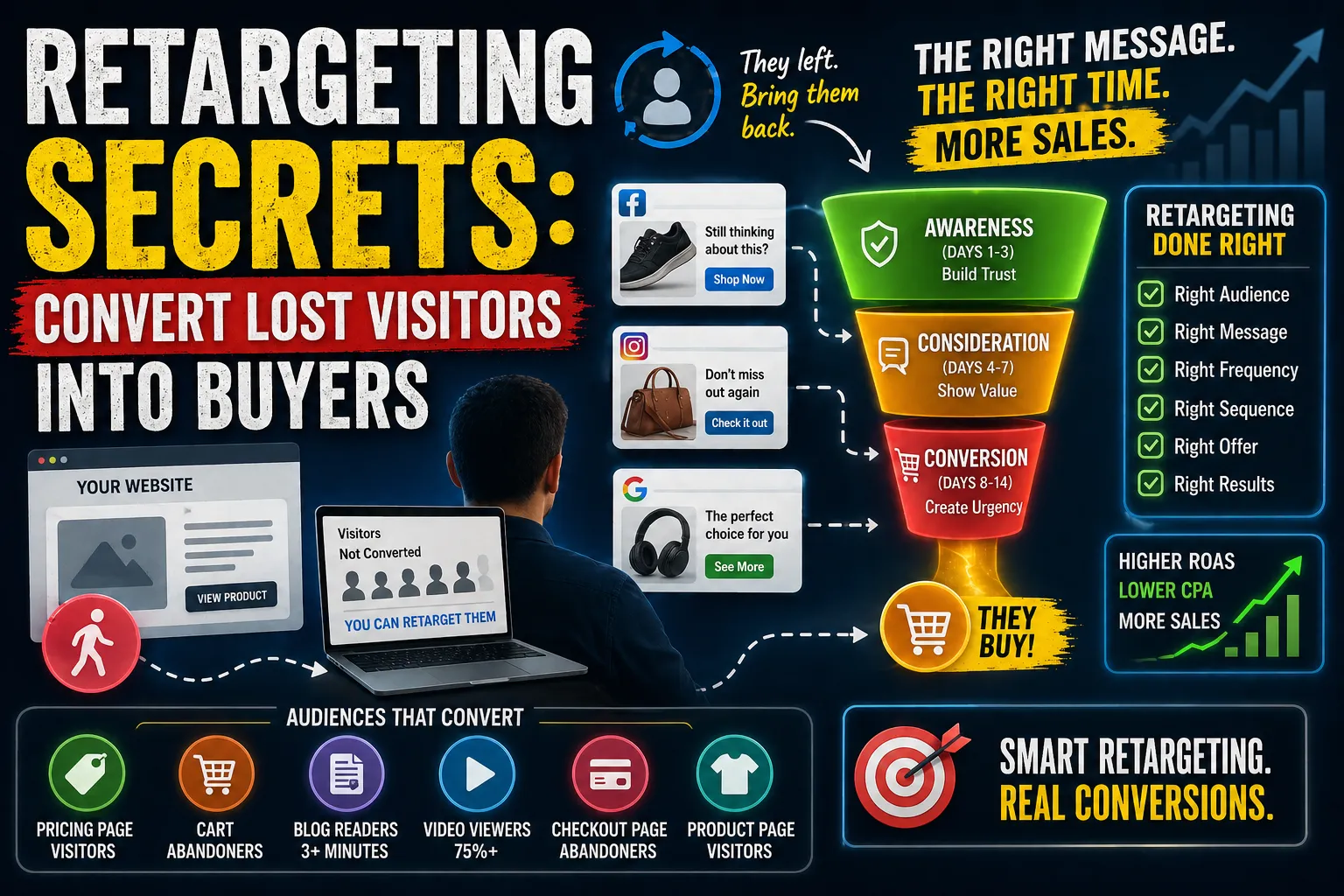
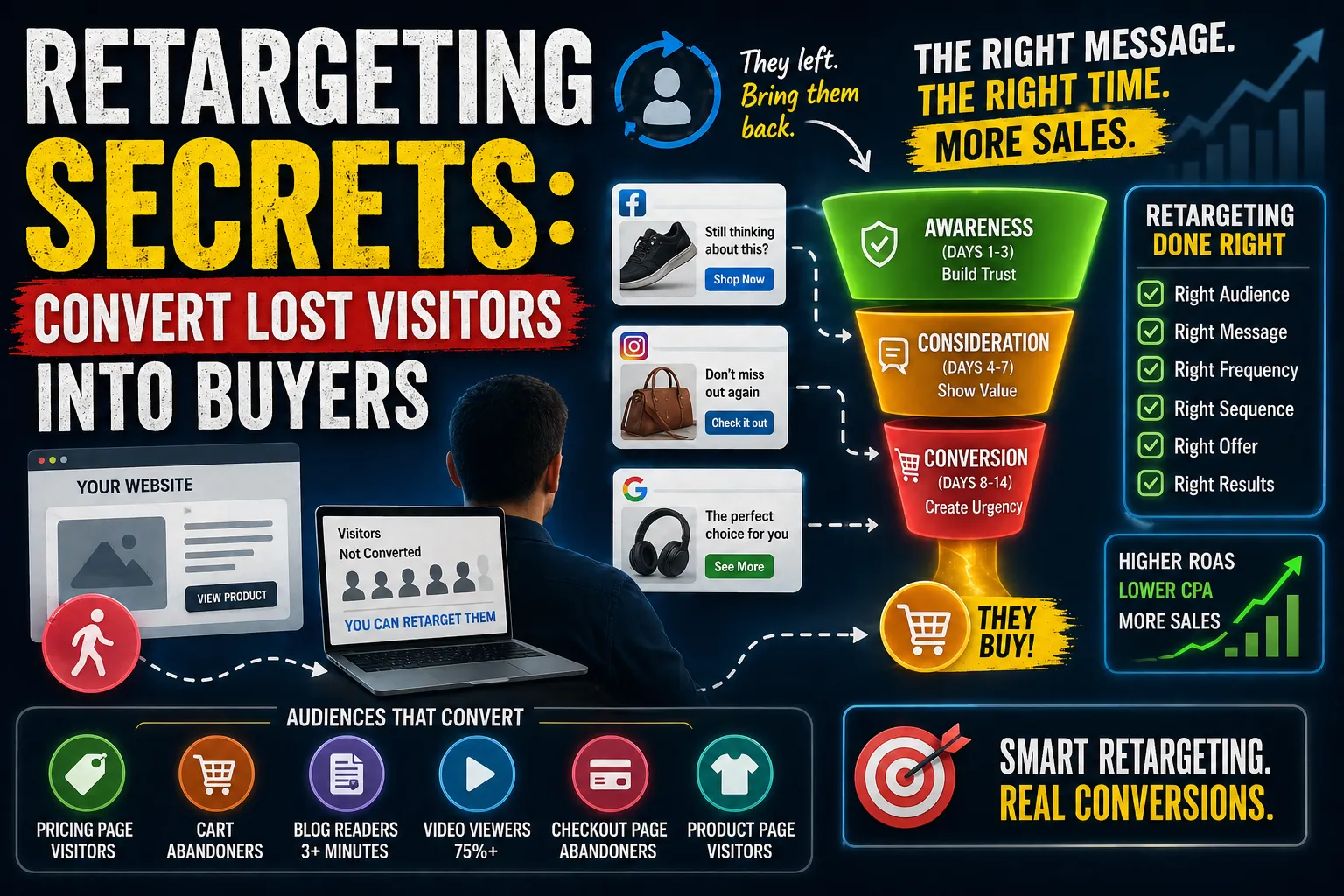
Forget the broad "all website visitors" bucket. These are the audiences that consistently produce the best return:
| Audience Segment | Why They Convert |
|---|---|
| Pricing page visitors | They were evaluating cost — they need one more push |
| Cart abandoners | They wanted it — something stopped them at the last step |
| Blog readers who spent 3+ minutes | High interest, just not ready — needs nurturing |
| Video viewers who watched 75%+ | Deep engagement — trust is already building |
| Checkout page abandoners | Closest to buying — most urgent retargeting priority |
| Product page visitors | Specific interest — show them that exact product again |
Build these as separate audiences inside Meta or Google. Each one needs a different message, a different offer, and a different level of urgency.
Secret 1 — Match the Message to Where They Dropped Off
This is the single biggest retargeting mistake people make.
Someone who visited your pricing page dropped off because of a specific concern. Maybe the price felt too high. Maybe they were not sure what was included. Maybe they wanted to compare options first.
Your retargeting ad for that person should not be a generic brand awareness message. It should directly address the hesitation they likely had.
"Wondering if it is worth it? Here is what our customers say about the price." "Not sure what is included? Here is exactly what you get."
Speak to the moment they left. That is where the conversion lives.
Secret 2 — The Frequency Sweet Spot
One of the most common retargeting campaign mistakes is showing the same ad to the same person 15 times in a week.
You have seen it happen to you. You look at one pair of shoes online and suddenly that exact shoe follows you across every platform for the next three weeks. It does not make you want to buy. It makes you resent the brand.
Frequency capping your retargeting ads is not optional — it is essential.
A good starting rule — no more than 3 to 5 impressions per person per week. After that, either change the creative completely or let the audience rest for a few days before hitting them again.
Retargeting should feel like a gentle reminder. Not a stalker.
Secret 3 — Use a Sequence, Not a Single Ad
The most sophisticated retargeting strategy for converting lost visitors is not one ad. It is a sequence.
Think of it like this — a three-step journey after someone leaves your site without buying:
Step 1 — Days 1 to 3: Show them social proof. A customer review, a result, a testimonial. No hard sell. Just reassurance that other people like them made this decision and it worked out.
Step 2 — Days 4 to 7: Show them the offer again with a benefit-focused message. Remind them what they were interested in and why it solves their specific problem.
Step 3 — Days 8 to 14: Add urgency or an incentive. A limited time offer, a free bonus, a deadline. Make there be a real reason to act now rather than later.
Sequential retargeting dramatically outperforms showing the same ad on repeat because it mirrors how real humans make decisions — they need reassurance before they need urgency.
Secret 4 — Retarget Your Email List Too
Most people think of retargeting as a website pixel strategy. It is also one of the most powerful things you can do with your email list retargeting setup.
Upload your email subscriber list to Meta and Google. Now you can show ads specifically to people who already know your brand, already receive your emails, but have not yet made a purchase.
These people trust you. They just have not been pushed to the purchase moment yet. A well-timed ad on the platforms they spend time on — combined with an email in their inbox — creates a multi-channel nudge that is very hard to ignore.
Customer list retargeting consistently delivers some of the lowest cost per acquisition numbers of any campaign type. And most businesses are sitting on an email list of hundreds or thousands of people they never activate this way.
Secret 5 — Dynamic Retargeting for Product Businesses
If you run an e-commerce store or a business with multiple products or services, dynamic retargeting ads are non-negotiable.
Dynamic ads automatically pull in the exact product someone viewed on your website and show it back to them in the ad. Not a generic brand ad. The specific red dress in size medium that they looked at for 3 minutes last Tuesday.
The personalisation level here is unmatched by any other ad format. And the conversion rates reflect that. Dynamic product retargeting campaigns routinely achieve two to three times better ROAS than standard retargeting because the ad is not guessing what the person wants — it already knows.
The One Thing That Makes All of This Work
Retargeting is powerful. But it is built on one thing that people often forget to check.
Your pixel needs to be working correctly.
If your Facebook Pixel or Google Tag is not firing properly — if it is missing from certain pages, if it is not tracking the right events — then your audiences are incomplete, your data is wrong, and your retargeting is running blind.
Before you build a single audience or launch a single campaign — verify your pixel is installed on every page, firing on every key action, and passing the right data back to the platform.
Pixel health checks are the unsexy foundation that every successful retargeting funnel is built on. Do not skip it.
Quick Checklist — Retargeting Done Right
| Action | Done? |
|---|---|
| Pixel installed and verified on all pages | ☐ |
| Separate audiences built for each page type | ☐ |
| Frequency cap set to 3 to 5 per week | ☐ |
| Message matches where visitor dropped off | ☐ |
| Sequential 3-step ad journey set up | ☐ |
| Email list uploaded for custom audience targeting | ☐ |
| Dynamic ads running for product pages | ☐ |
| Existing customers excluded from all retargeting | ☐ |
Final Thought
The visitors who left your website without buying are not lost forever.
They showed interest. They gave you their time. They just were not ready in that exact moment. Converting lost visitors into buyers is not about chasing people or being aggressive it is about being present at the right moment with the right message.
Done well, retargeting does not feel like advertising to the person seeing it. It feels like a helpful reminder arriving at exactly the right time.
That is the difference between retargeting that converts and retargeting that gets hidden.
Found this useful? Save it and share it with someone running ads who still has not set up retargeting properly. It might be the most valuable thing you send them this week.
Tags: retargeting secrets, convert lost visitors into buyers, retargeting campaign strategy, Facebook retargeting tips, dynamic retargeting ads, email list retargeting, sequential retargeting strategy, pixel health check, retargeting mistakes to avoid, how to retarget website visitors, customer list retargeting, retargeting funnel 2026
Frequently Asked Questions
What is retargeting and how does it work?
Retargeting is a digital marketing strategy that targets users who have previously visited your website but did not make a purchase. It works by displaying tailored ads to these visitors across various platforms, reminding them of their previous interest and encouraging them to return and complete their purchase.
Why do most retargeting campaigns fail?
Many retargeting campaigns fail because businesses often treat all website visitors the same, using generic ads for everyone. Effective retargeting requires segmenting audiences based on their behavior and tailoring messages to address their specific concerns or interests.
How can I segment my retargeting audiences effectively?
You can segment your retargeting audiences by analyzing user behavior on your site. For example, create separate groups for pricing page visitors, cart abandoners, and those who spent a significant amount of time on product pages, as each group has different levels of interest and needs.
What is the ideal frequency for retargeting ads?
It is essential to set a frequency cap on your retargeting ads to avoid overwhelming users. A good rule of thumb is to limit impressions to 3 to 5 times per week per person, ensuring your ads feel like gentle reminders rather than intrusive stalking.
How does sequential retargeting work?
Sequential retargeting involves showing a series of ads over time rather than a single ad repeatedly. This strategy guides potential customers through a three-step journey—starting with social proof, followed by a reminder of the offer, and finally introducing urgency to encourage prompt action.
Can I retarget my email subscribers?
Yes, retargeting your email subscribers is a powerful strategy. By uploading your email list to platforms like Meta and Google, you can target ads specifically to individuals who already know your brand but have not yet made a purchase, creating a multi-channel approach that enhances conversions.
What is dynamic retargeting and why is it important?
Dynamic retargeting automatically displays ads featuring specific products that users have viewed on your website. This personalized approach significantly increases the likelihood of conversion, as it shows users exactly what they are interested in, leading to higher return on ad spend (ROAS).
How can I ensure my retargeting campaigns are effective?
To ensure your retargeting campaigns are effective, start by verifying that your tracking pixels are correctly installed and functioning on all relevant pages. Additionally, segment your audiences, tailor your messages to their behaviors, and use frequency capping and sequential ads to maintain user engagement without annoyance.

























Sign in to leave a comment.