
Nobody talks about these in webinars. You will not find them in a free course. And most agencies keep them quietly to themselves.
But they are not secrets. They are just the kind of performance marketing tips that only show up after you have spent real money, made real mistakes, and started paying close attention to what actually moves numbers.
I am going to share the ones that still surprise people — the performance marketing hacks that work even when everything conventional wisdom says should not.
Buckle up.
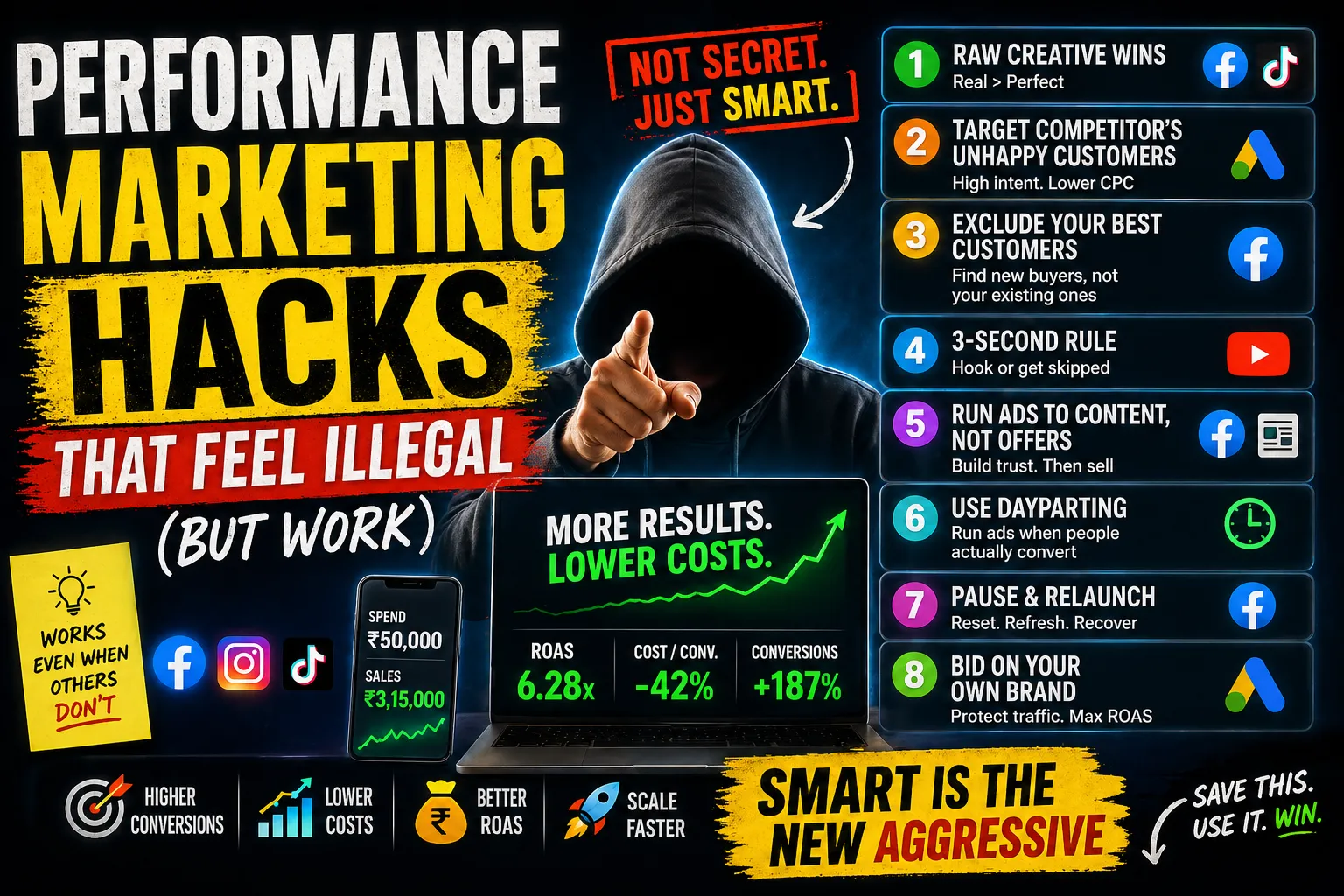
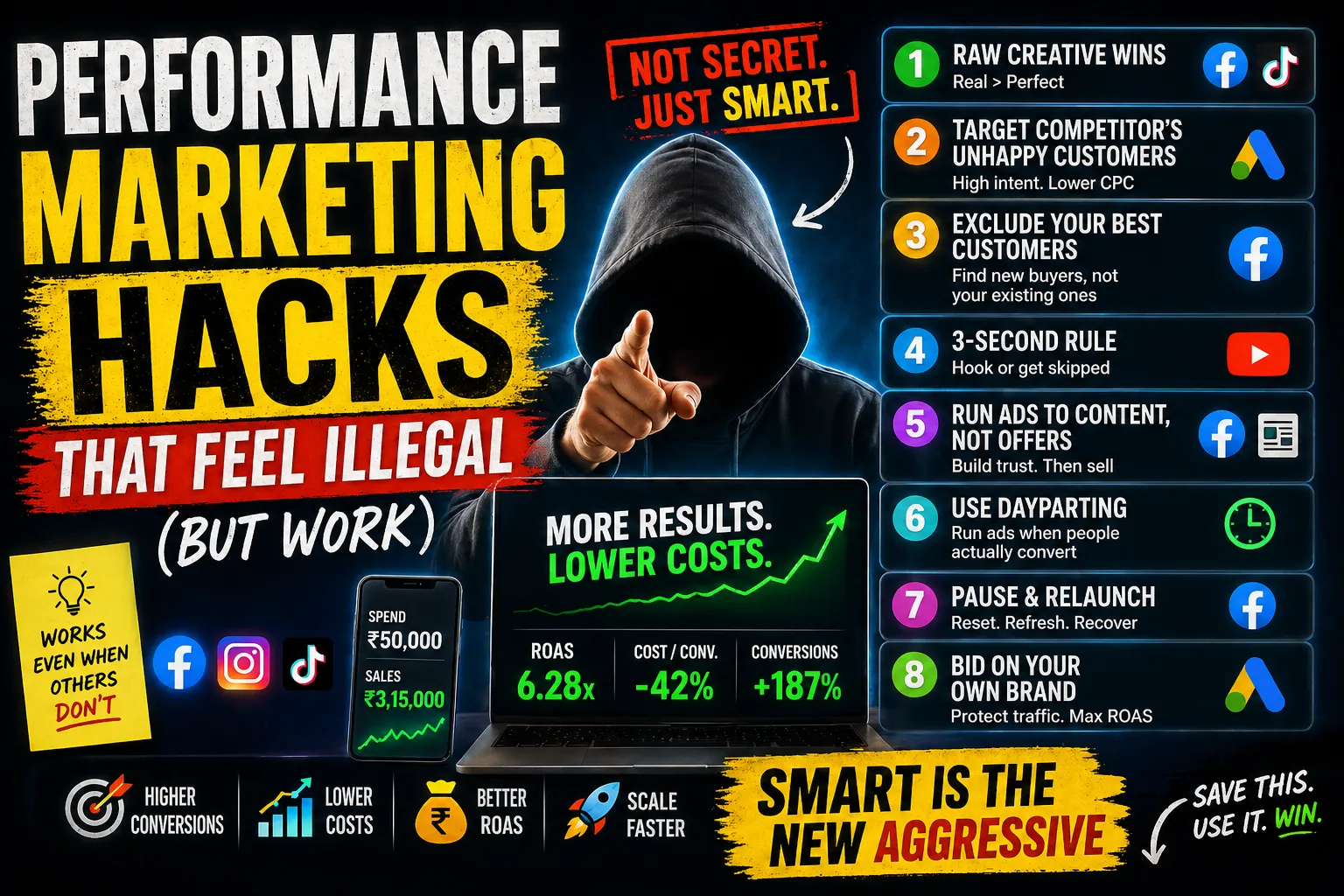
Hack 1 — Terrible Creative Sometimes Wins
Here is the one that makes designers uncomfortable.
Raw, unpolished, filmed-on-a-phone content regularly outperforms studio-shot ads on Meta and TikTok. Not sometimes. Regularly.
Why? Because polished looks like an ad. And people have trained their brains to skip ads.
A shaky video of a founder talking directly to the camera no music, no graphics, no fancy cuts — triggers a completely different response. It looks like content. It feels real. And when your ad feels real, people stop scrolling and actually listen.
This is one of the most reliable low budget ad hacks in 2026. Before you commission an expensive video, film a 45-second talking head on your phone and test it first. You might never go back.
Hack 2 — Target Your Competitor's Unhappy Customers
This one feels slightly illegal. It is completely not.
On Google Ads, you can bid on your competitor's brand name as a keyword. When someone searches "competitor name reviews" or "competitor name alternative" — those are people already dissatisfied or actively looking for other options.
They are warm. They have intent. And they are searching for exactly what you might offer.
Competitor keyword targeting consistently delivers some of the highest conversion rates in any Google Ads account — often at a lower cost per click than your own branded terms. Set up a dedicated landing page that speaks directly to switchers. Acknowledge the competitor respectfully. Show clearly why you are different.
Do not sleep on this one.
Hack 3 — Exclude Your Best Customers to Find New Ones
Most people use lookalike audiences to find people who look like their existing customers.
That is good. But here is the smarter version.
Upload your customer list and exclude it from your prospecting campaigns entirely. Now your ads are only reaching people who have never bought from you before. Your budget stops being wasted on people already in your ecosystem and starts working exclusively on acquiring new revenue.
This is one of those Facebook ads optimisation tricks that feels too simple to matter — until you see your cost per new customer drop noticeably in the first two weeks.
Hack 4 — The 3-Second Rule for Video Ads
Most marketers know that video ads should be short.
What fewer people know is that the first 3 seconds of a video ad are almost entirely responsible for whether the rest gets watched at all.
Meta and YouTube both track something called the 3-second view rate. If your opening three seconds do not create immediate curiosity, tension, or recognition — the algorithm quietly deprioritises your ad. You pay more per result. You reach fewer people.
What actually works in those 3 seconds:
- A bold statement that sounds wrong — "Stop running retargeting ads"
- A visual that creates instant curiosity — something unexpected in the frame
- A direct call out — "If you run Facebook ads and your ROAS is below 3, watch this"
The rest of your video can be brilliant. But it does not matter if nobody gets there.
Hack 5 — Run Ads to a Piece of Content, Not an Offer
This one goes against every instinct when you are trying to drive sales.
But promoting a blog post or video with paid ads — something genuinely useful, something with no hard sell — builds trust faster than any product ad ever will. And trust converts.
Here is how it works in practice. You run a small budget campaign promoting a helpful article to a cold audience. They read it, they learn something, they start to see you as someone who knows what they are talking about. Then your retargeting campaign hits them with the actual offer.
The content-first ad strategy works because the first touchpoint does not feel like advertising at all. By the time you ask for the sale, you are not a stranger anymore.
Hack 6 — Use Dayparting Even When Platforms Tell You Not To
Most AI bidding strategies will tell you to run ads all day and let the algorithm find the best times.
Sometimes that is right. But if you have 90 days of conversion data sitting in your account, open it right now and look at what time of day your actual paying customers convert.
For most B2B businesses, conversions cluster heavily between 9am and 12pm on weekdays. For most e-commerce brands, evenings and weekends dominate.
Dayparting your ad schedule — running ads only during your proven conversion windows — means your budget is never burning during hours that historically produce nothing. The platform algorithms do not always account for this correctly, especially with smaller data sets.
Your own data beats the algorithm's guess every time.
Hack 7 — The Pause and Relaunch Trick
This one genuinely feels illegal. It is not.
When a campaign has been running for a while and performance has plateaued — costs creeping up, results slowing down — instead of tweaking inside the existing campaign, pause it completely for 48 to 72 hours.
When you relaunch, Meta's algorithm treats it almost like a fresh campaign entering the learning phase again. It starts exploring new audiences, new placements, new users. Costs often reset. Performance often recovers.
Pausing and relaunching underperforming campaigns is not officially recommended by Meta. But marketers who discovered it quietly use it as a regular reset tool.
Hack 8 — Bid on Your Own Brand Name on Google
If you are ranking number one organically for your own brand name, you might think bidding on that term is wasteful.
It is not — for two reasons.
First, competitors can and do bid on your brand name. If you are not there, someone else's ad appears when people search specifically for you.
Second, branded keyword campaigns carry the highest quality scores, the lowest cost per click, and the highest conversion rates of any campaign type. The economics are almost always strongly positive.
Protect your brand name. The cost is minimal. The risk of ignoring it is higher than most people realise.
One Thing All of These Have in Common
None of these hacks work without solid fundamentals underneath them.
A fast landing page. A clear offer. An audience that has the problem you solve. Conversion tracking set up properly.
Advanced performance marketing optimisation is just good fundamentals applied with more precision and creativity. The hacks amplify what is already working. They cannot rescue something fundamentally broken.
Get the foundation right first. Then use these to pull ahead of everyone still doing things the conventional way.
Quick Reference — All 8 Hacks
| Hack | What It Does | Best Platform |
|---|---|---|
| Raw creative over polished | Breaks ad blindness, feels organic | Meta, TikTok |
| Competitor keyword targeting | Captures high-intent switchers | Google Ads |
| Exclude existing customers | Focuses spend on new acquisition | Meta |
| 3-second video hook rule | Improves watch rate and delivery | All video platforms |
| Content-first ad strategy | Builds trust before the sell | Meta, Google |
| Dayparting by conversion data | Removes dead-hour budget waste | All platforms |
| Pause and relaunch trick | Resets algorithm learning phase | Meta campaigns |
| Bid on own brand name | Protects brand, highest ROAS | Google Ads |
Saved this? Good. Share it with the person on your team who is still manually adjusting bids at midnight. They need it more than anyone.
Tags: performance marketing hacks, marketing tricks that work, Facebook ads optimisation tips, Google Ads advanced strategy, low budget ad hacks, competitor keyword targeting, content first ad strategy, performance marketing tips 2026, how to improve ROAS fast
Frequently Asked Questions
What are some effective performance marketing hacks for 2026?
Some effective performance marketing hacks for 2026 include using raw creative content to capture attention, targeting competitor's unhappy customers through Google Ads, and excluding existing customers from prospecting campaigns to focus on acquiring new ones. These strategies aim to enhance engagement, reduce costs, and improve conversion rates.
Why does unpolished content perform better in ads?
Unpolished content often performs better because it appears more authentic and relatable, breaking through the ad blindness that polished ads can create. Viewers are more likely to engage with content that feels real, such as a simple video shot on a phone, rather than a highly produced advertisement.
How can I target my competitor's customers effectively?
You can target your competitor's customers by bidding on their brand name as a keyword in Google Ads. This allows you to reach individuals who are already searching for alternatives, giving you an opportunity to present your offerings to those with high intent and dissatisfaction with your competitors.
What is the 3-second rule for video ads?
The 3-second rule for video ads emphasizes that the first three seconds are crucial for capturing viewer attention. If the opening seconds do not create curiosity or engagement, the ad is likely to be deprioritized by the platform's algorithm, leading to lower visibility and higher costs.
Is it beneficial to run ads promoting content instead of direct offers?
Yes, running ads that promote valuable content rather than direct sales offers can build trust and establish your authority with potential customers. By providing useful information first, you create a relationship that makes viewers more receptive to your sales pitches later.
What does dayparting mean in advertising?
Dayparting involves scheduling your ads to run only during specific times when data shows that conversions are most likely to occur. This strategy helps you avoid wasting budget during hours of low performance, optimizing your ad spend based on actual customer behavior.
How does the pause and relaunch trick work in ad campaigns?
The pause and relaunch trick involves pausing an underperforming ad campaign for 48 to 72 hours and then relaunching it. This approach can reset the algorithm's learning phase, allowing it to explore new audiences and placements, which often leads to improved performance.

















Sign in to leave a comment.