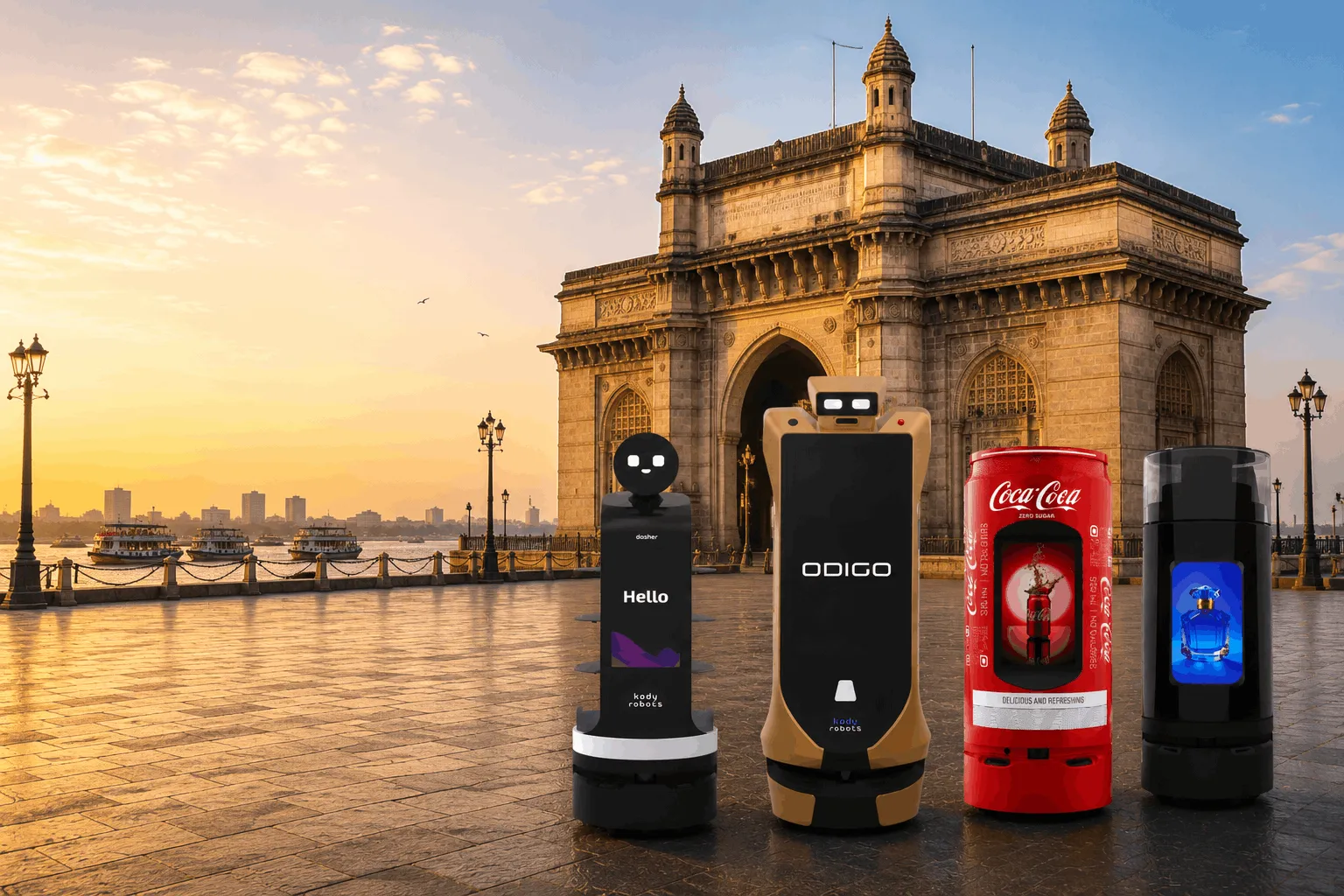

Anyone who has worked an exhibition floor at NESCO Goregaon in October knows the problem. Two hundred stalls, roughly the same pull-up banners, the same branded pens, the same team of four standing behind a counter hoping someone slows down. Visitors walk past in a straight line, eyes forward, phone in hand. Getting them to stop is the entire job, and most booths lose that job before lunch on day one.
That is the practical reason a growing number of marketing teams have started looking into a robot on rent in Mumbai. Not because robots are futuristic, and not because someone on the team saw a video from a trade fair in Shenzhen. It is a footfall problem, and a moving, talking, screen-carrying machine happens to solve it better than another standee.
This article is not a sales pitch. It is an attempt to explain what these rentals actually involve, where they work, where they do not, and what to check before you sign anything.
What an event robot actually does
There is a gap between what people imagine and what these machines do on the ground. Nobody is renting a humanoid that holds a philosophical conversation with a visitor. What you are renting is closer to a mobile, interactive kiosk with autonomous navigation and a personality layer on top.
In practice, most event robots handle some combination of the following:
Attracting attention and drawing footfall. This is the honest primary function. A robot moving through an aisle creates a small disturbance in the crowd flow. People stop, they look, they take out their phones. That pause is what you are paying for.
Displaying content. Most units carry a screen — often a large one — running product videos, campaign films, offers, or demos. Unlike a fixed LED wall, this screen goes to the audience instead of waiting for the audience to arrive.
Greeting and guiding. At corporate events and conferences, robots are used to welcome guests, direct them to registration or breakout halls, and answer basic questions. It removes a repetitive task from your staff.
Answering FAQs. Either through pre-set scripts or an AI layer, robots can handle the twenty questions every visitor asks. Where is the demo? What does this cost? Do you have an office in Andheri? Your team gets freed up for conversations that actually matter.
Capturing leads. QR codes, on-screen forms, sometimes both. Instead of a bowl of visiting cards you sort through on Monday, you get a structured list.
Serving. At weddings, launches, and hospitality-driven events, serving robots carry beverages or welcome drinks. It is theatre as much as service, and it works.
Multilingual interaction. In Mumbai this matters more than people assume. A robot switching between English, Hindi, and Marathi handles a mixed crowd better than a single hostess can.
Matching the robot to the event
A common mistake is treating "robot" as one category. Rental providers usually run distinct models built for different jobs, and picking the wrong one wastes the budget.
A serving and hospitality robot suits weddings, hotel launches, and corporate dinners. An advertising robot — essentially a mobile digital display — belongs at malls, expos, and anywhere your job is impressions rather than conversation. Interactive engagement robots fit high-footfall zones where you want people to stop and play. Product promotion robots are built to showcase a specific SKU, usually at launches and in-store activations.
Before you enquire anywhere, write down a single sentence describing what success looks like: "400 qualified leads over three days" is a different brief from "make the launch feel premium and get it on Instagram." Providers offering a robot on rent in Mumbai will typically recommend a different unit for each of those goals, and the recommendation is only as good as the brief you give.
Mumbai-specific realities worth planning for
This is where generic advice stops being useful. Deploying a robot in Mumbai has its own constraints.
Venue surfaces. These machines navigate best on flat, hard flooring. Carpeted exhibition halls are usually fine; thick pile carpets, cable ramps, and uneven temporary flooring are not. Ask for a site check, and ask specifically about cable management event floors are full of taped-down wiring.
Lift and loading access. BKC's premium venues, Jio World Convention Centre, hotel ballrooms in Lower Parel, all have service lift dimensions and loading dock windows. A robot arriving in a crate at 6 PM on a Friday when the service lift is booked for catering is a solvable problem, but only if someone flagged it a week earlier.
Crowd density. Autonomous navigation slows down in dense crowds, which is exactly when you want the robot moving. Good operators plan a route, a defined loop rather than free roaming, and keep a technician nearby.
Monsoon. June to September, transport and outdoor activations become genuinely risky. These units are not built for rain. If your activation is in an open mall atrium or a partly covered pandal, discuss it early.
Permissions. Malls in particular have their own rules about moving displays, audio volume, and lead capture. Your rental partner may have run activations at that mall before; ask.
What drives the cost
There is no fixed price, and anyone quoting one over the phone without asking questions is guessing. The variables that move the number are fairly consistent:
- Duration. A single-day mall activation is priced very differently from a five-day exhibition.
- Robot type and count. Larger screens and more advanced interaction cost more. Two robots working an aisle cost less than double one robot's rate, usually.
- Customisation depth. Skinning the robot in your brand colors, building custom conversation flows, and producing screen content all add time before the event.
- Manpower. On-site technical support for the full event duration is standard for serious deployments and should be in the quote, not an afterthought.
- Logistics. Transport, insurance, and setup — particularly for venues outside the island city.
Ask for the quote broken into these lines. A single lump-sum figure makes it impossible to compare two vendors or trim the budget sensibly.
Questions to ask before booking
A short checklist that separates prepared vendors from opportunistic ones:
- Have you deployed at this specific venue before?
- Who is on site during the event, and for how many hours?
- What is the contingency if the unit fails mid-event?
- How is lead data delivered, in what format, and who owns it?
- What is the battery runtime, and what is the charging arrangement?
- How much lead time do you need for custom content?
- What happens if the venue changes our booth position at the last minute?
The battery question catches people out. Runtime varies significantly by model and usage, and a robot charging in a corner for two hours during peak footfall is dead weight.
Measuring whether it worked
Novelty is easy to feel and hard to defend in a budget review. Decide your metrics before the event, not after.
Reasonable ones: total interactions logged by the robot, leads captured with contact details, average dwell time at the booth compared to your previous event, footfall counted at set intervals, and social mentions or tagged posts. Most rental providers can supply an interaction report; ask whether they do, and what it contains, before you book rather than after.
Compare against your own baseline, not against someone else's case study. If your last exhibition produced 120 leads with the same team and the same floor space, that is the number to beat.
Where robots do not help
Worth saying plainly. If your event is a closed-door meeting with fifteen senior decision-makers, a robot is a distraction. If your booth is nine square metres and already crowded, a moving machine makes it worse. If your product genuinely needs a twenty-minute technical explanation, a screen loop will not do that work.
Robots are an attention tool. They open conversations; they do not close them. Teams that treat the robot as a replacement for trained staff come away disappointed, and fairly so.
A reasonable way to start
Book one unit for one event. Pick something with high footfall and a clear metric — a mall activation or a mid-size exhibition works well. Brief the vendor properly, agree on what gets measured, and put a person next to the robot whose job is converting the crowd it gathers.
Mumbai's event calendar is dense enough that the difference between a booth people remember and one they walk past is not usually budget. It is whether anything on that floor gave them a reason to stop. For a growing number of brands, a robot on rent in Mumbai has turned out to be a fairly efficient answer to that question—provided the planning around it is done with the same seriousness as the rest of the activation.





















Sign in to leave a comment.