
In today’s digital-first world, AI app development is no longer a niche — it’s central to delivering competitive, value-driven mobile and web experiences. Whether you’re a startup, enterprise, or innovation leader, integrating artificial intelligence into your applications unlocks capabilities far beyond static features.
From intelligent assistants and predictive insights to image recognition and automation, AI empowers apps to understand, anticipate, and respond to user needs. In this comprehensive guide, we’ll explore how to plan, build, and scale AI apps—covering architecture, algorithms, best practices, risks, and future trends.
Why AI App Development Matters Now
Before diving into how, let’s clarify why AI apps are critical:
- User expectations are rising. People expect apps that personalize, predict, and simplify decision-making. Static experiences feel outdated.
- Automation boosts efficiency. Tasks like content moderation, recommendation, image analysis, or sentiment detection can be handled by AI, freeing human effort.
- New business models emerge. AI enables features like dynamic pricing, adaptive user flows, conversational agents, and smarter analytics.
- Competitive differentiation. Early adopters of AI in apps create stronger brand positioning and build intellectual property around models and data.
When done right, AI app development transforms your product from a tool into a responsive ecosystem.
Core Capabilities You Can Infuse with AI
An AI-powered app may include one or more of these capabilities:
- Natural Language Processing (NLP): Chatbots, voice assistants, text summarization, translation.
- Computer Vision/Image Recognition: Object detection, facial recognition, image classification, and augmented reality overlays.
- Recommendation & Personalization Engines: Suggesting content, products, routes based on user behavior and preferences.
- Predictive Analytics & Forecasting: Demand forecasting, risk scoring, anomaly detection.
- Automation & Intelligent Workflows: Automating repetitive tasks, triaging events, optimizing processes.
- Reinforcement or Adaptive Systems: Systems that adjust behavior over time based on feedback and outcomes.
Not all apps need all capabilities. Choose those aligned with your business goals and user journeys.
Stages of AI App Development
Here’s a typical lifecycle when developing an AI-enabled application:
1. Ideation & Problem Definition
- Define the problem statement: What human or business pain will AI solve?
- Evaluate whether AI is the right tool (versus rule-based or heuristic logic).
- Sketch user stories: which users will use AI features? Under what conditions?
2. Data Strategy & Collection
- Identify required data (text, images, sensor readings, logs).
- Assess availability and quality of historical data.
- Plan for ongoing data pipelines—ingestion, cleaning, and labeling.
- Address privacy, permissions, and compliance (GDPR, HIPAA, etc.).
3. Model Selection & Prototyping
- Choose algorithms or pre-trained models: classification, clustering, sequence models, etc.
- Use frameworks and libraries (TensorFlow, PyTorch, Hugging Face, OpenCV, etc.).
- Build prototype AI models and validate them on sample data.
- Define evaluation metrics: accuracy, precision, recall, F1, latency.
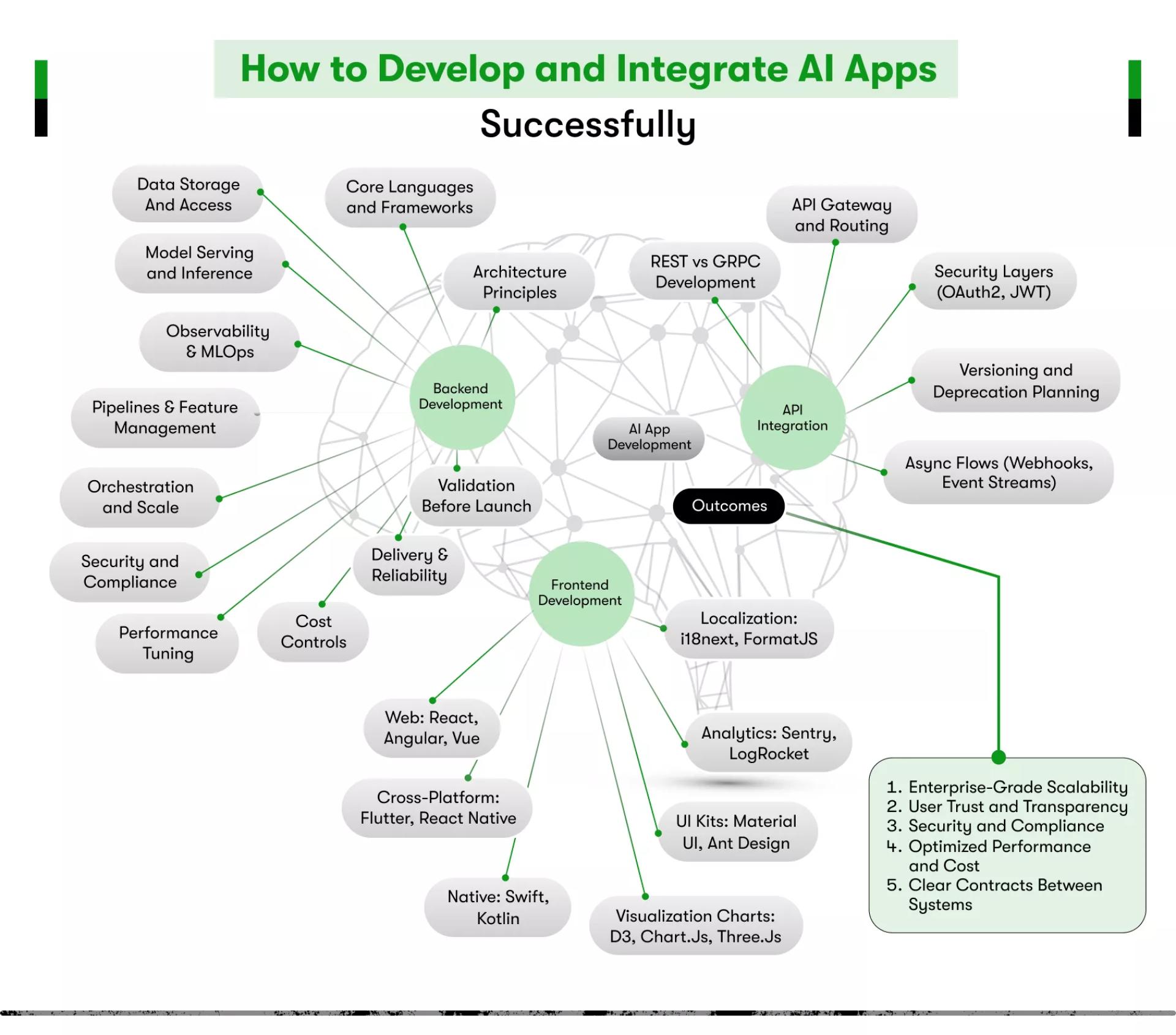
4. Integration & Architecture
- Design a backend layer for model serving (REST APIs, microservices).
- Deploy models using containers, serverless, or edge inference.
- Integrate AI modules into app frontend, UX flows, UI components.
- Ensure fallback or default logic when AI predictions are unavailable or off.
5. Testing & Validation
- Perform validation on holdout data, cross-validation, real user testing.
- Monitor for prediction drift, edge cases, adversarial inputs.
- Test app performance, latency, concurrency, scaling.
- Collect feedback, build human-in-the-loop correction mechanisms.
6. Deployment & Monitoring
- Deploy AI models in production incrementally (A/B testing).
- Monitor usage, error rates, latency, feedback capture.
- Update models over time with new training data to keep performance fresh.
- Use logging, auditing, alerting around prediction quality.
7. Iteration & Scaling
- Expand model scope as data increases.
- Introduce new AI features or modalities.
- Optimize for mobile/edge deployment, reduce model size, quantization.
- Establish governance, versioning, and performance benchmarks.
Helpful Tools & Tech Stack
Here’s what your AI app development stack might look like:
- Frontend / Client: React Native, Flutter, native iOS/Android.
- Backend & API Layer: Node.js, Python (Flask / FastAPI / Django), or Java Spring.
- Model Frameworks: TensorFlow, PyTorch, scikit-learn, Hugging Face transformers.
- Data Infrastructure: PostgreSQL, MongoDB, data warehouses, streaming systems (Kafka).
- Model Serving/Deployment: TensorFlow Serving, TorchServe, Docker, Kubernetes, AWS SageMaker, GCP AI Platform.
- Monitoring & Logging: Prometheus, Grafana, and ELK stack.
- Cloud Providers / Infrastructure: AWS, GCP, Azure, or hybrid (on-prem + cloud).
- Edge/On-Device Inference: TensorFlow Lite, ONNX, Core ML, or TFLite Micro for mobile/IoT deployment.
Choosing modular, decoupled architecture ensures you can swap models, scale, or evolve components independently.
Best Practices & Design Principles
To make your AI app reliable, maintainable, and trustworthy:
- Start Small & Focus on MVP
- Launch with a minimal AI feature, validate value, then expand.
- Maintain Explainability
- Provide feedback on why a prediction was made—especially for critical cases.
- Human-in-the-Loop Controls
- Allow users or moderators to correct predictions or override AI decisions.
- Version & Rollback Safety
- Always version your models and maintain rollback plans for new releases.
- Governance & Privacy by Design
- Build compliance frameworks, data anonymization, secure pipelines from day one.
- Bias Audits & Fairness Checks
- Regularly test models for demographic bias or unintended unfair outcomes.
- Monitor Model Drift
- When data distributions change, model performance may degrade—have retraining pipelines.
- Optimize for Latency & Efficiency
- Especially for mobile or real-time apps, reduce model size, quantize, prune.
- Logging & Metrics
- Log predictions, inputs, outcomes. Track false positives, latency, usage patterns.
Sample Use Cases in Real Life
- Smart Personal Assistants: Apps that respond conversationally to booking, reminders, or context-aware suggestions.
- Image-driven Products: Apps that let users photograph items and get product suggestions or identify objects.
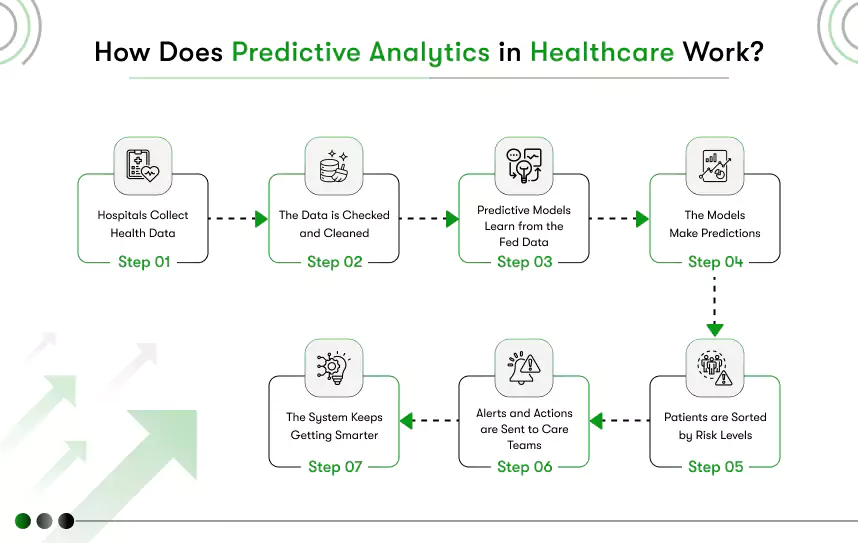
- Health & Wellness: AI that analyzes wearables, user input, and lifestyle to recommend personalized routines or alerts.
- Finance & Credit: Predictive credit scoring, risk analysis, fraud detection baked into finance apps.
- Content Platforms: Personalized news, media, or educational suggestions based on behavior and sentiment analysis.
These illustrate how broadly AI app development touches domains—from consumer to enterprise.
Challenges & Risks to Be Aware Of
AI apps don’t come without pitfalls. Watch out for:
- Data Scarcity or Poor Quality
- Accurate models need quality, labeled training data. In many domains, that’s hard to come by.
- Overfitting & Generalization
- Models may perform well in training datasets but fail in real-world, new scenarios.
- Regulation & Compliance
- Sensitive domains (health, finance) face strict compliance—your AI must adhere to standards.
- Resource & Cost Constraints
- Model training and serving can be expensive—optimize infrastructure, use efficient models.
- User Trust & Acceptance
- Users may distrust AI predictions if they feel opaque or wrong. Transparency is key.
- Model Decay
- As user behavior or environment changes, models degrade unless updated.
Recognizing these risks early helps you build mitigation strategies.
The Future of AI App Development
Looking ahead, several trends will advance the field:
- Generative AI & LLMs
- Apps using large language models will offer deeper conversational intelligence, content creation, and reasoning.
- Edge AI & On-device Inference
- More computation will shift to devices (phones, wearables), reducing latency and improving privacy.
- Hybrid Models & Federated Learning
- Learning from distributed data across devices without centralizing it—preserving privacy while improving models.
- Cross-Modal AI
- Blending vision, language, audio into unified models for richer user interactions.
- AI Tooling Maturity
- Better autoML, deployment frameworks, model debugging tools will lower barriers to building AI apps.
Conclusion & Call to Action
AI app development is no longer optional—it's an essential competitive differentiator. It lets apps evolve from passive tools into smart assistants that understand, anticipate, and personalize user journeys.
By focusing on strong data practices, smart architecture, human oversight, and ethical design, you can build AI-powered applications that truly resonate with users and stand the test of time.























Sign in to leave a comment.