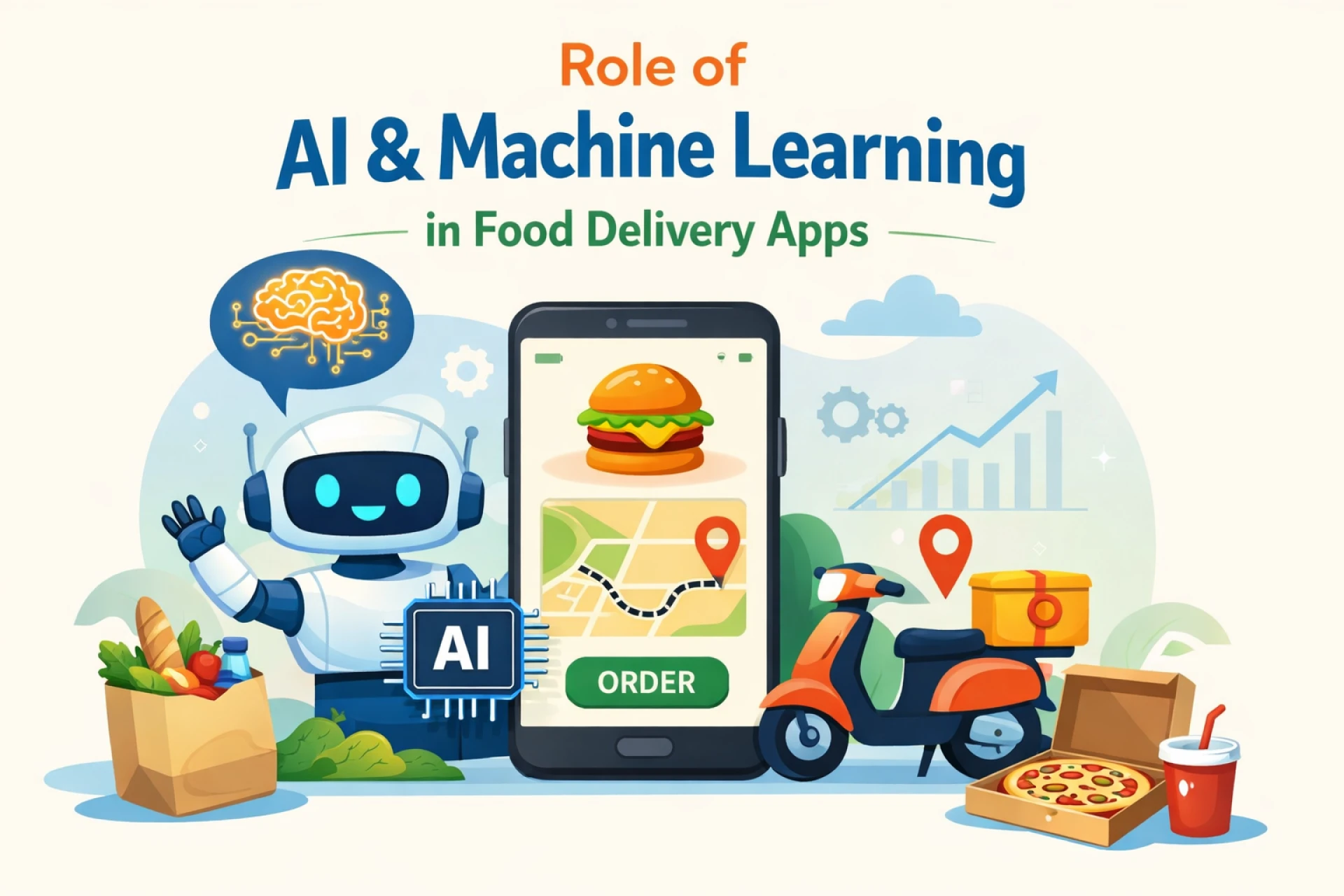

The food delivery industry has undergone a massive digital transformation over the last decade. What started as simple online ordering platforms has now evolved into intelligent, data-driven ecosystems that predict user behavior, optimize deliveries, and personalize customer experiences. At the heart of this evolution are Artificial Intelligence (AI) and Machine Learning (ML).
Today’s leading food delivery apps don’t just connect users with restaurants they think, learn, and adapt in real time. From smart recommendations to dynamic pricing and route optimization, AI and ML play a critical role in shaping how modern food delivery platforms operate and scale.
This article explores how AI and Machine Learning are transforming food delivery apps, their key use cases, benefits, and why businesses should embrace these technologies for long-term success.
Understanding AI & Machine Learning in Food Delivery Apps
Artificial Intelligence refers to systems that mimic human intelligence to perform tasks like decision-making, pattern recognition, and problem-solving. Machine Learning, a subset of AI, allows systems to learn from data and improve their performance over time without being explicitly programmed.
In food delivery apps, these technologies analyze massive volumes of data—user preferences, order history, delivery patterns, traffic conditions, restaurant performance, and more—to make smarter, faster, and more accurate decisions.
Why AI & ML Are Essential for Food Delivery Platforms
The food delivery market is highly competitive and customer-driven. Users expect fast delivery, accurate recommendations, real-time tracking, and personalized experiences. AI and ML help businesses meet these expectations by:
- Enhancing operational efficiency
- Reducing delivery time and costs
- Improving customer satisfaction
- Increasing customer retention and order value
Without intelligent automation, scaling a food delivery app becomes complex, expensive, and inefficient.
Key Applications of AI & Machine Learning in Food Delivery Apps
1. Personalized Food Recommendations
One of the most visible uses of AI in food delivery apps is personalized recommendations. Machine learning algorithms analyze:
- Past orders
- Browsing behavior
- Preferred cuisines
- Time of ordering
- Location and weather conditions
Based on these insights, apps suggest restaurants, dishes, and combo meals tailored to each user. This personalization not only improves user experience but also increases average order value and repeat purchases.
2. Smart Search & Voice Assistance
AI-powered search allows users to find food faster and more accurately. Instead of exact keyword matches, AI understands user intent, synonyms, and contextual meaning.
For example:
- Searching “healthy dinner” may show salads, grilled dishes, or low-calorie meals.
- Voice-based ordering enables hands-free search using natural language.
These features make apps more user-friendly and accessible.
3. Demand Forecasting & Inventory Management
Machine learning models predict future demand by analyzing historical data, festivals, weather, weekends, and local events. This helps restaurants and delivery platforms:
- Prepare for peak demand
- Avoid food wastage
- Optimize inventory levels
- Plan staffing efficiently
Accurate demand forecasting ensures smoother operations and better customer satisfaction.
4. Dynamic Pricing & Smart Offers
AI enables dynamic pricing strategies based on demand, location, order frequency, and time of day. For instance:
- Higher delivery fees during peak hours
- Personalized discounts for inactive users
- Smart coupons based on user preferences
These data-driven pricing models maximize revenue while maintaining competitiveness.
5. Intelligent Order Allocation
Machine learning algorithms intelligently assign orders to delivery partners by considering:
- Delivery partner availability
- Distance to restaurant
- Traffic conditions
- Past delivery performance
This reduces delivery time, improves efficiency, and ensures a balanced workload among delivery agents.
6. Route Optimization & Real-Time Navigation
AI-powered route optimization analyzes live traffic data, weather conditions, and road closures to determine the fastest and most efficient delivery routes.
Benefits include:
- Faster deliveries
- Reduced fuel consumption
- Lower operational costs
- Improved delivery partner productivity
This real-time optimization is essential for meeting customer expectations in on-demand food delivery.
7. Chatbots & AI-Driven Customer Support
AI chatbots handle common customer queries such as:
- Order status
- Refund requests
- Delivery delays
- Menu inquiries
These chatbots operate 24/7, resolve issues instantly, and reduce dependency on human support teams. Over time, machine learning helps chatbots improve response accuracy and conversational quality.
8. Fraud Detection & Risk Management
Food delivery apps face issues like fake orders, payment fraud, and coupon abuse. AI algorithms detect suspicious activities by analyzing behavioral patterns, transaction history, and device data.
This proactive fraud detection helps platforms:
- Minimize financial losses
- Protect users and restaurants
- Maintain platform credibility
9. Restaurant Performance Analytics
AI tools provide deep insights into restaurant operations, including:
- Order preparation time
- Customer ratings and reviews
- Popular menu items
- Peak ordering hours
These insights help restaurants optimize menus, pricing, and operations, leading to better overall ecosystem performance.
10. Predictive Customer Retention Strategies
Machine learning predicts customer churn by analyzing order frequency, engagement levels, and feedback. Based on these insights, apps can trigger personalized offers, loyalty rewards, or re-engagement campaigns to retain users.
This proactive approach significantly improves customer lifetime value.
Benefits of AI & ML in Food Delivery Apps
Enhanced User Experience
Personalization, faster search, and intelligent recommendations create a seamless customer journey.
Operational Efficiency
Automation reduces manual effort, errors, and delays across the delivery pipeline.
Data-Driven Decision Making
Real-time insights help businesses make smarter strategic and operational decisions.
Scalability
AI systems adapt easily as user base, orders, and geographic coverage grow.
Competitive Advantage
Apps powered by AI stay ahead in a crowded marketplace by offering smarter, faster, and more reliable services.
Role of Technology Partners in AI-Powered Food Delivery Apps
Implementing AI and ML requires technical expertise, data infrastructure, and industry understanding. This is where professional food delivery app development services play a crucial role.
An experienced development partner helps with:
- AI model integration
- Data analytics setup
- App architecture design
- Scalability and security
- Continuous optimization
Collaborating with a reliable on demand app development company ensures that AI features align with business goals while delivering a superior user experience.
Challenges of Implementing AI & ML
While AI offers immense potential, businesses must address certain challenges:
- High initial development cost
- Data privacy and security concerns
- Need for quality data
- Algorithm bias and accuracy
- Continuous model training and updates
However, with the right strategy and development partner, these challenges can be effectively managed.
Future of AI in Food Delivery Apps
The future of AI in food delivery looks promising and innovative. Emerging trends include:
- Hyper-personalized meal planning
- AI-driven nutrition recommendations
- Autonomous delivery via drones and robots
- Predictive ordering based on habits
- Advanced voice and conversational AI
As technology evolves, AI will become even more deeply integrated into every aspect of food delivery platforms.
Conclusion
AI and Machine Learning have become the backbone of modern food delivery apps. From personalized experiences and faster deliveries to smarter operations and improved customer retention, these technologies are redefining how food is ordered and delivered.
For businesses aiming to build or scale a food delivery platform, integrating AI is no longer optional it’s essential. Partnering with the right development experts and adopting intelligent solutions will determine long-term success in this fast-growing, competitive industry.


























Sign in to leave a comment.