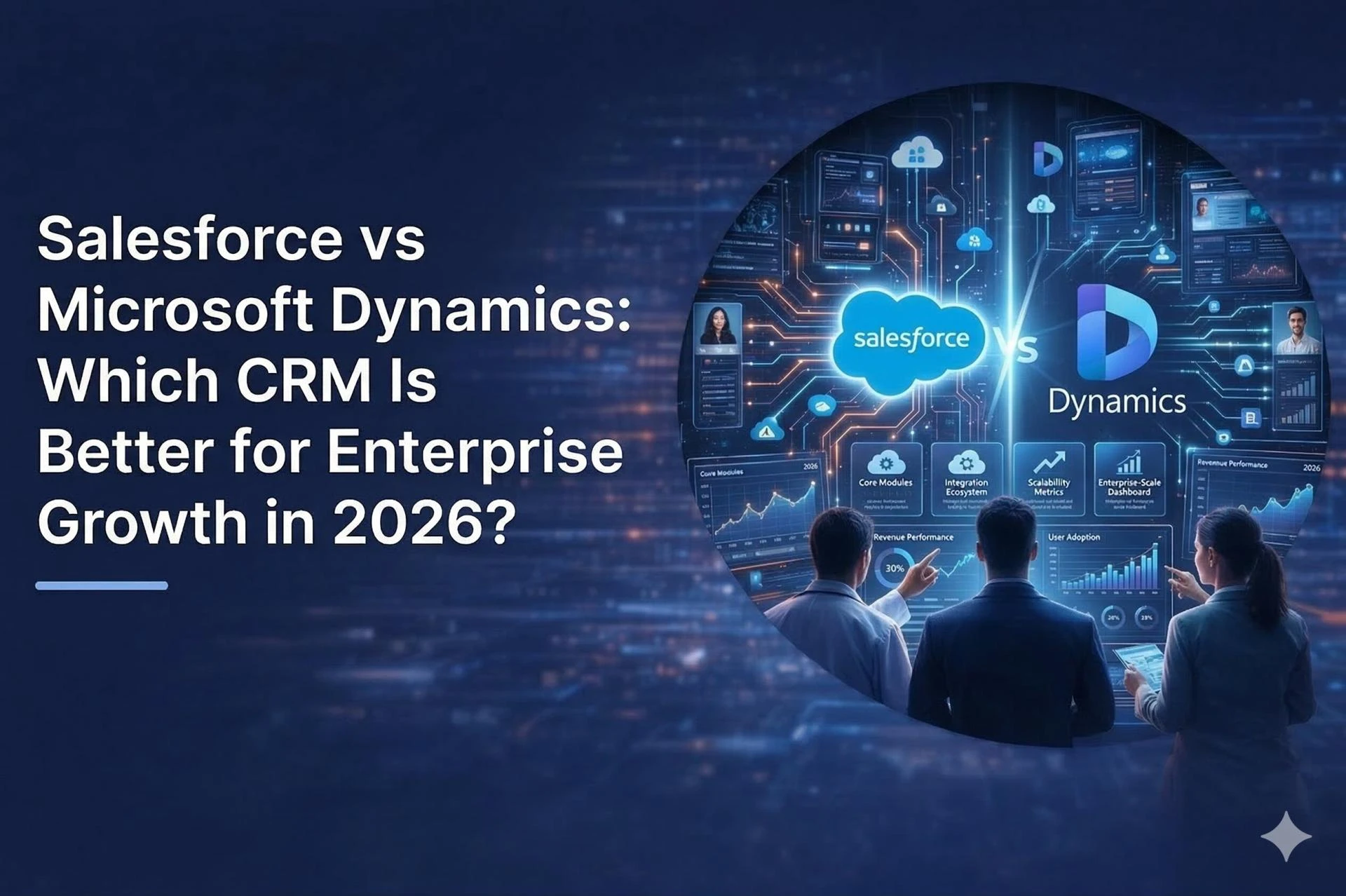

In 2026, that question is more relevant than ever. For most enterprises, it comes down to two leading options Salesforce and Microsoft Dynamics 365. Both are powerful, both have evolved with AI and automation, and both promise to support long-term growth. But they aren’t built the same, and choosing between them isn’t as straightforward as it seems.
This isn’t just a technology decision,it’s a business decision that impacts productivity, scalability, and how your teams operate every day. In this guide, we’ll break down the key differences to help you decide which platform aligns best with your growth goals.
The Enterprise CRM Landscape in 2026
CRM was never just a contact database. But in 2026, it has become the operational spine of modern enterprises connecting sales, marketing, finance, customer service, and AI-driven intelligence into a single system of truth.
Together, Salesforce and Microsoft Dynamics 365 control roughly 60% of the enterprise CRM market. Salesforce leads with approximately 28% global market share, while Dynamics 365 has gained significant ground since its cloud-native relaunch, particularly among Microsoft-native organizations.
Both platforms appear as leaders in Gartner's CRM Magic Quadrant and have made aggressive moves in AI, automation, and industry-specific solutions. The gap between them, once wide, has narrowed considerably. And that's precisely what makes the Salesforce vs Dynamics 365 decision harder not easier.
Salesforce vs Microsoft Dynamics: A Feature-by-Feature Breakdown
AI and Automation
AI is no longer a differentiator,it's a baseline expectation. The real question is: whose AI fits your workflow?
Salesforce Einstein AI underpins predictive lead scoring, automated opportunity insights, conversation intelligence, and generative AI across the entire Sales Cloud. Einstein is deeply integrated into the Salesforce UI, making it relatively seamless for sales reps to benefit from intelligent recommendations without ever leaving their workflow.
Microsoft Dynamics 365 Copilot, on the other hand, leverages the full power of Microsoft's AI infrastructure, including Azure OpenAI. For organizations already living in Teams, Outlook, and Excel, Copilot's natural language capabilities surface directly inside tools teams already use daily without friction or a context switch.
Bottom line: Salesforce Einstein wins on sales-specific AI depth. Microsoft Copilot wins on cross-platform AI reach.
Integration and Ecosystem Fit
This is where the decision often gets made and made fast.
Dynamics 365 is built to work natively with the entire Microsoft stack: Office 365, Teams, Azure, Power BI, Power Platform, and SharePoint. If your enterprise has standardized on Microsoft, Dynamics 365 doesn't feel like a separate tool,it feels like an extension of what your teams already do. The Power Platform alone (Power Apps, Power Automate, Power BI) gives IT teams low-code customization without heavy development cycles.
Salesforce wins on third-party integration breadth. The AppExchange marketplace hosts thousands of pre-built connectors across virtually every category marketing automation, CPQ, ERP, analytics, and more. Salesforce also owns MuleSoft, which is purpose-built for enterprise integration across complex, heterogeneous tech stacks. If your environment is multi-vendor and your architecture is sprawling, Salesforce's integration layer is hard to beat.
Bottom line: Dynamics 365 is the natural choice if you're Microsoft-first. Salesforce wins when your tech stack is diverse or vendor-agnostic.
Pricing and Total Cost of Ownership
Pricing is often where organizations get surprised. Let's be direct.
| Plan | Salesforce Sales Cloud | Microsoft Dynamics 365 |
|---|---|---|
| Entry-level | $25/user/month (Starter Suite) | $65/user/month (Professional) |
| Enterprise tier | $165/user/month | $105/user/month |
| AI-enabled tier | Bundled (varies) | $150/user/month (Sales Premium) |
| Implementation cost | $300K–$2M+ (enterprise) | $300K–$2M+ (enterprise) |
Salesforce's entry tier looks affordable but costs escalate quickly with add-ons. Marketing Cloud, CPQ, advanced storage, and premium support can push total cost of ownership (TCO) well beyond initial projections.
Dynamics 365 tends to reward scale. Organizations already holding Microsoft enterprise agreements often access significant licensing discounts. Over a 3–5 year horizon, Dynamics 365 typically delivers more predictable TCO a meaningful consideration for CFOs and procurement teams.
Real-World Use Cases: Who Should Use What?
The Global Manufacturing Enterprise
A large B2B manufacturer with 5,000+ employees, operating on Azure, managing complex supply chains and multi-department workflows. Their sales team lives in Teams and Outlook.
Best fit: Microsoft Dynamics 365
The native ERP-CRM integration means they don't need to stitch together separate platforms for finance, inventory, and customer management. Everything connects under one roof.
The High-Growth SaaS Company
A 500-person SaaS company scaling rapidly, with a sales-led growth model, complex commission structures, and a need to integrate with tools like Marketo, Gainsight, DocuSign, and Stripe.
Best fit: Salesforce
AppExchange gives them a marketplace of pre-built integrations. Salesforce's flexible object model and robust developer ecosystem means they can customize extensively as they scale and the Trailblazer community provides an enormous support network.
The Healthcare System
A regional healthcare network managing patient relationships, referrals, and care coordination requiring HIPAA compliance, workflow integration with EHR systems, and cross-departmental data visibility.
Best fit: Microsoft Dynamics 365
Its hybrid deployment options (cloud + on-premises), native compliance tooling via Azure, and modular approach make it a strong fit for regulated industries where data residency and governance are non-negotiable.
Common Challenges and What No One Tells You
Here's the uncomfortable truth: 40% of CRM implementations fail, regardless of which platform is selected. The culprit is almost always adoption not features.
Both Salesforce and Dynamics 365 are powerful systems of record. Neither solves the fundamental challenge of getting reps to enter data consistently and accurately. In enterprise deployments, 30–40% of opportunities are routinely missing key context, next steps, or deal value estimates.
For Salesforce: Governance is critical. The high degree of customizability is a double-edged sword without strong architectural oversight, orgs accumulate technical debt quickly.
For Dynamics 365: Adoption can plateau after initial rollout. Organizations need to invest in change management and continuous training to sustain momentum, especially for non-Microsoft-native teams.
Neither platform is "easy." Both require executive sponsorship, a skilled implementation partner, and a long-term change management strategy. Budget accordingly.
Expert Insights: What Enterprise Architects Get Right
Experienced enterprise architects who've deployed both platforms consistently point to one pattern: the winning CRM is the one that matches your existing data strategy not your feature wishlist.
Before committing to either platform, they recommend:
- Audit your ecosystem first. Count how many enterprise tools are Microsoft vs. third-party. That ratio often tells the story.
- Involve Finance in the TCO conversation. Licensing is just the start factor in implementation, customization, training, and ongoing support.
- Pilot with your highest-complexity use case. Don't evaluate CRMs with simple demos. Stress-test integration, reporting, and workflow automation against your actual edge cases.
- Define adoption metrics before go-live. Data quality KPIs, user activity rates, and pipeline accuracy benchmarks should be agreed upon before a single rep logs in.
Salesforce vs Microsoft Dynamics: The Verdict for 2026
There is no universal winner in the Salesforce vs Microsoft Dynamics debate and any vendor who tells you otherwise is selling something.
Choose Salesforce if:
- Your tech stack is multi-vendor and requires flexible third-party integrations
- You operate in sales-intensive industries like SaaS, financial services, or insurance
- You need a massive app marketplace and a large developer/partner ecosystem
- AI-driven sales intelligence at the CRM layer is a top priority
Choose Microsoft Dynamics 365 if:
- Your organization is already invested in the Microsoft ecosystem
- You need CRM and ERP capabilities on a unified platform
- Cost predictability at scale is a strategic priority
- You operate in regulated industries requiring hybrid deployment or strict compliance
In 2026, the CRM decision is ultimately a platform alignment decision. Both tools are feature-complete. Both are AI-capable. The real question is which platform will compound value across your entire technology ecosystem not just your sales team.
Ready to Make the Right CRM Call?
Choosing between Salesforce and Microsoft Dynamics 365 isn't just a technology decision,it’s an architectural commitment that shapes how your business scales over the next 5 to 10 years.
If your team is evaluating enterprise CRM platforms and needs an objective, implementation-experienced perspective, our top CRM development services are designed to guide you every step of the way. From platform selection to customization and integration, our consultants help you model the right fit based on your ecosystem, your team, and your growth roadmap.
Let’s talk. Reach out to explore how a structured CRM strategy assessment backed by expert CRM development services can save your organization time, cost, and adoption headaches before you sign on the dotted line.




























Sign in to leave a comment.