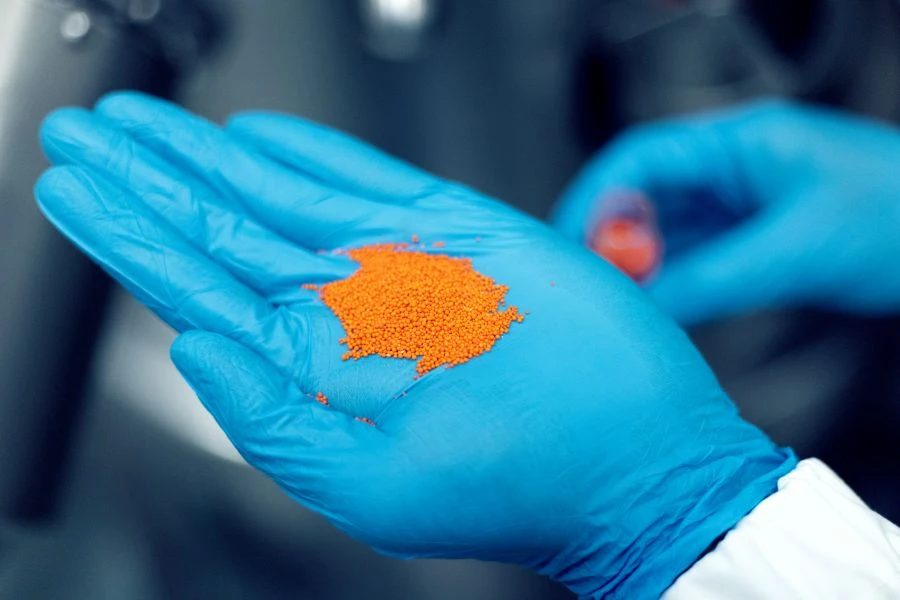

The Wurster coating method remains a cornerstone in multiparticulate manufacturing, valued for its precision in producing modified-release pellets, taste-masked systems, and functional coatings. Yet, the scale-up of this process is rarely straightforward. Success depends on reproducing the delicate interplay of droplet deposition, solvent evaporation, and particle recirculation. Any imbalance between these forces can cause agglomeration, film defects, spray loss, or non-uniform coating build-up. This variation explores how these mechanisms must be preserved to ensure reliable performance at larger scales.
Spraying Fundamentals
The spray zone is the heart of the Wurster system, and its behaviour directly shapes coating quality. The system must generate droplets of the correct size, trajectory, and velocity; otherwise, the process becomes unstable.
Over-wetting arises when large droplets land faster than the system can evaporate their solvent. High-viscosity polymer dispersions, concentrated coating mixtures, insufficient atomisation energy, or overly aggressive spray rates all contribute to this imbalance. When droplets cannot dry quickly enough, particle surfaces remain tacky, promoting sticking and the formation of soft agglomerates.
Spray drying, in contrast, is a symptom of droplets drying before contacting the substrate. Excessive atomisation pressure, low-viscosity coatings, or very long spray distances yield fine droplets with rapid drying kinetics. These desiccated particles may remain suspended, forming dusty deposits rather than contributing to effective coating.
Variations in coating uniformity often reflect the geometry and orientation of the spray cone. Narrow patterns enhance penetration into the Wurster column but may concentrate wetting in a confined area, while wider patterns improve coverage at the risk of overspray if the nozzle height is inappropriate.
Spraying quality creates the first condition for coating, but the outcome depends on how efficiently drying and circulation work alongside it.
Drying Mechanisms
Drying controls the transition from wet droplets to coherent films. The rate of solvent removal determines whether deposition results in coalesced layers or brittle, poorly fused particles.
Over-wetting develops when the drying rate fails to match droplet deposition. Low inlet temperature, inadequate air velocity, or high ambient humidity (which elevates dew point) slows evaporation. Longer drying times leave surfaces soft and adhesive, encouraging particle–particle bonding and bed disruption.
Premature drying results from excessive heat or very dry air, causing droplets to lose solvent before fusion can occur. High inlet temperature, large air volumes, or low dew points accelerate evaporation so dramatically that droplets solidify mid-air. These particles produce dusty residue and adhere poorly, leading to fragile, cracked films.
Coating inconsistency stems from conditions below the polymer’s minimum film-forming temperature, producing rough or brittle coatings. Extremely dry air can also promote electrostatic charge accumulation, particularly with hydrophobic polymers, enhancing inter-particle attraction and destabilising the bed.
Effective drying requires balancing thermal input, solvent evaporation, and film-forming kinetics to support smooth, continuous coating development.
Fluidisation and Circulation Control
Wurster coating relies on stable particle movement through spray, drying, and return zones. Circulation quality directly governs exposure frequency, residence time, and uniformity.
Agglomeration frequently originates from excessive bed loading. Too many particles reduce mobility, increase contact frequency, and elevate the likelihood of wet particles colliding. If the annular gap restricts airflow or inlet velocity is too low, fluidisation weakens and agglomerate growth accelerates.
Premature drying linked to circulation occurs when airflow is so intense that droplet evaporation accelerates unnaturally. Particles return to the spray zone in a partially dried state, reducing adhesion and compromising coating strength.
Non-uniform coating is among the most common circulation-induced issues. A wide particle size distribution creates differing residence times across the bed. Larger pellets remain in the spray zone longer but cycle less frequently, forming thicker layers. Smaller particles circulate more rapidly yet receive reduced deposition per pass. Underfilling the chamber increases turbulence, while incorrect partition height disrupts the draw-in effect required to direct particles efficiently into the coating column. High partitions lower draw-in rates; low partitions restrict adequate coating exposure.
Pressure-drop measurements across the distributor plate serve as a reliable indicator of fluidisation quality. A sudden pressure reduction suggests the bed is collapsing; slower, incremental drops often indicate entrained particles escaping the system.
Maintaining predictable circulation requires consistent airflow, appropriate fill volume, correct partition geometry, and well-controlled particle characteristics.
Parameters to Fix Early in Development
A number of operating conditions should be fixed during development because modifying them during scale-up adds unnecessary complexity and risk.
Selection of the distribution plate should be completed at the smallest scale, as plate characteristics significantly influence airflow behaviour and fluidisation stability. The same relative plate design should follow the process across all equipment sizes.
Atomisation pressure must also be set early. Even though it interacts with viscosity, spray rate, and nozzle hardware, it is essential to optimise this parameter before scale-up begins, as it governs droplet size distribution and film-forming behaviour.
Environmental controls, especially inlet temperature, product temperature, and dew point, should be kept constant. These directly influence drying rate, solvent removal, and coating coalescence. Adjustments during scale-up should be conservative and data-driven.
These fixed parameters form the operational backbone of the Wurster process, providing reference points that remain stable while other settings scale proportionally.
Scale-Up Methodology
Successful scale-up depends on having geometrically similar coating chambers across development, pilot, and production units. When dimensional equivalence exists, scaling parameters becomes logical rather than experimental guesswork.
Volumetric airflow must scale directly with column cross-sectional area to maintain linear fluidisation velocity. Spray rate should also increase proportionally with area, ensuring comparable droplet loading per unit airflow. Partition height must reflect the recommended range for each chamber size and adjust with increasing particle diameter as coating progresses.
Key parameters that should remain consistent across scales include:
- Spray rate, matched proportionally to airflow and column area
- Atomisation pressure, held constant unless droplet quality requires minor modification
- Air volume, scaled to maintain consistent circulation and drying behaviour
- Inlet air temperature, kept constant for thermal stability
- Dew point, preserved to maintain solvent evaporation characteristics
- Fill level, retained as a consistent percentage of column capacity
- Partition height, maintained relative to particle size and equipment geometry
Even correct mathematical scaling does not eliminate the influence of increased batch mass, which changes the thermal load and solvent burden. Early pilot-scale batches typically require fine-tuning before establishing stable conditions for commercial operation.
Scientific Insights into Particle Behaviour
Although increasing atomisation pressure is often used to compensate for higher spray rates, this adjustment does not come without consequences. Enhanced droplet momentum can increase the impact forces within the nozzle region—especially where larger particles accumulate—leading to attrition, surface abrasion, and fines generation.
Studies of particle movement indicate that residence-time distribution significantly affects coating uniformity. Larger particles spend extended periods in the spray zone but re-enter it less frequently, amplifying thickness variation. Recirculation loops, where particles return to the spray region opposite the intended flow path, further broaden coating variability.
Advanced computational simulations, supported by tracer-based physical experiments, show that airflow rate and column height strongly influence particle trajectories and cycle frequency. Inadequate scaling of these parameters causes inefficient recirculation and wider coating variability.
Other investigations highlight that solvent evaporation depends largely on inlet air temperature, while airflow governs material retention and overall process efficiency. CFD–DEM studies demonstrate that optimal interplay among airflow, spray rate, and temperature can substantially reduce overspray and minimise process duration.
Conclusion
Scale-up of the Wurster process requires more than reproducing settings from a smaller unit—it requires reproducing particle experience. Spraying, drying, and circulation must evolve together across equipment sizes to maintain dynamic equilibrium. When these fundamental behaviours are preserved, coating performance becomes predictable, robust, and consistent from development through commercial production.





























Sign in to leave a comment.