

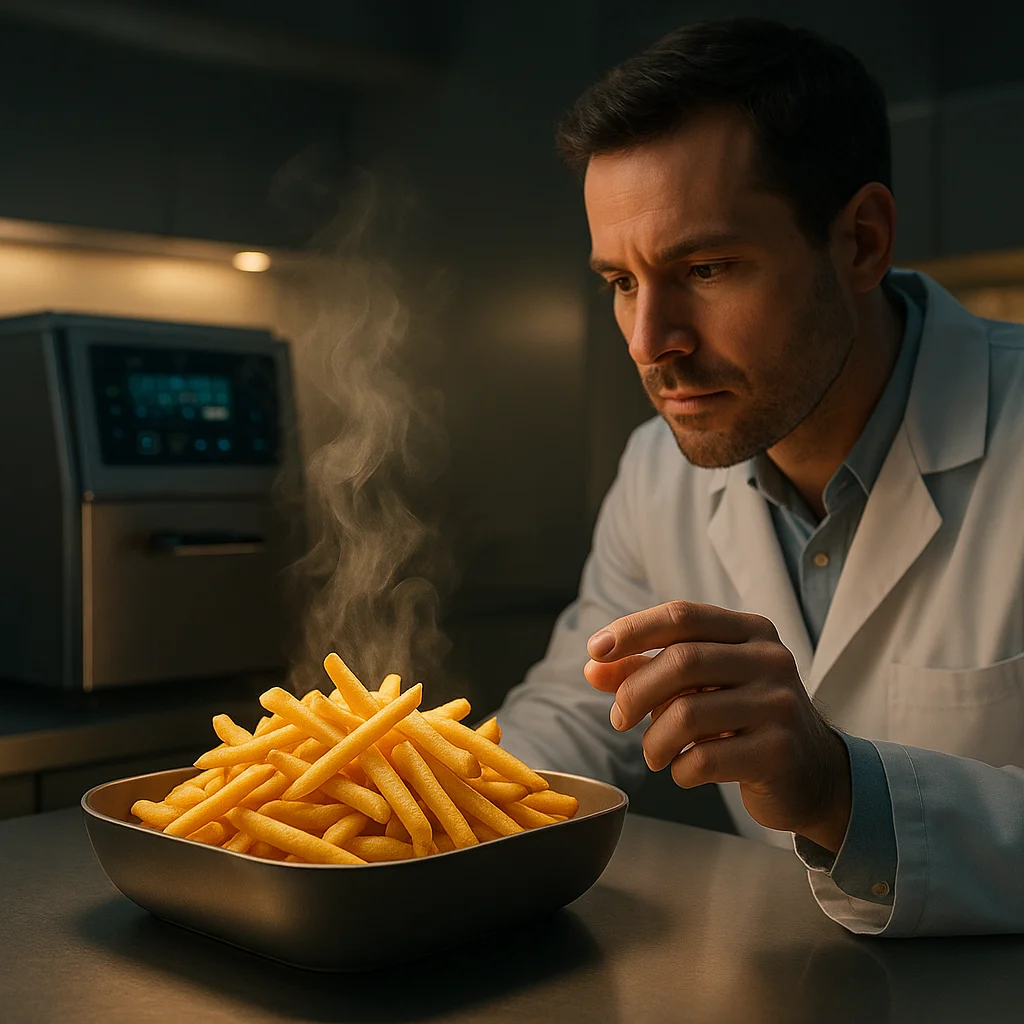
A French fry sounds simple: potato, oil, salt, heat. Yet food scientists have spent years trying to solve a problem hidden inside that simplicity. When potatoes are fried at high temperatures, especially after being stored in ways that raise their sugar content, they can form acrylamide, a chemical compound that has drawn regulatory and public-health attention for more than two decades. The recent breakthrough making headlines is not a gimmick and not a lab curiosity with no kitchen value. It is a practical method aimed at reducing acrylamide formation while preserving the texture and flavor people expect from fries. That matters to home cooks, restaurant chains, frozen-food manufacturers, and health-conscious consumers who do not want a “better-for-you” fry that eats like damp cardboard.
The core development, covered in MSN’s report on a healthier French fry method, centers on a treatment that helps limit the chemical reactions responsible for acrylamide during frying. If you have followed this story through related coverage such as Scientists Have Made a French Fry Breakthrough and Scientists’ French Fry Breakthrough: Complete Guide, the big question is no longer whether the science is interesting. It is whether the method can scale, whether it changes taste, and whether it might alter how the food industry handles one of its most popular side dishes.
My read is straightforward. This is a meaningful food-science advance because it addresses the part consumers rarely see: the chemistry that starts before the fry ever hits the basket. To understand why researchers are excited, it helps to break the issue into three pieces: 1) what acrylamide is, 2) why fries are especially vulnerable, and 3) what this new intervention changes in real production settings. Once those are clear, the significance of the breakthrough becomes much easier to judge.
The most important point is not that scientists want to “reinvent” fries. It is that they are trying to reduce a known processing risk without stripping away the qualities that made fries globally popular in the first place.
Why French Fries Became a Scientific Problem
The acrylamide issue entered mainstream food discussions in the early 2000s, when researchers and regulators began paying closer attention to how high-temperature cooking could create unwanted compounds in carbohydrate-rich foods. Potatoes are a prime candidate because they naturally contain the amino acid asparagine and varying levels of reducing sugars such as glucose and fructose. When exposed to frying temperatures, these compounds participate in the Maillard reaction, the same family of browning reactions that creates savory flavors and the golden exterior people crave. The trouble is that the desirable browning and the undesirable acrylamide formation are linked.
This is why the challenge has always been harder than it sounds. You cannot simply tell manufacturers to fry less aggressively and call it solved. Lower temperatures can affect texture, color, and food safety protocols. Different potato varieties behave differently. Storage conditions matter. A potato held too cold can accumulate more sugars through what the industry calls cold-induced sweetening, which increases browning and can push acrylamide levels higher during frying. In other words, the problem starts in the supply chain, not just in the fryer.
Food companies have already used several mitigation strategies over the years. They have adjusted blanching, selected lower-sugar potato varieties, modified storage temperatures, and fine-tuned fry times. Some processors also use asparaginase, an enzyme that can reduce acrylamide formation by converting asparagine before cooking. None of these measures is trivial, and none is universally perfect. Each brings cost, process complexity, or sensory trade-offs. That is why every credible new approach draws attention.
For readers who want the broader context, Scientists Achieve Major Breakthrough in Healthier French Fries and Common Mistakes in the Healthier French Fry Breakthrough are useful companion reads because they show how easy it is to oversimplify the issue. A “healthier fry” is not one single thing. It can mean lower acrylamide, less oil uptake, a better starch profile, or a combination of those factors. This particular breakthrough matters because it targets a specific, well-documented processing concern with a method that appears designed for real-world application.
- Core risk factor 1: potatoes contain asparagine and reducing sugars that can react during frying.
- Core risk factor 2: high heat drives browning and flavor, but also acrylamide formation.
- Core risk factor 3: storage, variety selection, and pre-treatment all affect final fry chemistry.
- Core industry challenge: lowering acrylamide without sacrificing crispness, color, and taste.
What the Breakthrough Actually Changes
The most useful way to think about the breakthrough is not as a magical ingredient but as a targeted intervention in the chemistry of frying. According to the MSN report, scientists identified a way to make fries healthier by reducing acrylamide formation through a treatment step before frying. That is the practical leap. Instead of trying to fix the issue after cooking, the process attempts to change the fry’s chemical starting point.
Why does that matter so much? Because prevention is more stable than correction. Once a potato strip enters hot oil, the reaction window is short and intense. Manufacturers need methods that work consistently across large batches, different harvests, and normal production speeds. A pre-fry treatment can be integrated into existing processing lines more easily than a complete redesign of the frying stage. In food manufacturing, that distinction often determines whether an idea stays in journals or reaches supermarket freezers.
The second important feature is sensory preservation. Consumers are ruthless with fries. They will accept a healthier yogurt or a low-sodium soup more readily than a fry that loses crunch. That is why breakthroughs in this category are judged by two standards at once: chemical improvement and eating quality. Reports around this research suggest the method is promising because it reduces the harmful compound while keeping the product recognizably fry-like. That sounds obvious, but it is the whole commercial case.
There is also a regulatory angle. Acrylamide has been monitored closely in several markets, particularly in Europe, where food businesses have long faced pressure to apply mitigation practices. Any method that helps processors document lower formation levels could become commercially valuable even if consumers never see the technical details on a package. Sometimes the most important food innovation is invisible to the diner and highly visible to the quality-assurance team.
A strong food-science breakthrough is rarely about novelty alone. It succeeds when it can survive scale-up, pass sensory tests, fit existing equipment, and satisfy compliance teams.
That is why I would frame this development in four steps:
- Identify the chemical bottleneck. In this case, the pathway leading to acrylamide during frying.
- Alter the raw material before heat hits. Pre-treatment is often cheaper and more controllable than post-cook correction.
- Protect product quality. A safer fry that no one wants to eat will not last in the market.
- Design for adoption. Industry uptake depends on cost, speed, and compatibility with current production lines.
That framework helps separate real progress from food-tech hype. This story looks more like the former than the latter.
How This Fits Into the 2026 Food Industry
By mid-2026, food companies are under pressure from several directions at once. Ingredient lists are scrutinized more closely, ultra-processed food debates remain active, and consumers increasingly expect indulgent foods to come with some form of nutritional or safety improvement. French fries sit right in the middle of that tension. They are a comfort food with a deeply entrenched global market, but they also carry associations with excess oil, sodium, and industrial processing. A breakthrough that improves one measurable aspect of fry safety arrives at a moment when the category is unusually receptive to change.
The frozen potato segment has also become more innovation-driven than many casual observers realize. Manufacturers are not just competing on price. They are competing on hold time, air-fryer performance, crispness after delivery, ingredient simplicity, and now, more visibly, health positioning. Over the past few years, air fryers changed consumer expectations at home. People now want fries that can crisp with less oil and do so consistently. That trend has made pre-treatment science more valuable, because products need to perform across multiple cooking environments, from deep fryers to convection ovens to countertop appliances.
Another 2026 reality is that food manufacturers are trying to avoid binary messaging. They do not want to imply older products were unsafe, but they do want to market improvements. That makes this kind of scientific advance especially attractive. It allows companies to talk about better processing, smarter formulation, and research-backed quality control rather than promising a miracle food. The language of “healthier fries” works best when it is anchored to a specific mechanism, and acrylamide reduction provides that anchor.
Recent coverage and discussion across food and consumer media suggest the public is more willing to engage with processing science than it was a decade ago. People who once ignored terms like glycemic response, resistant starch, or oxidation are now hearing them in mainstream nutrition conversations. The same goes for frying chemistry. That does not mean the average shopper wants a lecture in the freezer aisle. It means there is a larger audience prepared to reward brands that can explain improvements clearly and honestly.
For trend-watchers, French Fry Innovation: A 2026 Culinary Breakthrough captures the commercial mood well. The category is no longer standing still. Fries are being redesigned for healthier preparation, better texture retention, and more precise process control. The current breakthrough fits that broader movement rather than sitting outside it.
- 2026 consumer expectation: indulgent foods should show at least some measurable improvement.
- 2026 retail pressure: frozen and prepared foods must perform well in air fryers and ovens.
- 2026 industry incentive: process innovations that reduce risk without changing flavor are easier to commercialize.
- 2026 communication challenge: brands must explain benefits without sounding alarmist.
The Science Behind Healthier Fries Is Bigger Than One Headline
A lot of reporting on food breakthroughs flattens the story into a single dramatic claim. Real progress is usually more layered. In the case of fries, scientists and manufacturers are working on several fronts at once, and acrylamide reduction is only one of them. There is also work on oil absorption, starch retrogradation, potato genetics, cut geometry, coatings, and post-fry holding performance. The reason this matters is simple: a breakthrough in one area often becomes more powerful when paired with advances in another.
Take coatings, for example. Some processors use thin coatings to improve crispness and reduce moisture loss. Others focus on blanching and drying steps that alter the fry surface before it ever reaches oil. Researchers have also looked at how natural additives, fermentation-related treatments, and enzyme use can influence browning chemistry. The current breakthrough should be understood as part of this larger toolbox. It is not replacing everything the industry already knows. It is adding a sharper instrument.
The potato itself is another underappreciated variable. Variety selection affects sugar levels, dry matter, texture, and frying color. Agronomy decisions months before harvest can influence what happens in the fryer later. Storage management is just as important. If processors can combine a lower-risk variety with better storage control and a pre-fry treatment that suppresses acrylamide, the cumulative effect may be much greater than any single intervention alone.
This is where the story becomes interesting for chefs and serious home cooks too. While industrial methods do not translate perfectly to the home kitchen, the principles do. Soaking or blanching can reduce surface sugars. Avoiding overly dark browning helps. Using potatoes suited to frying matters. So does not refrigerating raw potatoes in ways that may increase sugar buildup. The breakthrough does not mean every home cook needs laboratory technique. It does mean the science validates a lot of best practices cooks have learned through trial and error.
One reason I like this story is that it rewards practical thinking. If you run a restaurant, the lesson is to pay more attention to potato sourcing, storage, and color targets. If you are a home cook, the lesson is to respect prep steps instead of treating them as optional. If you are a manufacturer, the lesson is that chemistry-led improvements can still protect pleasure. That is a healthier message than the usual all-or-nothing debate over “good” and “bad” foods.
What Restaurants, Brands, and Home Cooks Should Watch Next
The next phase of this story will not be driven by headlines alone. It will be driven by adoption. The key questions are practical. Can the treatment be implemented economically at scale? Does it work across multiple potato varieties and harvest conditions? Will major frozen-food companies or quick-service chains publicly talk about it, or will they quietly fold similar methods into standard production? Those are the signs that separate a promising paper from a category shift.
Restaurants have a narrower but still important lane here. Most independent operators are not going to install advanced pre-treatment systems overnight. What they can do is tighten process discipline. That means watching holding temperatures, reducing sugar-heavy potato lots when possible, avoiding excessively dark fries, and training staff to understand that color is not just cosmetic. A darker fry often signals more intense browning chemistry, and with it, potentially higher acrylamide formation.
Brands, meanwhile, have a communication test ahead. If they overstate the breakthrough, consumers may tune out. If they explain it well, they can build trust. The strongest message is usually the plainest one: we improved the way our fries are prepared to reduce a known heat-related compound while keeping the taste and texture people expect. That is specific enough to be credible and simple enough to be useful.
Home cooks can borrow the spirit of the breakthrough even without industrial tools. Three steps matter most. First, choose frying potatoes with a reputation for lower sugar and higher dry matter when available. Second, rinse or blanch to remove some surface starches and sugars, then dry thoroughly. Third, aim for golden rather than deeply browned fries. These are not perfect substitutes for commercial mitigation technologies, but they move in the same direction.
- For manufacturers: watch for process validation, sensory testing, and regulatory positioning.
- For restaurants: improve potato handling, color standards, and fry consistency.
- For retailers: expect more “better processing” language in frozen potato marketing.
- For home cooks: focus on potato choice, prep, and avoiding over-browning.
My broader takeaway is measured optimism. This breakthrough does not make fries a health food. It does make one of the world’s most popular indulgences a little smarter, and in food science that is often how real change happens: not through total reinvention, but through reducing avoidable harm while preserving joy.
Why This Breakthrough Matters More Than the Hype Cycle
Food trend coverage often swings between two extremes. Either a new development is treated as revolutionary, or it is dismissed because it does not solve every problem at once. The French fry breakthrough deserves a more disciplined reading. It matters because it addresses a known issue with a plausible, process-based fix. It does not ask consumers to abandon fries. It does not rely on fantasy ingredients. It works within the realities of how fries are actually made and eaten.
That is a stronger model for innovation than many splashier food-tech stories. Consumers tend to trust improvements that preserve familiar foods while making them safer or more reliable. Industry teams prefer interventions that fit existing lines and can be measured in quality-control data. Regulators respond better to targeted mitigation than vague wellness claims. This breakthrough checks those boxes more convincingly than many trend pieces imply.
There is also a cultural reason the story has traction. Fries are universal enough that almost everyone understands the stakes immediately. A better fry is not an abstract concept. It touches fast food, school cafeterias, pub menus, freezer aisles, and home dinners. When scientists improve a staple at that scale, even a modest gain can have outsized significance. If a method lowers undesirable compound formation across millions of servings, that is not trivial. It is the kind of quiet systems improvement that public health often depends on.
So my final assessment is simple. Scientists have made a real French fry breakthrough, but the breakthrough is best understood as precision improvement, not miracle transformation. The fry remains a fry. The pleasure remains intact. The chemistry gets a little cleaner. For a food this established, that is exactly the kind of progress worth taking seriously.
































Sign in to leave a comment.