

India has 22 officially recognized languages and hundreds more spoken regionally, and a huge share of the country's internet and smartphone users are far more comfortable communicating in a regional language than in English. Yet a striking number of businesses rolling out WhatsApp automation build it entirely in English, treating language as an afterthought rather than the foundational design decision it actually is. The result is automation that technically works — messages send, replies arrive — while quietly failing the exact customers it was supposed to serve better.
This isn't a minor localization detail to handle after the fact. For WhatsApp automation specifically, language is close to the whole game, because WhatsApp itself is the channel where people expect to communicate the way they naturally would with a friend or family member — in their own language, without translation friction. Getting this wrong doesn't just create a worse experience; it can actively drive customers away from a channel your business is investing real effort into.
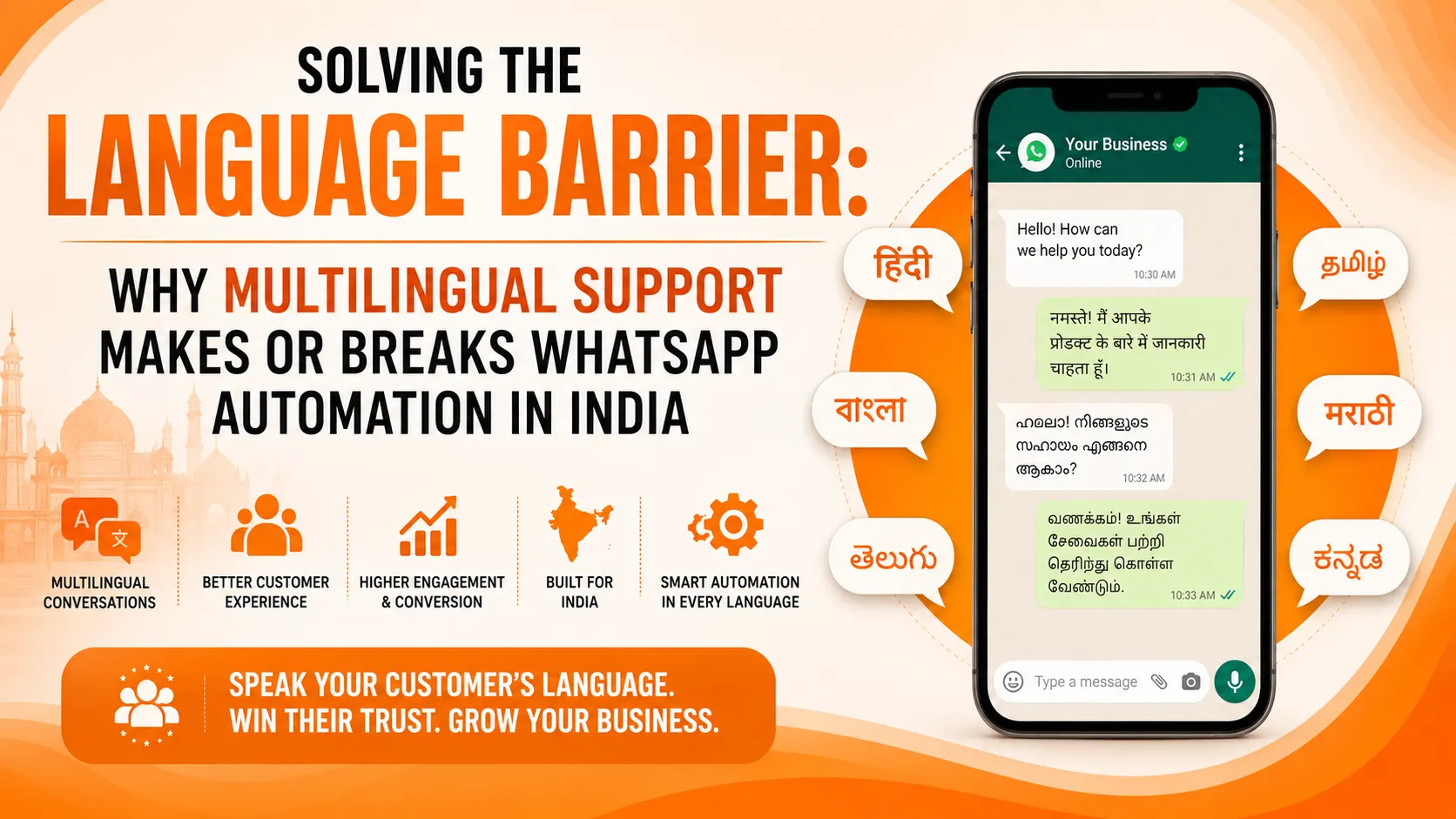
Why Language Matters More on WhatsApp Than on Other Channels
A website with English-only content is a known, accepted limitation — users expect some friction from a formal, text-heavy medium, and many will tolerate reading in a second language for information they specifically sought out. WhatsApp is different. It's the exact same interface people use to message their family in their mother tongue, and when a business shows up there speaking only English, the mismatch is immediately, viscerally noticeable in a way it isn't on a website or an app.
This matters even more for automated messaging specifically, since a customer interacting with a bot has less patience for friction than one talking to a person. A confusing, English-only automated flow doesn't just create mild annoyance — it often results in the customer simply giving up and disengaging entirely, exactly the outcome your automation was meant to prevent.
Where the Language Gap Actually Shows Up
Template messages. Order confirmations, appointment reminders, and promotional broadcasts sent as WhatsApp templates are frequently built and approved only in English, even when a large share of the recipient list would engage far more naturally with the same message in Hindi, Tamil, Bengali, or another regional language.
Chatbot flows and automated replies. A rule-based or AI-powered bot built to recognize only English keywords or phrasing will simply fail to understand — or worse, misunderstand — a customer typing in a regional language or in the common code-mixed style many Indian WhatsApp users actually type in, blending English and a regional language within the same message.
Menu options and quick replies. Automated menus presenting options only in English create an immediate barrier for customers who would engage far more naturally and confidently if the same options were presented in their preferred language.
Customer support escalation. Even when a conversation successfully escalates from bot to human agent, if the routing doesn't account for which language the customer actually needs support in, the handoff itself becomes a new point of friction — a customer who's been typing in Marathi suddenly connected to an agent who only communicates in English.
The Real Business Cost of Getting This Wrong
Lower engagement and completion rates. Customers who don't fully understand an automated flow are measurably more likely to drop off mid-conversation rather than push through the confusion — a direct, quantifiable cost to conversion, whether that conversion is a completed purchase, a booked appointment, or a resolved support query.
Higher block and complaint rates. A customer who consistently receives messages they can't comfortably read or engage with is more likely to ignore, block, or report your business number — and since WhatsApp's quality rating system tracks exactly these engagement signals, poor language fit can directly and measurably degrade your number's sending capacity over time, not just create a one-off bad experience.
Missed reach in exactly the markets with the most growth potential. A large share of India's next wave of digital and e-commerce growth is concentrated in smaller cities and towns, where comfort with English is often lower and regional language preference is stronger — businesses building English-only automation are effectively opting out of engaging this audience as effectively as they could.
Brand perception damage. For a business specifically trying to build trust and local relevance — a regional retailer, a local service provider, an educational institute — automated communication that only speaks English can quietly signal a lack of genuine local understanding, undermining exactly the local trust the business may be trying to build.
What "Multilingual Support" Actually Needs to Cover
It's worth being specific, because "multilingual support" as a feature claim can mean very different levels of actual capability.
Genuine template localization, not machine-translated approximations. Templates need to be written — or carefully, professionally translated — in a way that reads naturally in each supported language, since a stiff, literal translation can feel just as alienating as no translation at all, even if it's technically understandable.
Language detection and routing in chatbot flows, so a bot can recognize which language a customer is typing in — including common code-mixed patterns — and respond appropriately, rather than assuming every customer is typing in English by default.
Multilingual menu and quick-reply options, presented directly in the customer's preferred language rather than forcing them to navigate an English-only menu structure to reach content that might later be available in their language.
Agent routing that accounts for language capability, so a human handoff connects a customer to an agent who can actually communicate comfortably in the language the conversation has been happening in, rather than creating a jarring language switch at exactly the point where clear communication matters most.
Language preference stored and respected over time, so a customer who's indicated a language preference — explicitly or through their messaging pattern — doesn't have to re-establish that preference in every new conversation.
Why This Is Genuinely Harder Than It Sounds
Multilingual support in WhatsApp automation isn't just a translation task — it involves several distinct technical challenges that are easy to underestimate.
Code-mixing is the norm, not the exception, in how many Indian WhatsApp users actually type — blending English words into a regional language sentence, or vice versa, within the same message. A system built to recognize only "pure" language input, in one language at a time, will struggle with a meaningful share of real customer messages.
Template approval needs to happen per language. Since WhatsApp templates go through Meta's review process, supporting multiple languages means managing and maintaining multiple approved template versions for the same underlying message — a real, ongoing operational task, not a one-time setup step.
Regional dialects and script variations add further complexity. Even within a single named language, real usage varies by region and by whether customers type in native script or in transliterated Roman script — both patterns show up regularly in Indian WhatsApp usage, and a system built to recognize only one adds friction for customers using the other.
What to Actually Look for in a Multilingual-Capable Platform
For a business evaluating WhatsApp automation software for small businesses in India with multilingual capability as a genuine priority — not just a checkbox — a few specific things matter more than a general "multilingual support" claim on a feature list:
Ask which specific languages are supported, and at what depth — full chatbot flow support, or just template translation. These are meaningfully different levels of capability, and the gap matters enormously for how well the automation actually serves non-English-preferring customers.
Ask how the platform handles code-mixed input, since this is genuinely one of the harder and more commonly overlooked aspects of building for Indian WhatsApp usage specifically.
Ask how template management works across languages, since maintaining multiple approved template versions per message is an ongoing operational task that a well-designed platform should meaningfully simplify, not leave entirely to manual management.
Ask how human agent handoff accounts for language, to confirm the platform actually solves the full customer journey, not just the automated portion of it.
What This Looks Like in a Platform Built for the Indian Market
ItTalk by Imbibe Tech is a useful example of a platform built with this specific requirement in mind from the outset, rather than treating multilingual support as an afterthought. It offers multi-language broadcast support across major Indian languages, built specifically around the reality that a single business's contact list often spans multiple regional language preferences — allowing campaigns and templates to be managed and sent appropriately across that variation, rather than forcing every customer through the same English-only messaging regardless of their actual preference. Combined with its no-code setup and segmentation tools — filtering by geography, among other factors, which correlates meaningfully with language preference across India's regions — this reflects a platform genuinely engineered around Indian linguistic diversity rather than a global tool with a translation layer bolted on afterward. For a business evaluating WhatsApp automation software for small businesses in India where multilingual reach genuinely matters to the customer base being served, this kind of native-language design is exactly the capability worth verifying directly, rather than assuming any platform claiming "multilingual support" delivers it at the same depth.
The Bottom Line
Language isn't a secondary localization detail for WhatsApp automation in India — it's close to the central design decision that determines whether automation actually serves your customer base or quietly alienates a meaningful share of it. The businesses getting real value from WhatsApp automation are the ones that treated multilingual capability as a first-class requirement from the start: genuine template localization, code-mixing-aware chatbot logic, language-aware human handoff, and remembered language preference — not a translation afterthought layered onto an English-first system.
For a country as linguistically diverse as India, automation that only speaks one language isn't really automation built for the Indian market at all — it's automation built for a narrower slice of it, quietly leaving real reach, engagement, and trust on the table with every customer it fails to properly speak to.


























Sign in to leave a comment.