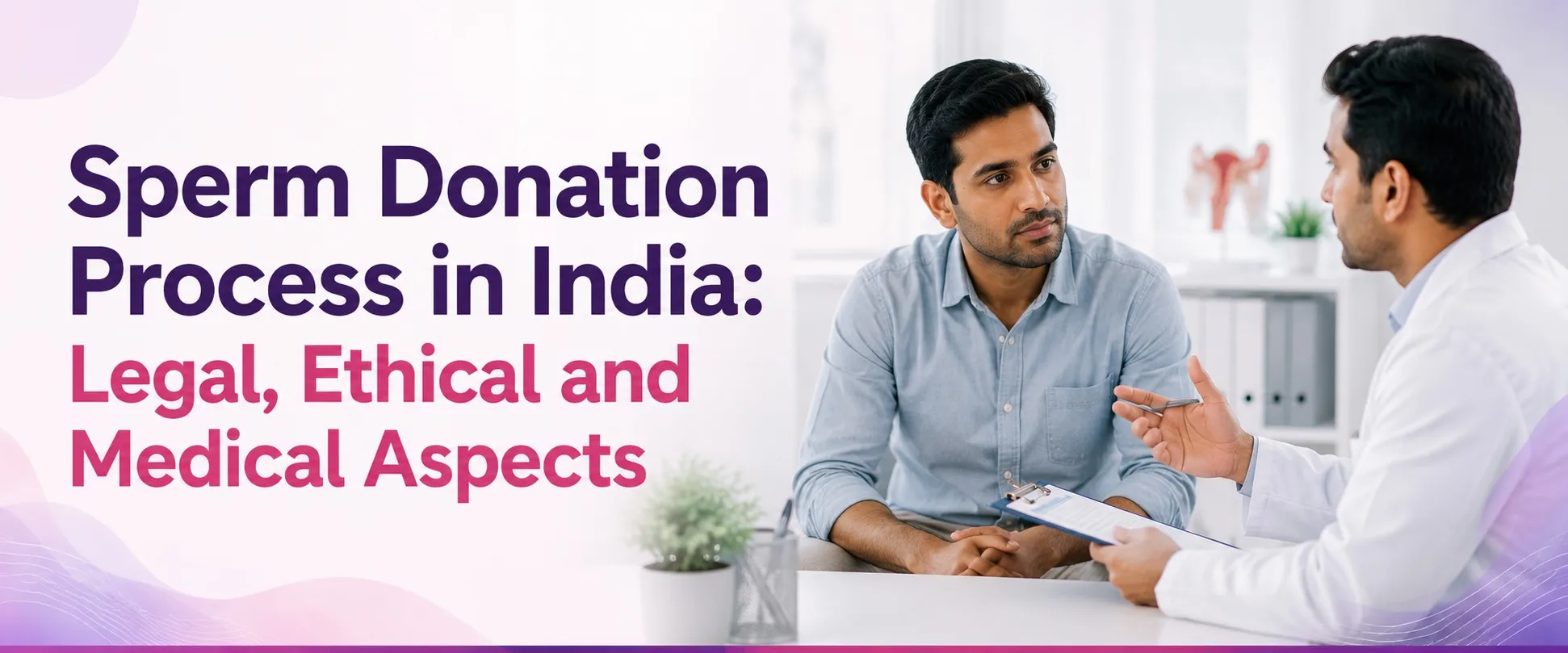

Sperm donation has helped thousands of families in India. But it comes with important legal, ethical, and medical considerations that every donor and recipient should understand.
For many couples and individuals struggling with infertility, sperm donation offers a genuine path to parenthood. It is a well-established medical practice, used widely across the world and increasingly across India.
But sperm donation is not a simple or casual process. There are strict medical protocols, clear legal guidelines, and important ethical questions that surround it. Whether you are considering donating sperm or using donor sperm to conceive, understanding all of these aspects is essential before taking any step.
Here is a complete, honest guide.
What Is Sperm Donation?
Sperm donation is when a man voluntarily provides his sperm to help another person or couple conceive a child. The donated sperm is used either in an intrauterine insemination procedure(IUI) or as part of an IVF cycle, depending on the recipient's medical situation.
The donor and the recipient are typically anonymous in India. It means neither party knows the other's identity. This is by design, and it is governed by law.
Who Needs Donor Sperm?
Donor sperm is used in a range of situations, including:
- Couples where the male partner has no sperm or very poor sperm quality that cannot be treated
- Men with genetic conditions they do not wish to pass on to a child
- Single women who wish to conceive without a male partner
- Same-sex female couples who want to start a family
- Men who have undergone cancer treatment that affected their fertility
In all of these cases, the best IVF center in Jaipur will evaluate the medical need carefully before recommending donor sperm as part of a treatment plan.
The Legal Framework Governing Sperm Donation in India
India has clear and enforceable laws around sperm donation. These are primarily governed by the Assisted Reproductive Technology Regulation Act, 2021, commonly referred to as the ART Act. This was a landmark piece of legislation that brought formal regulation to a field that had previously operated with limited oversight.
Key legal points under the ART Act include:
Donor anonymity is mandatory. The identity of the sperm donor cannot be revealed to the recipient couple, and the recipient's identity cannot be shared with the donor. This protects both parties legally and emotionally.
- A donor can contribute to a maximum of one registered ART bank only. This limits how many families a single donor can help create and reduces the risk of unknowing biological relationships in the future.
- All sperm must be sourced from registered sperm banks only. Clinics cannot accept donations directly from individuals brought in by the recipient couple. This rule exists to maintain medical and legal standards.
- The donor has no parental rights or legal responsibilities toward any child born from his donation. This is clearly established under Indian law.
- The recipient couple is considered the legal parents of the child from the moment of birth. No legal ambiguity exists on this point under the ART Act.
- Compensation to donors is permitted in the form of reasonable reimbursement for time, travel, and inconvenience. However, outright commercial sale of sperm by donors is not permitted.
It is important to work only with clinics and sperm banks that are fully registered and compliant with the ART Act. A reputable fertility specialist in Jaipur will always follow these legal protocols strictly.
Who Can Donate Sperm in India?
Not everyone who wishes to donate sperm is eligible. Sperm banks follow strict selection criteria to ensure the health and safety of recipients and future children. Eligibility requirements typically include:
- Age: Donors must generally be between 21 and 45 years of age. Most banks prefer donors between 21 and 35.
- Health: Donors must be in good general physical health with no significant medical history.
- Sperm quality: A semen analysis is conducted to assess count, motility, and morphology. Only men with high-quality sperm are accepted.
- Genetic screening: Donors are tested for hereditary and genetic conditions to ensure no inherited diseases are passed on.
- Infectious disease testing: Donors are screened for HIV, hepatitis B, hepatitis C, syphilis, gonorrhoea, chlamydia, and other sexually transmitted infections.
- Psychological evaluation: Some banks also conduct a basic psychological or behavioural assessment.
- Family history: A thorough family medical history is taken to rule out hereditary conditions.
If a donor meets all criteria, their sperm is collected, processed, frozen, and quarantined for a mandatory period, usually around six months, before being cleared for use. This quarantine period allows for repeat infectious disease testing to confirm safety.
The Step-by-Step Donation Process
For someone considering sperm donation, here is what the process typically looks like:
Initial application: The potential donor contacts a registered sperm bank and fills out a detailed medical and personal history form.
- Screening and testing: A comprehensive medical evaluation is conducted including blood tests, semen analysis, genetic screening, and infectious disease panels.
- Counselling: The donor receives counselling about the legal implications, including the fact that they will have no parental rights or obligations toward any resulting child.
- Sample collection: If approved, the donor provides semen samples at the sperm bank facility. Multiple samples are usually collected over several visits.
- Processing and freezing: Samples are processed in the lab, mixed with a protective medium, and cryopreserved or frozen for future use.
- Quarantine period: The frozen samples are stored for a minimum period and the donor is retested before samples are cleared for use.
- Release for use: Once cleared, the samples are made available to recipient couples through the sperm bank.
Ethical Considerations Around Sperm Donation
Beyond the legal framework, sperm donation raises genuine ethical questions that deserve thoughtful consideration.
The right of the child to know their origins is a growing topic of discussion globally. In India, donor anonymity is currently protected by law. However, as children born through donation grow older and genetic testing becomes more accessible, questions about identity and biological heritage are increasingly being raised. This is an evolving area and one that medical communities worldwide are actively debating.
Donor limits exist to prevent one donor from fathering an unusually large number of children. The ART Act addresses this, but ensuring compliance requires robust record-keeping by registered banks.
Informed consent is non-negotiable. Both donors and recipients must fully understand what they are agreeing to, including the medical process, legal outcomes, and emotional implications. Reputable clinics ensure that consent is documented thoroughly and that no pressure is placed on either party.
Exploitation of donors, particularly economically vulnerable young men, is a concern that the ART Act tries to address by regulating compensation. Working only with registered, transparent institutions helps protect against this.
Recipient rights must also be respected. Couples using donor sperm deserve accurate, honest information about the donor's health, genetics, and screening results, without compromising anonymity.
What Recipients Should Know
If you and your partner are considering using donor sperm, here are some important things to keep in mind:
You will receive a profile of the donor that includes physical characteristics, blood group, educational background, and health information. You will not receive the donor's name or identifying details.
The child born will be legally yours in every sense. No separate adoption process is required.
You may wish to consider when and how to tell your child about their conception. Many child psychologists recommend age-appropriate honesty, but this is a deeply personal decision for each family.
Counselling before, during, and after the process is strongly recommended. A good clinic will offer this as a standard part of care.
Choosing the Right Clinic
This is not a process to navigate with a clinic you do not fully trust. When choosing where to pursue donor sperm treatment, look for:
- Full registration under the ART Act 2021
- Association with a licensed and registered sperm bank
- Transparent communication about donor profiles and medical screening
- Comprehensive counselling support for both partners
- Clear documentation of all legal consents
- A team that treats your case with sensitivity and discretion
The best IVF center will meet all of these criteria and will make sure you feel fully informed and supported at every stage of the process.
A Final Word
Sperm donation is a generous act that gives families a chance at parenthood they might not otherwise have. When done through the right channels, with proper medical screening, legal compliance, and ethical care, it is a safe and effective option.
If you are considering sperm donation, whether as a donor or a recipient, take the time to understand the process fully. Ask questions. Seek counselling. And always work with registered, reputable professionals.
The journey to parenthood looks different for every family. What matters most is that it is built on a foundation of honesty, care, and informed choice.
Considering donor sperm as part of your fertility treatment? Speak with a fertility specialist in Jaipur to understand your options and receive compassionate, legally compliant guidance.





























Sign in to leave a comment.