
The automotive repair industry is undergoing a massive digital transformation. From cloud-based shop management software to digital vehicle inspections (DVIs) sent via text message, modern service bays are increasingly paperless. Customers can now book appointments online, approve repair estimates on their smartphones, and pay their invoices via email links. However, despite all of this technological advancement, there is one undeniable reality: a vehicle requires a physical key.
Because the key must physically change hands from the customer to the mechanic, the need for secure, physical documentation during the intake process remains absolute. The bridge between the digital world and the physical repair bay is the humble drop envelope.
Why Apps Can't Replace the Drop Envelope Many forward-thinking dealerships have attempted to fully digitize the after-hours drop-off process. They instruct customers to check in via a mobile app, scan a QR code at the door, and then drop their bare key into a slot. While this sounds efficient in theory, it frequently falls apart in practice.
Without a physical envelope tying the key to the digital record, chaos ensues. If a customer drops a bare key into a box, and another customer does the same ten minutes later, the service advisor arrives the next morning to find a pile of unidentified keys. They are then forced to play a guessing game, walking around the lot pressing the panic button on key fobs just to figure out which vehicle belongs to which digital appointment.
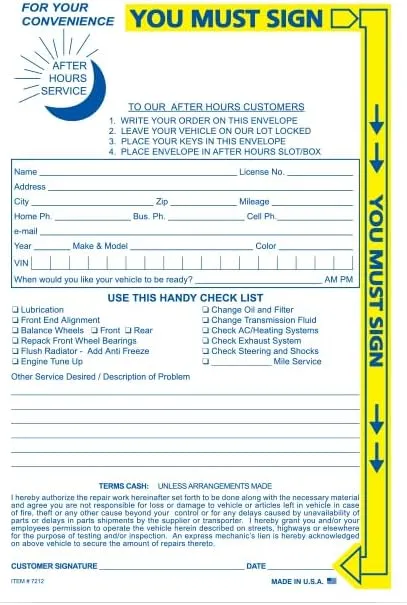
By requiring customers to use key drop box envelopes, shops eliminate this disconnect entirely. The key is securely sealed inside a packet that explicitly lists the customer’s name, vehicle, and contact information right on the outside.
The Legal Requirement for Signatures Beyond simple organization, physical envelopes provide a crucial legal safeguard. In many states, automotive repair facilities are legally required to obtain a customer's signature authorizing diagnostic work before a mechanic can even touch the vehicle. While digital signatures are valid, capturing them during a 10:00 PM towing emergency is highly impractical.
A printed envelope provides a legally binding signature line right where the customer is standing. When the customer signs the envelope to authorize the initial tear-down or diagnostic fee, the shop is legally protected. This allows the technicians to start working at 8:00 AM sharp without waiting for a service advisor to successfully reach the customer on the phone for verbal approval.
Enhancing the Digital Workflow Rather than fighting the digital revolution, physical drop envelopes actually enhance it. When a service advisor arrives in the morning, they simply collect the envelopes, open their shop management software, and transcribe the customer's written notes into the digital ticket. The envelope serves as the perfect "source document" to initiate the digital workflow.
To ensure this process is seamless, shops must invest in high-quality dealership materials that are designed to hold up to the elements. Thin, generic office envelopes will disintegrate in the rain or tear under the weight of modern, heavy smart keys. Purpose-built automotive envelopes are constructed from heavy-duty Kraft paper, ensuring the customer's vital instructions—and their expensive key fob—survive the journey into the collection box.
Conclusion Technology will continue to streamline how auto shops operate, but the physical nature of automotive repair means paper will never be entirely eliminated. By utilizing robust physical drop envelopes, dealerships and independent garages ensure the physical transfer of the vehicle perfectly matches their high-tech digital workflows.
Frequently Asked Questions (FAQ)
Q: Do customers find filling out physical envelopes annoying?
A: Not if the envelope is well-designed. A proper automotive envelope uses clear, check-box style formatting (e.g., checking a box for "Oil Change" or "Check Engine Light") so the customer only has to write their name, number, and signature, taking less than a minute.
Q: Are standard office envelopes a suitable substitute?
A: No. Standard envelopes are too thin and will tear easily when heavy key fobs are inserted. They also lack the pre-printed legal authorization language required by most state automotive repair laws.
Q: Can drop envelopes be used alongside an online booking system?
A: Yes, they pair perfectly together. A customer can book their appointment online and simply write their digital "Confirmation Number" on the exterior of the physical envelope when dropping off their key, tying the two systems together seamlessly.



























Sign in to leave a comment.