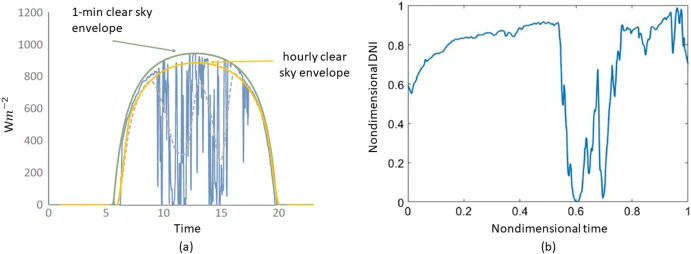

Let’s talk about solar power and prediction for a second. Not in a glossy, futuristic brochure way, but in the gritty, real-world sense of keeping the lights on when the sun ducks behind a cloud. If you’ve ever followed the energy space, you’ve heard the debate simmering: for a renewable-heavy grid, what matters more? A hyper-accurate forecast for tomorrow, or a super-high-frequency read on the next five minutes?
I’ve been turning this over lately, and the answer feels less like a technical choice and more like a question of perspective. Where you stand on the grid changes what you need to see.
The Control Room View: Why Five Minutes Feels Like a Lifetime
Picture a grid operator in Texas. It’s a bright afternoon, but on the horizon, a line of pop-up thunderstorms is brewing. A standard day-ahead forecast might tell her, “High solar generation, maybe a dip late afternoon.” Useful, but vague.
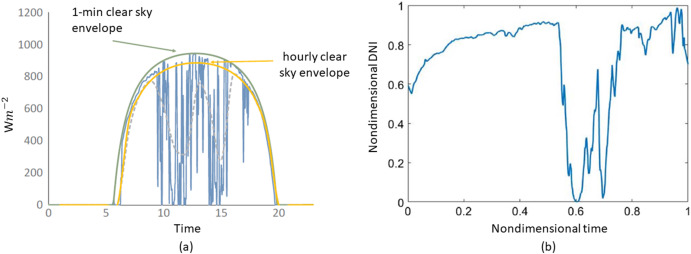
Now imagine she has a live, rolling model updating every 300 seconds. It shows the precise density and speed of those cloud formations, predicting the exact shadow they’ll cast over her solar fields. That’s not a forecast; it’s a stroboscope, flashing a rapid-fire picture of the immediate future.
For her, this isn’t just data—it’s her steering wheel. A bank of clouds can slash a solar farm’s output by 70% in under a minute. You can’t fix that with a gas plant that takes half an hour to spin up. You fix it with batteries, with demand response, with flywheels—technologies that live and die by sub-ten-minute timelines.
The high-frequency forecast is the nervous system for this new grid anatomy. Without it, you’re not managing variability; you’re just getting hit by it.
The Boardroom View: Why Accuracy is the Bottom Line
But let’s switch seats. From the perspective of a utility CFO or a solar farm owner, that five-minute frenzy is just noise. Their world runs on contracts, budgets, and day-ahead markets. They need to know, with ruthless confidence, how many megawatt-hours the sun will essentially promise for tomorrow.
This is where high-accuracy forecasting is non-negotiable. It’s the bedrock that turns sunlight from a weather pattern into a bankable commodity.
Think of it this way: a high-frequency model with poor foundational accuracy is like a hyper-alert guard dog that barks at squirrels, mail carriers, and the wind. You’ll stop listening to it. If your fancy five-minute model consistently over-predicts, you’ll be pre-emptively firing up expensive standby power for dips that never materialize—burning money and carbon for no reason. The financial stability of the whole operation depends on getting the big picture right.
The Scaling Problem: A Matter of Growing Dependence
So, is it a tie? Do we just say both are vital and call it a day? Not quite. The relationship between accuracy and frequency isn’t static; it evolves with the amount of solar on the grid.
Phase One (Low Penetration): A decent day-ahead forecast is a revelation. Solar is a minor player, and the grid can absorb its quirks with existing flexibility.
Phase Two (High Penetration): This is where we’re headed. At 40%, 60%, or 80% solar generation, the grid’s tolerance for minute-by-minute volatility shrinks to zero. The day-ahead forecast is still the strategic map, but the five-minute update becomes the tactical lifeline. You can’t manage what you can’t see in near-real time.
The importance of frequency intensifies with scale. Accuracy is the price of admission, but resolution is the key to the dance.
The Verdict: A Necessary Hierarchy
If you back me into a corner and make me choose for a grid committed to a solar-dominated future, my vote leans toward the stroboscope. Here’s why:
The ultimate goal isn’t just to predict the sun, but to synchronize our entire infrastructure with its rhythms. That requires seeing its flickers, not just its arc.
High-frequency forecasting is the tool that acknowledges the fundamental truth of solar: its power is immense, but its mood swings are real. We will always chase better accuracy—that’s a constant engineering pursuit. But without the temporal resolution to act within the window that matters, we’re building a complex, renewable-heavy grid with a blindfold on.
The holy grail, of course, is the model that blends ruthless accuracy with five-second granularity. We’re not there yet. The sensor networks, the computing power, the algorithms—it’s a staggering challenge. But this quiet race to see the future not as a snapshot, but as a living, breathing stream, might just be one of the most critical—and underrated—engineering stories of our time. It’s how we learn to bend our world to the sun’s logic, one flickering forecast at a time.
So, Whats the Option
Looking back at the discussion we've had, a lot of the "stroboscope versus weatherman" tension hinges on getting forecasts that are both fast and personalized. That's exactly where a platform like Solar-Forecast.com steps in, offering a practical bridge between the two approaches. The platform provide rooftop solar forecasting as well as coded and easy-to-use solar forecast API.



















Sign in to leave a comment.