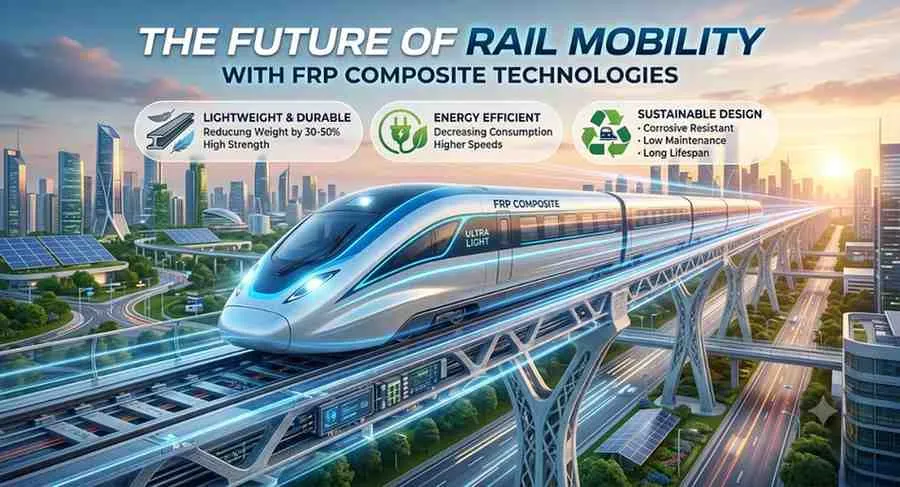

The Future of Rail Mobility with FRP Composite Technologies
Rail transport is at an inflection point globally, and India is no exception. The push toward faster intercity corridors, higher passenger volumes, and lower operating costs is forcing a fundamental rethink of how rolling stock and rail infrastructure are built. Fibre-reinforced polymer is central to that rethink. Superindia Composites' FRP solutions for the mobility sector are already embedded in this shift, with composite technologies developed for the demands that next-generation rail will place on materials and manufacturing.
The future of rail mobility will not be built from the same materials that built the last century of rail. The reasons for that are structural, economic, and environmental.
Speed Requirements Are Changing Material Specifications
India's rail ambitions have moved well beyond conventional intercity speeds. The Vande Bharat programme, the Mumbai-Ahmedabad high-speed corridor, and multiple semi-high-speed route upgrades under development all operate on a shared engineering premise: deadweight must come down for speed targets to be achievable within existing infrastructure constraints.
At higher speeds, aerodynamic drag grows exponentially. Every kilogram of unnecessary structural mass requires additional traction energy to overcome both inertia and drag simultaneously. The materials that work adequately at 110 kilometres per hour become engineering liabilities at 160 or 200. FRP addresses this directly. Its strength-to-weight ratio allows engineers to meet structural performance targets while removing mass that steel construction cannot shed without compromising integrity.
As Indian rail speed targets increase across the network, FRP's role in rolling stock design will expand from optional upgrade to baseline specification.
Hydrogen and Electric Rail Will Demand Lighter Vehicles
The next phase of Indian Railways' decarbonisation strategy involves electrification of remaining diesel routes and early-stage evaluation of hydrogen fuel cell traction for specific corridors. Both technologies share a constraint: energy storage and generation systems add significant weight to the vehicle platform.
Hydrogen storage tanks, fuel cell stacks, and battery packs for hybrid or fully electric traction each carry substantial mass. To keep total vehicle weight within acceptable axle load limits for existing track infrastructure, weight must be removed from every other system on the vehicle. Structural components, interiors, and body panels are the primary targets.
FRP makes this weight budget achievable. A coach built with composite interior and structural components can absorb the mass of new traction technologies without pushing total vehicle weight beyond track design limits. This is not a future consideration. It is an engineering constraint that rail designers are working with now as next-generation traction systems move from pilot to procurement.
Smart Composites and Embedded Sensing
The next generation of FRP is not passive structural material. Research and early commercial deployment of smart composite systems are already underway in advanced rail markets, and Indian railways will encounter these technologies as imported train sets and domestic development programmes mature.
Smart composites embed sensing elements directly into the fibre layup during manufacture. Strain gauges, temperature sensors, and acoustic emission detectors become part of the panel or structural member rather than surface-mounted additions. This enables continuous structural health monitoring without external sensor arrays, wiring harnesses, or the maintenance overhead that conventional sensor installations require.
For Indian Railways managing a vast and aging asset base, structural health monitoring through smart composites offers a path toward predictive maintenance. Components flag developing fatigue or damage before failure, maintenance teams respond to data rather than scheduled intervals, and service disruptions from unexpected structural failures reduce significantly.
Sustainability and End-of-Life Material Strategy
Rail operators globally are under increasing pressure to account for the full environmental lifecycle of the materials they specify. FRP's longevity is an advantage here. Components that remain in service for 25 to 30 years without corrosion degradation or frequent replacement have a lower cumulative material consumption footprint than shorter-lived steel alternatives.
The challenge for composite materials has historically been end-of-life processing. Thermoset FRP, which dominates current railway applications, cannot be remelted like steel. This is a genuine limitation that the composites industry is actively addressing.
Thermoplastic composite systems, which can be reprocessed at end of life, are advancing rapidly. Recyclable resin systems and fibre reclamation technologies are moving from laboratory scale toward industrial viability. Future railway procurement specifications are likely to include recyclability requirements, and manufacturers developing thermoplastic composite capability now will be positioned to meet those specifications when they arrive.
Urbanisation and Metro Rail Expansion
India's metro rail network is expanding faster than almost any comparable country. New metro systems are being constructed or extended in dozens of cities, and the rolling stock specifications for urban metro applications differ from mainline rail in ways that favour FRP even more strongly.
Metro coaches make hundreds of acceleration and braking cycles per day. Reduced vehicle weight directly improves energy efficiency across each cycle, and the cumulative effect across a fleet operating in dense urban conditions is substantial. Metro coaches also operate in underground and semi-enclosed environments where corrosion from humidity and pollutant exposure is more aggressive than on open mainline routes.
FRP interior systems in metro coaches deliver weight reduction, corrosion immunity, and easier cleaning and replacement cycles. As metro procurement volumes increase across Indian cities, composite component demand will scale accordingly.
Domestic Manufacturing Capability as a Strategic Asset
India's ability to manufacture certified FRP components domestically is not just a supply chain convenience. It is a strategic capability that determines how quickly Indian Railways can scale next-generation rolling stock programmes without import dependency.
As design complexity increases and certification requirements tighten, the gap between manufacturers with established composite capability and those without will widen. Domestic producers investing in advanced layup techniques, resin systems, and quality infrastructure now are building the foundation for supply relationships that will sustain India's rail ambitions across the next two decades.
For Indian Railways and its rolling stock suppliers, the domestic composites ecosystem is an asset worth developing deliberately rather than treating as an interchangeable commodity input.
Frequently Asked Questions
How will FRP technology evolve for future rail applications?
FRP is moving toward smart composite systems with embedded sensors for structural health monitoring, thermoplastic matrices for recyclability, and more complex integrated geometries that reduce part count in rolling stock assemblies.
Why is FRP important for high-speed rail development in India?
At higher speeds, aerodynamic drag and traction energy requirements increase sharply. FRP's strength-to-weight ratio allows structural performance targets to be met while removing the mass that makes speed efficiency difficult with steel construction.
How does FRP support hydrogen and electric rail traction systems?
Hydrogen storage and battery systems add significant vehicle weight. FRP structural and interior components offset this mass addition, keeping total vehicle weight within axle load limits for existing track infrastructure.
What is a smart composite in railway applications?
A smart composite embeds sensing elements such as strain gauges or acoustic detectors directly into the fibre layup during manufacture, enabling continuous structural monitoring without external sensor installations.
Will FRP components become recyclable?
Thermoplastic composite systems and fibre reclamation technologies are advancing toward industrial viability. Future railway procurement is likely to include recyclability specifications, and thermoplastic FRP is positioned to meet them.






















Sign in to leave a comment.