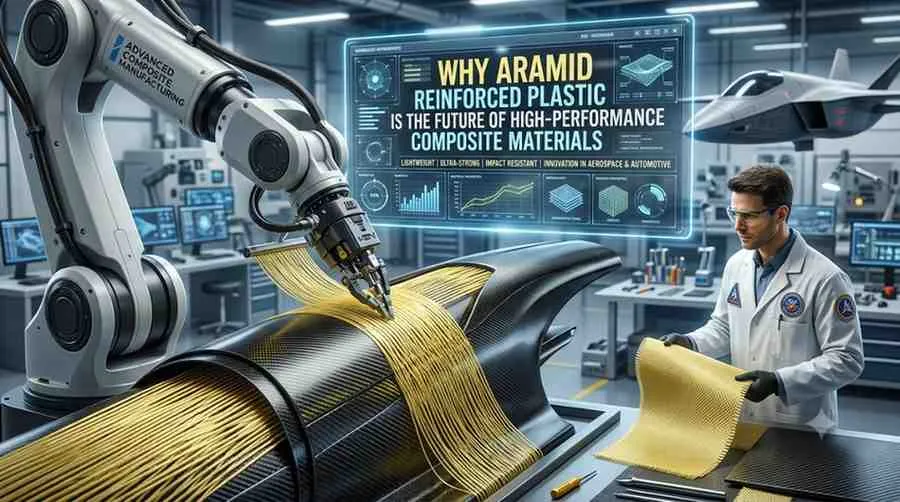

Modern engineering keeps asking for the same thing: materials that weigh less but perform more. Aerospace teams want lighter airframes. Defense contractors want tougher armor. Renewable energy companies want components that survive decades outdoors without failing.
This demand has pushed manufacturers toward advanced composites instead of traditional metals. Among these, Aramid Reinforced Plastic has become one of the most reliable choices for engineers who need strength, weight savings, and long-term durability in one material. Manufacturers like Super Strong ARP have built dedicated product lines around this shift, reflecting how mainstream the material has become across industrial sectors.
This article breaks down what Aramid Reinforced Plastic actually is, where it performs best, and how it compares to steel, aluminum, and standard FRP.
What Is Aramid Reinforced Plastic?
Aramid Reinforced Plastic (ARP) is a composite material made by embedding aramid fibers into a polymer resin matrix, typically epoxy or polyester.
The aramid fibers act as the structural backbone. The resin binds them together and transfers load across the fiber network. This combination gives the finished part its strength, stiffness, and shape.
Aramid fiber is an organic fiber from the aromatic polyamide family, known for low density, high tenacity, and strong impact resistance. That combination is why it behaves so differently from glass or carbon fiber composites, and why it holds up so well under sudden impact loads.
Unlike metals, ARP does not corrode, rust, or fatigue the same way under repeated stress. Unlike standard fiberglass composites, it absorbs impact energy instead of cracking on contact.
Key Benefits of Aramid Reinforced Plastic
High strength-to-weight ratio. Aramid has a density of roughly 1.4 g/cm³, far lighter than steel at 7.8 g/cm³, yet it remains several times stronger than steel on an equal-weight basis. This lets engineers cut part weight without cutting performance.
Excellent impact resistance. ARP absorbs and dissipates energy on impact rather than shattering, which is why it shows up in ballistic protection and structural safety components.
Corrosion resistance. ARP does not rust or degrade from moisture exposure, making it suitable for marine and outdoor infrastructure work.
Chemical resistance. Aramid fiber composites show good chemical stability against fuels and solvents, which matters in industrial and automotive environments.
Electrical insulation. ARP does not conduct electricity, so it works well near live equipment or in electrical enclosures.
Long service life. Because it resists fatigue and environmental degradation, ARP parts often outlast metal equivalents in the field.
Low maintenance. No repainting, no rust treatment, no corrosion inspection cycles.
Dimensional stability. ARP holds tight tolerances across temperature swings, which is critical for precision components.
Industries That Benefit from ARP
Aerospace relies on ARP for lightweight structural panels and interior components where every gram affects fuel efficiency.
Defense uses ARP in ballistic panels, vehicle armor, and protective equipment, since impact absorption is a core requirement there.
Renewable energy applies ARP in wind turbine components and enclosures that need to survive years of outdoor exposure.
Electrical and electronics manufacturers use ARP for insulating housings and structural supports near power equipment.
Infrastructure projects use ARP for reinforcement in bridges, panels, and structural retrofits where corrosion resistance extends service life.
Automotive applications include reinforced panels and safety components where weight reduction improves fuel economy.
Marine equipment benefits from ARP's resistance to saltwater corrosion and moisture damage.
Industrial manufacturing uses ARP for machine guards, enclosures, and structural parts exposed to repeated mechanical stress.
Why Engineers Are Choosing ARP Over Traditional Materials
| Property | Steel | Aluminum | Standard FRP | Aramid Reinforced Plastic |
|---|---|---|---|---|
| Weight | Heavy | Moderate | Light | Very Light |
| Strength-to-weight ratio | Low | Moderate | Moderate | High |
| Impact resistance | Moderate | Low-Moderate | Moderate | High |
| Corrosion resistance | Poor (without coating) | Moderate | Good | Excellent |
| Maintenance needs | High | Moderate | Low | Very Low |
| Lifecycle cost | High | Moderate | Moderate | Low over time |
Steel offers strength but adds weight and requires ongoing corrosion protection. Aluminum cuts weight but sacrifices some strength and stiffness. Standard FRP improves on both but still falls short of ARP's impact resistance and toughness.
ARP closes these gaps. It matches or beats steel on strength-to-weight performance, avoids the corrosion issues of metals, and outperforms standard FRP under impact loading. Over a product's lifecycle, lower maintenance and longer service life often offset the higher upfront material cost.
Factors to Consider Before Choosing an ARP Solution
Mechanical requirements. Define the load, stress, and impact conditions the part must withstand before selecting fiber orientation and resin type.
Environmental conditions. Account for UV exposure, moisture, temperature swings, and chemical contact in the operating environment.
Manufacturing process. Confirm whether the part needs compression molding, filament winding, or hand layup, since this affects tolerances and cost.
Customization. Check whether the manufacturer can adjust fiber content, thickness, and geometry to your specific application.
Quality standards. Look for compliance with relevant industry certifications for your sector, whether aerospace, defense, or infrastructure.
Long-term performance. Ask for test data on fatigue resistance and expected service life under your specific operating conditions.
Choosing the Right Manufacturing Partner
Material specifications only matter if the manufacturing process is consistent. A supplier's experience with aramid composites directly affects part quality, batch-to-batch consistency, and how well the finished product performs under real-world stress.
Look for manufacturers with documented quality control processes, relevant certifications, and in-house engineering support that can guide material selection for your application. Companies such as Super India Group, which works across advanced composite formulations including aramid-based materials, illustrate how established manufacturers combine engineering support with custom production capabilities to meet varied industrial specifications.
Custom manufacturing capability matters too. Standard product lines rarely fit every application exactly, so the ability to adjust fiber layup, thickness, and resin formulation to your load requirements is worth confirming upfront.
Key Takeaways
- Aramid Reinforced Plastic combines high strength, low weight, and strong impact resistance in one material.
- ARP resists corrosion, chemicals, and fatigue better than steel, aluminum, and standard FRP.
- Aerospace, defense, renewable energy, and infrastructure sectors are the largest adopters.
- Lifecycle cost often favors ARP despite higher upfront material pricing.
Manufacturing partner experience and quality control directly affect finished part performance.
Aramid Reinforced Plastic addresses a problem that steel and aluminum cannot fully solve: delivering high strength without the weight and maintenance burden that comes with metal parts. As industries continue prioritizing lightweighting, durability, and lower lifecycle costs, ARP is positioned to become a standard material choice rather than a specialty alternative, particularly for engineers designing components that need to perform under sustained mechanical and environmental stress.
FAQs
1. What is Aramid Reinforced Plastic?
It is a composite material made of aramid fibers embedded in a polymer resin, offering high strength, low weight, and strong impact resistance.
2. Where is Aramid Reinforced Plastic commonly used?
It is used in aerospace, defense, renewable energy, marine, automotive, electrical, and infrastructure applications.
3. Is Aramid Reinforced Plastic stronger than traditional materials?
On a strength-to-weight basis, ARP outperforms steel, aluminum, and standard FRP, particularly in impact resistance.
4. What are the main benefits of ARP composites?
High strength-to-weight ratio, impact resistance, corrosion resistance, chemical resistance, electrical insulation, and low maintenance.
5. How do I choose the right Aramid Reinforced Plastic manufacturer?
Look for documented quality certifications, engineering support, custom manufacturing capability, and proven experience with aramid composite formulations.



























Sign in to leave a comment.